


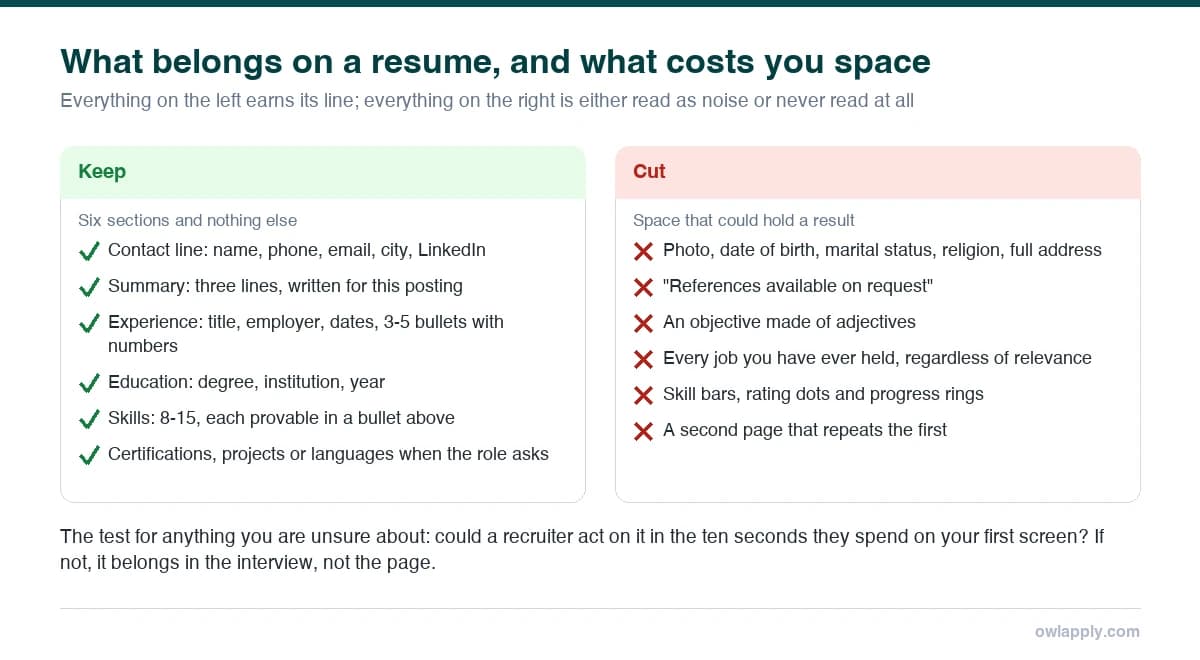
What to put on a resume: your contact details, a three-line summary (or a two-line objective if you are new), work experience with three to five result bullets per role, education, a grouped skills section, and, where they help, certifications, projects and languages. Nothing else is required, and several things people still add (a photo, date of birth, references, a declaration, an objective full of adjectives) cost space or points. This guide goes through every section in order, what belongs in each, what to leave off in 2026, and how the priorities change for a first job, a career change and a senior role.
The sections, in order, and what goes in each
| Section | Include | Leave out |
|---|---|---|
| Contact line | Full name; city and country; phone with country code; a professional email; LinkedIn URL; portfolio or GitHub if relevant | Street address; date of birth; marital status; photo (unless the posting asks); nationality unless a visa question is relevant |
| Summary or objective | 3-line summary with two numbers (experienced); 2-line objective naming the role and two skills (fresher) | "Seeking a challenging position"; anything longer than 3 lines |
| Work experience | Title, company, city, dates; 3–5 bullets per role, each verb + task + number; most recent first; 10–15 years of history | Duties copied from a job description; roles older than 15 years in detail (one line each, or an "Earlier experience" block) |
| Education | Degree, major, institution, year; GPA/percentage if strong and recent; relevant coursework and thesis for freshers | High school once you have a degree; GPA after 5 years of experience |
| Skills | 8–15 hard skills grouped by type, in the posting's words; languages with level | Soft-skill lists; skill bars and ratings; tools used once |
| Certifications | Name, issuer, year; those with an exam or a recognised body | Course-completion badges; expired certifications |
| Projects | For freshers, career changers and technical roles: 2–3 with stack, scope and a number | Class assignments with no outcome |
| Optional | Publications, patents, awards, volunteering with scope, speaking | Hobbies (unless relevant), references ("available on request"), a declaration for private-sector jobs |
If it is easier to see the sections in place than to read about them, open one of these in the builder and delete your way to your own version.

Project Manager
Why this resume works:
- Managed 12 concurrent enterprise transformation projects totaling $47M at Accenture with 96% on-time delivery
- Led cross functional teams of 35+ and reduced average project cycle time by 22% through PMO governance implementation
- PMO framework saved $3.2M in unplanned costs and cut scope creep incidents by 38% over 3 years

Customer Service Representative
Why this resume works:
- Maintained a 96% CSAT across 2,400+ monthly interactions on phone, email, and live chat
- Top 5% on first-contact resolution for 2 consecutive years across a 240-agent contact center
- Bilingual English and Spanish with Zendesk and Salesforce expertise plus CCM certification

Software Engineer
Why this resume works:
- New-grad Software Engineer resume for 2026 FAANG / AI-first recruiting
- Programming languages, frameworks, and system design coursework
- LeetCode counts, GitHub star totals, and open-source contributions
What to put in the experience section (the part that decides interviews)
Each bullet is a verb, the thing you did, and the number it produced: "Rebuilt the checkout flow used by 1.2M monthly customers, lifting conversion 6.4%." In our checker data, 54.1% of resumes were told to add quantified achievements and 22.7% had bullets that did not start with an action verb; those two findings alone cost more points than any layout problem. Numbers are everywhere once you look: volume (calls per day, orders per week), money (budget, revenue, savings), time (hours saved, days cut), quality (error rate, CSAT, uptime), scale (team size, users, sites). If a bullet has none of those, ask what would have been different if you had done the job badly; the answer is usually the number.
Turning a duty into a result is the hardest line-by-line work on the page. If you get stuck on a bullet, the bullet point generator rewrites your own sentence into a verb-plus-number line rather than inventing an achievement, and the keyword optimizer shows which terms from the posting are missing from what you wrote.
What to put on a resume with no experience (first job, student)
Education moves above experience, and projects, internships, part-time work and volunteering fill the middle, each written with the same verb-plus-number bullets as a job. A final-year project with 1,200 users, a college fest where you raised 3 lakh rupees in sponsorship, a part-time front-desk job with a 22% conversion rate: all of these are experience. Certifications with an exam (Google, AWS, NPTEL Elite, ISTQB) go in their own section. The full layout, with six copyable samples, is in the resume format for freshers guide, and the no-experience version in how to write a resume with no experience.
What to put on a resume for a career change
A summary that names the target role first and your transferable results second; a skills section written in the new field's vocabulary; experience bullets that keep the original numbers but describe the work in terms the new role recognises (a teacher's "assessment design" becomes an instructional designer's "learning-outcome measurement"); and a projects or certifications section that proves you have already started. Leave out bullets that only make sense in the old field.
What to put on a senior or executive resume
Scope before tasks: team size, budget, revenue, geography, in the first line of each role. Two pages are expected; three are not. Older roles compress to one line. Board work, P&L ownership, M&A, transformations and hires who were promoted are the bullets that matter. Skills sections shrink to a short line of domains and systems; the summary carries the weight.
What not to put on a resume in 2026
Do this
- Contact line in the body, top two lines
- Numbers in most bullets
- Standard section headings
- One column, one font, PDF
- Tailored summary and skills per application
Avoid this
- Photo, DOB, marital status, religion, full address
- "References available on request"
- Objective full of adjectives
- Tables, columns, icons, skill bars (parsers lose them)
- The same resume sent to 50 postings
The layout rules behind that right-hand column, with the failure rates from 44,255 checked files, are in the ATS resume format guide.
The one-page checklist before you send it
What to put on a resume: final check
- Contact line complete: phone with country code, professional email, LinkedIn URL
- Summary: title in the first three words, two numbers, three lines
- Every role: 3–5 bullets, verb first, number in most
- Skills: 8–15, grouped, in the posting's words, each backed by a bullet
- Education: degree, institution, year; GPA only if strong and recent
- Certifications with issuer and year; nothing expired
- Dates in one format everywhere
- One page (under 10 years) or two; standard headings; single column
- File named Firstname-Lastname-Resume.pdf
- Uploaded to the ATS checker and the extracted text read once
Check what a parser reads from your resume
Upload the file and see the extracted text plus 34 checks with their fixes: missing numbers, skills without evidence, headings a parser does not recognise. Free, no account.
Check my resumeOnce you know what goes in, the order decides how it reads. Most people should use a reverse-chronological layout; a functional resume is the exception, not the default. And if the content already exists on your profile, you can build the resume from LinkedIn instead of retyping it.