


A functional resume is a format that groups your experience by skill area (for example "Project coordination", "Client communication", "Data analysis") instead of by job, and pushes the employment history to a short list near the bottom. It exists to solve one problem: a work history that, read in date order, does not make the case for the role, because of long gaps, frequent short jobs, a career change, or a first job after years of freelancing or caregiving. It solves that problem at a cost: recruiters know why people use it and some read it as hiding something, and applicant tracking systems map experience by role and date, so a functional layout can parse as a resume with no experience at all. This guide shows when the functional format is the right call, when a combination (hybrid) resume is the better answer, and gives you a functional resume template and two examples that keep the dates visible enough to parse.
Functional vs chronological vs combination: which format, when
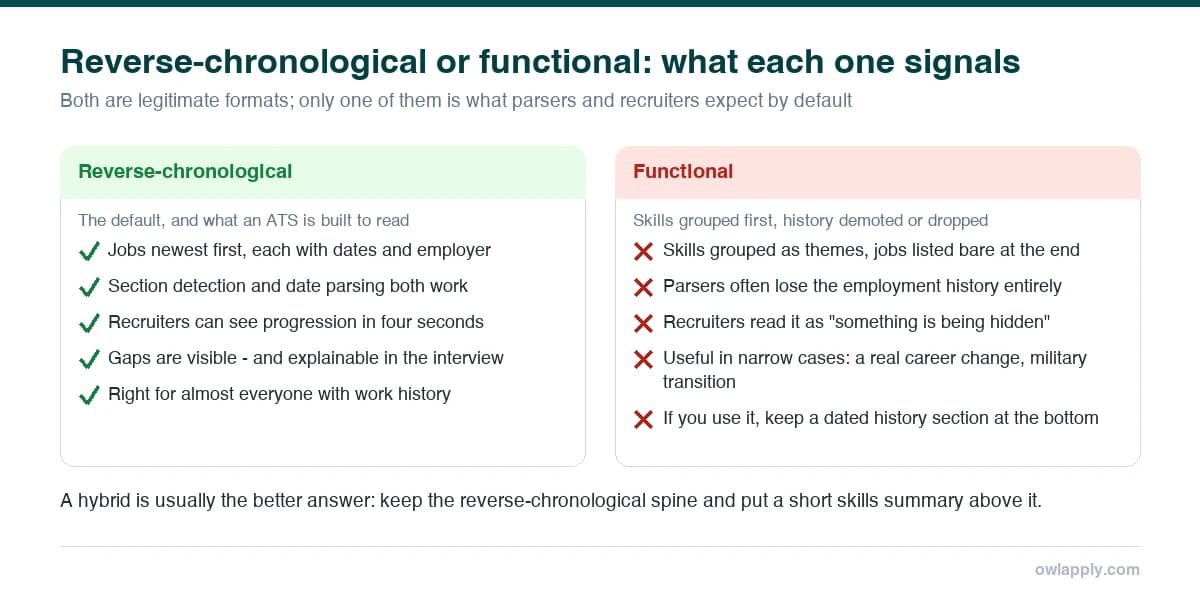
| Format | Structure | Use it when | Risk |
|---|---|---|---|
| Reverse-chronological | Jobs in date order, bullets under each | Your history is continuous and relevant; 90% of candidates | None; it is the default every parser and recruiter expects |
| Functional | Skill groups with bullets, then a short employment list | Gaps over a year, a career change with no relevant titles, returning after a long break, or a portfolio career of short engagements | Recruiters suspect hidden history; parsers may find no dated experience |
| Combination (hybrid) | A skills-and-achievements block up top, then a full chronological history | Career change with some relevant experience; senior candidates with many roles; anyone tempted by functional | Longer; needs discipline to avoid repeating bullets |
When a functional resume actually works
- Returning after 3+ years out of the workforce and the last dated role is not what you are applying for.
- Career change with no relevant job titles, where the transferable skills are real but scattered across unrelated roles.
- Freelance or contract careers with twenty short engagements that would look like job-hopping in date order.
- Trades and skills-certified roles where the licence and the competencies matter more than the employer list.
- Applications that go to a person, not a portal: a referral, a small business, a direct email to a hiring manager. If the resume goes through an ATS first, use a combination format instead.
Functional resume template
Two rules keep this template readable by both a recruiter and a parser: every achievement bullet ends with the employer and year in brackets, so the claim is anchored, and the employment history keeps real dates, so an ATS still finds a work-experience section. A functional resume with no dates anywhere is the version that gets discarded.
Functional resume example: returning to work after a break
Combination resume example: career change with some relevant experience
If you have even one relevant dated role, the combination format is the better bet: a skills-and-achievements block at the top, then a full chronological history with short bullets. The teacher-to-instructional-designer case is the classic one: the summary names the target role, a "Learning design" skills block leads with the three e-learning modules built, and the five years of teaching follow in date order with the curriculum and assessment results. Recruiters see continuity; the parser finds dated experience; the skills block does the redirecting.
Does a functional resume pass an ATS?
It parses, but not the way you want unless you keep dated employment entries. Parsers map work experience by detecting a company, a title and a date range together; a skills-grouped section with no dates is read as text, not as experience, and some screening filters (years of experience, most recent title) then return nothing. Keep a real employment history section with dates, use standard headings ("Employment History", "Skills", "Education"), keep a single column, and run the file through the free ATS resume checker to read what the parser extracted. If the experience section comes back empty, switch to the combination format.
Do this
- Skill groups named in the target role's vocabulary
- Every bullet anchored with employer and year
- A dated employment history, even if short
- Standard headings, one column, PDF
- Combination format if any relevant dated role exists
Avoid this
- No dates anywhere
- Skill groups like "Communication" and "Teamwork" with adjectives under them
- Hiding a gap that a one-line explanation would have neutralised
- Two columns or a sidebar for the skills groups
- Using functional because a template looked good
Build either format in a template that parses
Every template in the library is single-column and tested on major ATS platforms; switch between chronological and skills-first layouts without rebuilding.
See resume templates