

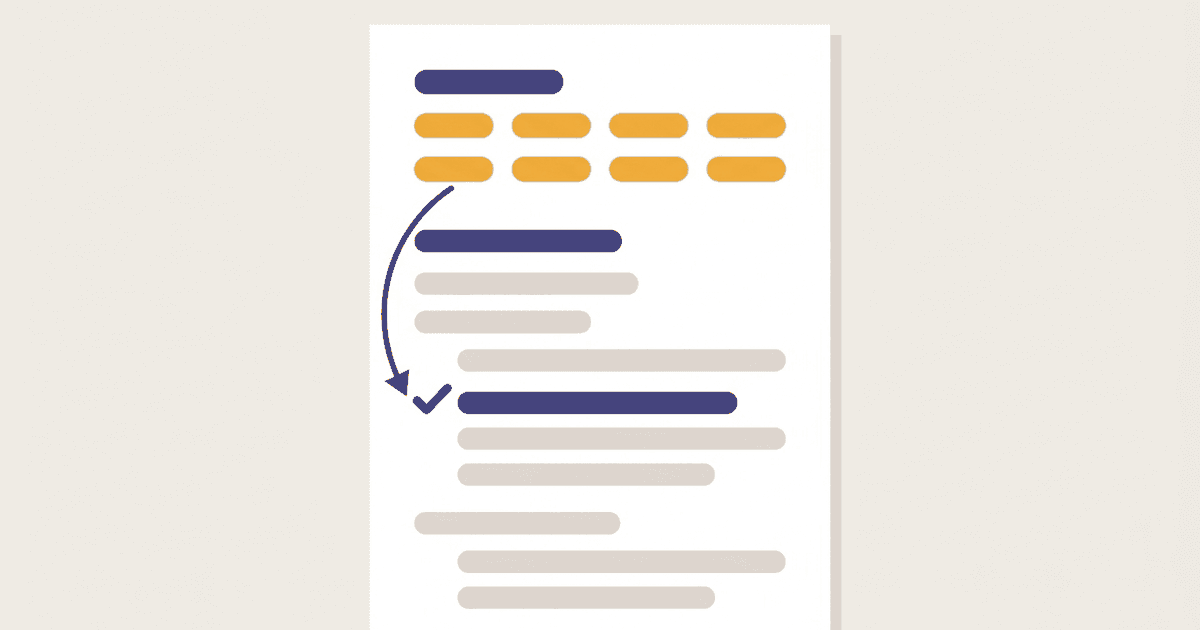
The best skills to put on a resume are the 8 to 15 hard skills the job posting names that you can prove somewhere else on the page, plus two or three soft skills shown through results in your bullets rather than listed. Pick them from the posting, group them by type in a plain-text Skills section, and repeat the important ones in your experience. That is the rule for 2026, and below are 200+ examples by job, six copyable skills sections and the mistakes to avoid.
The second half of that rule is where most resumes fall down. In 33,746 resumes run through the free ATS resume checker (one per person, all re-scored by the same checker in September 2026), 80.9% listed skills where fewer than half appear anywhere in the experience, projects or summary. Four resumes in five, in other words, claim skills they never demonstrate. The full method is in our ATS résumé statistics study.
Skills on 33,746 resumes, one per person (OwlApply checker, September 2026)
- 80.9%
- listed skills where fewer than half appear in the experience, projects or summary
- 74.0%
- were told to work specific listed skills into the text
- 54.5%
- were told to trim an over-long skills list
- 27.7%
- were told to mention key skills in the summary
Those four numbers are one problem seen from four sides. A long list of skills that never show up again reads to a recruiter like a wish list, and to a keyword search like a single mention with no context. The rest of this guide is built around fixing that: choosing fewer skills, choosing them from the job ad, and proving each one where it counts.
What are good skills to put on a resume?
Good skills to put on a resume are skills that are relevant to the job, specific enough to be checked, and backed by evidence elsewhere on the page. "Excel" is weaker than "Excel (pivot tables, Power Query, XLOOKUP)". "Communication" is weaker than a bullet showing you presented results to a client every week. Relevance beats impressiveness: a rare skill the posting does not mention is worth less than a common one it asks for twice.
If you want a short, general-purpose list to start from, these are the skills that appear across the most job postings in almost every field. Treat it as a menu, not a template; keep only the ones that match the job you are applying for and that you can back up with a bullet.
| Skill | Type | How to make it specific on a resume |
|---|---|---|
| Microsoft Excel / Google Sheets | Hard | Name the features: pivot tables, XLOOKUP, Power Query, macros |
| Data analysis | Hard | Name the tool and the output: SQL queries, Power BI dashboards, A/B test reads |
| Project management | Hard | Name the method and the scale: Agile/Scrum, budgets, number of projects |
| Customer service | Hard/soft | Name the channel and the metric: phone, chat, CSAT, first-contact resolution |
| CRM software | Hard | Name the system: Salesforce, HubSpot, Zoho, Dynamics 365 |
| Written communication | Soft | Prove it: reports, proposals, documentation, newsletters with readers |
| Teamwork and collaboration | Soft | Prove it: cross-team projects, shared targets, handovers |
| Problem-solving | Soft | Prove it: a fault you found and fixed, with the cost or time saved |
| Time management | Soft | Prove it: volume handled, deadlines met, a schedule you ran |
| Foreign languages | Hard | Give a level: native, fluent, professional working, or CEFR (B2, C1) |
Employers say the same thing from their side. In the NACE Job Outlook 2026 Spring Update (survey run 12 February to 17 March 2026, published 20 April 2026), employers named the ability to work in a team, solve problems and communicate as the leading attributes they look for on a graduate's resume, and 85% said they look for evidence of teamwork. Note the word evidence: they are looking for teamwork in what you did, not the word "teamwork" in a list.
Hard skills vs soft skills: what is the difference?
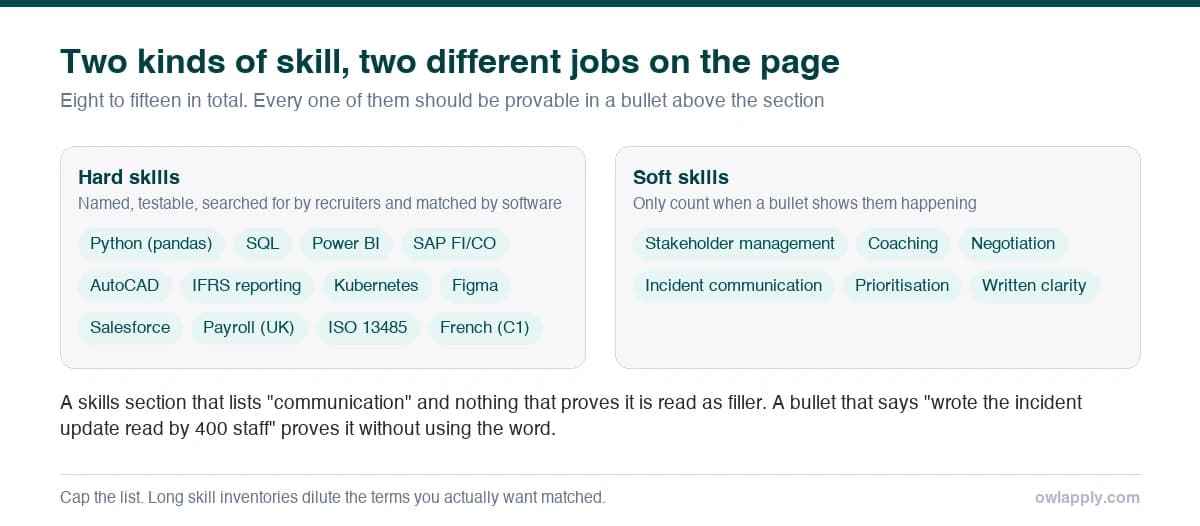
Hard skills are teachable, testable abilities with a name, such as SQL, AutoCAD, phlebotomy, forklift operation or Spanish. Soft skills are the ways you work with people and problems, such as communication, leadership and adaptability. Hard skills belong in the Skills section, where software and recruiters search for them. Soft skills belong in your bullets, where a result shows them happening.
| Hard skills | Soft skills | |
|---|---|---|
| What they are | Named, learnable, testable abilities | Behaviours: how you work, decide and deal with people |
| Examples | Python, QuickBooks, IV insertion, CNC programming, SEO | Communication, leadership, adaptability, conflict resolution |
| Where they go | Skills section, and again in bullets | Bullets and summary, described as results |
| How an employer checks them | Keyword search, tests, certifications, portfolio | Your examples, references and the interview |
| How many to list | 8 to 15, grouped | Two or three, proved rather than listed |
Hard skills examples
Hard skills are always tied to a field, so the useful way to list them is by type. Pick the group closest to the job, then use the exact names the posting uses.
| Category | Hard skill examples |
|---|---|
| Office and productivity | Excel (pivot tables, XLOOKUP, Power Query), Google Workspace, PowerPoint, Word mail merge, Outlook calendar management, typing speed (wpm) |
| Data and analytics | SQL, Python (pandas), R, Power BI, Tableau, Looker Studio, Google Analytics 4, A/B testing, statistical analysis, data cleaning |
| Software and IT | JavaScript/TypeScript, Java, C#, React, Node.js, REST APIs, Git, Docker, AWS, Azure, Linux, Active Directory, ITIL, ticketing systems |
| Marketing and content | SEO, Google Ads, Meta Ads, email marketing (Klaviyo, Mailchimp), copywriting, content strategy, HubSpot, CMS (WordPress), social media analytics |
| Design | Figma, Adobe Photoshop, Illustrator, InDesign, After Effects, Canva, prototyping, design systems, typography, UX research |
| Finance and accounting | Financial modelling, budgeting and forecasting, GAAP or IFRS, accounts payable/receivable, reconciliations, QuickBooks, Xero, SAP FI/CO, NetSuite |
| Sales and customer | Salesforce, HubSpot CRM, prospecting, discovery calls, pipeline management, contract negotiation, Zendesk, POS systems, cash handling |
| Operations and supply chain | Inventory management, ERP (SAP, Oracle), Lean, Six Sigma, demand planning, procurement, vendor management, WMS, OSHA safety |
| Healthcare | Patient assessment, EHR (Epic, Cerner), medication administration, phlebotomy, vital signs, BLS/ACLS certification, HIPAA, medical coding (ICD-10, CPT) |
| Skilled trades | Blueprint reading, MIG/TIG welding, electrical wiring, HVAC diagnostics, CNC operation, forklift certification, power tools, preventive maintenance |
| Languages | English, Spanish, Mandarin, Hindi, Arabic, French, ASL, each with a level: native, fluent, professional working, B2, C1 |
Soft skills examples
Soft skills are the same across every job; what changes is the evidence. The table below pairs each common soft skill with the kind of bullet that proves it, which is how they should appear on the page.
| Soft skill | Prove it with a bullet like |
|---|---|
| Communication | "Presented weekly status to 3 client stakeholders; escalations fell from 5 a month to 1" |
| Leadership | "Led a team of 6 through a system migration with no missed payroll runs" |
| Teamwork | "Worked with design and engineering to ship the onboarding flow 2 weeks early" |
| Problem-solving | "Traced a recurring stock mismatch to a scanner setting; write-offs dropped 40%" |
| Adaptability | "Moved 120 in-person classes online in 10 days when the campus closed" |
| Time management | "Handled 60+ tickets a day while keeping first response under 2 hours" |
| Attention to detail | "Audited 1,400 invoices and recovered $38,000 in duplicate payments" |
| Conflict resolution | "Mediated a dispute between two shift teams that had blocked a rota change for months" |
| Customer focus | "Kept a 97% satisfaction score across 2,000+ calls a quarter" |
| Initiative | "Built a shared FAQ that cut new-hire questions to the team lead by half" |
What are the 7 soft skills and the 7 employability skills?
There is no single official list of seven soft skills or seven employability skills; the numbers vary by publisher. The closest thing to a standard in the US is the NACE career readiness competencies, which lists eight: career and self-development, communication, critical thinking, equity and inclusion, leadership, professionalism, teamwork and technology. Colleges and employers use them to describe what "job-ready" means.
Most "seven soft skills" lists boil down to communication, teamwork, problem-solving, adaptability, time management, leadership and work ethic. All of them are fine to show on a resume, and none of them should be listed as bare words. Pick the two or three the posting stresses and prove each one in a bullet.
What are your top 5 skills?
Your top five skills are the five that sit where what the job asks for meets what you can prove with a result. To find them, list every skill the posting mentions, cross out any you cannot back with a specific example, and keep the five that appear most often or highest in the ad. Usually that means three or four hard skills and one or two soft skills.
The same question comes up in applications and interviews ("What are your top five skills?"). Answer it with the same five, each with a one-line example. Here is a version you can adapt:
What are the top 10 skills employers want in 2026?
Across employer surveys, the skills employers want most in 2026 are teamwork, problem-solving, communication, critical thinking, professionalism, leadership and technology skills, plus the specific technical skills of each occupation. The NACE Job Outlook 2026 Spring Update puts teamwork, problem-solving and communication at the top, with 85% of employers looking for teamwork on the resume.
For a particular job, do not rely on generic top-ten lists. The O*NET OnLine database, run for the US Department of Labor, lists the skills, knowledge areas and software (with "hot technologies" flagged) for almost every occupation, and the Occupational Outlook Handbook from the Bureau of Labor Statistics describes the important qualities for each job in its "How to Become One" section. Combine one of those with three or four real postings for the role and you have a far better list than any article, including this one, can give you.
| Skill employers want | What it looks like on a resume |
|---|---|
| 1. Teamwork | Shared targets, cross-team projects, "with" and "alongside" in bullets |
| 2. Problem-solving | A problem, what you did, and the measurable result |
| 3. Communication (written and verbal) | Reports, presentations, documentation, client contact, with audience size |
| 4. Critical thinking | A decision you made from data, and what changed because of it |
| 5. Professionalism and work ethic | Reliability numbers: attendance, deadlines, accuracy rates |
| 6. Leadership | People led, trained or mentored, even informally |
| 7. Technology skills | Named software and tools in the Skills section |
| 8. Adaptability | New system, new role or new market learned quickly, with the timeframe |
| 9. Initiative | Something you started that nobody asked for, and its result |
| 10. The job's own technical skills | Taken word for word from the posting and from O*NET for that occupation |
Skills for a resume by job (200+ examples)
Each row lists the hard skills that postings for that job commonly ask for, and the soft skills worth proving in bullets. Use it to jog your memory, then let the posting decide. Copying a whole row onto your resume would defeat the point: 8 to 15 skills, chosen for the job in front of you.
| Job | Hard skills (Skills section) | Soft skills (prove in bullets) |
|---|---|---|
| Software developer | Java, Python, JavaScript/TypeScript, React, Node.js, REST APIs, SQL, Git, Docker, AWS, unit testing, CI/CD | Code review, cross-team collaboration, debugging under pressure |
| Data analyst | SQL, Excel (Power Query, pivot tables), Python (pandas), Power BI, Tableau, statistics, data cleaning, A/B testing, Looker Studio | Explaining findings to non-technical audiences, curiosity, attention to detail |
| Project manager | Agile/Scrum, Jira, MS Project, budgeting, risk registers, stakeholder reporting, resource planning, PMP or PRINCE2, change control | Leadership, negotiation, prioritisation |
| Registered nurse | Patient assessment, medication administration, IV therapy, EHR (Epic, Cerner), care planning, wound care, BLS/ACLS, telemetry, infection control | Compassion, calm under pressure, clear handovers |
| Teacher | Lesson planning, differentiated instruction, classroom management, formative assessment, Google Classroom, IEP support, state curriculum standards, data-driven instruction | Patience, parent communication, adaptability |
| Customer service representative | CRM (Zendesk, Salesforce), ticketing, live chat, phone etiquette, order management, refunds and returns, typing 50+ wpm, knowledge base writing | Empathy, de-escalation, active listening |
| Sales representative | Prospecting, cold calling, discovery, pipeline management, Salesforce or HubSpot, contract negotiation, forecasting, product demos, LinkedIn Sales Navigator | Persuasion, resilience, relationship building |
| Marketing specialist | SEO, Google Ads, Meta Ads, GA4, email marketing, content calendars, copywriting, HubSpot, social media analytics, landing page testing | Creativity, collaboration with sales, deadline management |
| Accountant | GAAP, month-end close, reconciliations, accounts payable/receivable, QuickBooks, NetSuite, Excel modelling, tax preparation, audit support | Accuracy, integrity, clear explanation of numbers |
| Administrative assistant | Calendar management, Microsoft 365, Google Workspace, travel booking, minute-taking, data entry, filing systems, expense reports, phone and front desk | Organisation, discretion, multitasking |
| Graphic designer | Adobe Photoshop, Illustrator, InDesign, Figma, typography, branding, layout, print production, motion basics (After Effects) | Taking feedback, meeting deadlines, client communication |
| Retail sales associate | POS systems, cash handling, merchandising, inventory counts, loss prevention, upselling, opening and closing procedures | Friendliness, teamwork, reliability |
| Warehouse associate | Forklift certification, pallet jack, RF scanners, WMS, picking and packing, inventory cycle counts, shipping and receiving, OSHA safety | Reliability, physical stamina, following procedures |
| Electrician | Residential and commercial wiring, NEC code, conduit bending, troubleshooting, blueprints, panel upgrades, test equipment, state licence | Safety focus, problem-solving, customer communication |
| Mechanical engineer | SolidWorks, AutoCAD, GD&T, FEA, DFM, prototyping, MATLAB, materials selection, tolerance analysis | Teamwork with manufacturing, technical writing, analytical thinking |
| HR generalist | HRIS (Workday, BambooHR), onboarding, benefits administration, employee relations, FMLA and leave, payroll coordination, recruiting, policy writing | Discretion, conflict resolution, empathy |
| Medical assistant | Vital signs, phlebotomy, injections, EHR, scheduling, insurance verification, medical terminology, HIPAA, CPR certification | Bedside manner, accuracy, calm with patients |
| IT support specialist | Windows and macOS, Active Directory, Microsoft 365 admin, networking basics, ticketing (ServiceNow, Jira), hardware setup, remote support, CompTIA A+ | Patience, clear explanations, prioritisation |
| Business analyst | Requirements gathering, process mapping (BPMN), SQL, Excel, Jira, user stories, UAT, Visio, stakeholder interviews | Facilitation, critical thinking, written clarity |
| Cashier / food service | Cash handling, POS, food safety certification, order accuracy, stock rotation, cleaning standards, drive-through systems | Speed under pressure, friendliness, teamwork |
| Social media manager | Content planning, Meta Business Suite, TikTok, LinkedIn, Canva, short-form video editing, community management, analytics reporting, paid social | Creativity, trend awareness, brand voice |
| Operations manager | Budgeting, KPI dashboards, Lean, scheduling, vendor management, ERP, SOP writing, safety compliance, capacity planning | Leadership, decision-making, coaching |
Three finished resumes where every skill in the section is proved by a bullet above it. Open one in the builder to see how the two halves line up.

Data Analyst
Why this resume works:
- Built 8 Tableau dashboards as a Goldman Sachs Data Analytics intern, surfacing $480K in cross-desk margin leakage
- Wrote 40+ SQL queries against a Snowflake warehouse and shipped a weekly retention report saving 4 hours per analyst
- B.S. in Statistics from UCLA, 3.8 GPA, Google Data Analytics Certificate and Microsoft PL-300 (Power BI)

Registered Nurse
Why this resume works:
- 99.4% medication accuracy managing a 1:5 patient ratio at NYU Langone Health
- 22% reduction in 30-day readmissions through structured discharge education and post-discharge follow-up protocols
- 96th-percentile Press Ganey patient satisfaction score for two consecutive quarters

Digital Marketing Manager
Why this resume works:
- Owns blended ROAS, MER and CAC across a multi-channel 2026 mix
- Manages $6M+ paid budget with agency partners (Tinuiti, Wpromote)
- Runs quarterly planning, MMM cadence and creative reviews
How many skills should you put on a resume?
Put 8 to 15 skills in your resume's Skills section for most jobs. Go toward 8 for entry-level and non-technical roles, toward 15 for technical roles with long tool lists, and group them so a reader can scan them in seconds. Fewer, relevant skills beat a long inventory, because each extra skill dilutes the ones the posting asks for.
Our checker data points the same way. More than half of the resumes we scored, 54.5% of 33,746, were told to trim an over-long skills list. A list of 30 tools makes the reader do the filtering you should have done.
| Situation | Skills section | Notes |
|---|---|---|
| Student or first job | 6 to 10 | Tools from coursework, projects and part-time work; add languages |
| Early career (1 to 5 years) | 8 to 12 | Mostly hard skills from the posting; group them |
| Experienced (5+ years) | 10 to 15 | Drop basics everyone has (email, Word); keep specialised tools and methods |
| Technical roles (engineering, data, IT) | 12 to 20, grouped | Group by Languages, Frameworks, Cloud, Tools; still cut what you have not used in years |
| Executive | 6 to 10 areas of expertise | Domains rather than tools: P&L, M&A, turnaround, board reporting |
Where do you put skills on a resume?
Put skills in three places: a dedicated Skills section for hard skills, your experience bullets where each skill is used with a result, and your summary for the two or three that matter most for the job. The Skills section helps the keyword match; the bullets and summary make the match believable.
- Skills section. Usually after Experience for experienced candidates, and after Education (or straight after the summary) for students and career changers. Keep it in the main body of the page, not in a sidebar.
- Experience bullets. Name the skill inside the sentence that proves it: "Built a Power BI dashboard used by 40 store managers" covers Power BI, data visualisation and stakeholder reporting at once.
- Summary. Two or three of the posting's top skills in the first lines. Only 27.7% of the resumes we checked were told to add them there, which means most people already do this; make sure yours match the job you are applying to now, not the last one.
- Projects and certifications. For technical roles and freshers, projects are where skills get their proof; certifications carry their own weight when an exam is behind them.
Keep the Skills section out of the sidebar
How to match your skills to a job description
Match your skills to a job description by copying the skill names the posting uses, in its own wording, into your Skills section and bullets, as long as you genuinely have them. Recruiters search for those exact terms and applicant tracking systems rank on them, so "Salesforce" will match where "CRM software" may not.
- Copy the posting into a document and highlight every tool, method, certification and noun phrase in Requirements and Responsibilities.
- Count repeats and note position. A skill that appears in the title, the first lines and the requirements is a must-have; one that appears once under "nice to have" is optional.
- Mark what you can prove. For each highlighted skill, write the bullet or project where you used it. If you cannot, leave it off or say how you are learning it.
- Use their wording. If they write "financial modeling", do not write "forecasting spreadsheets". Spell out acronyms once: "Search engine optimization (SEO)".
- Place it twice. Each must-have skill goes in the Skills section and in at least one bullet or the summary.
- Re-read as the recruiter. Could someone see in ten lines that you have the top three requirements? If not, move those bullets up.
This step is where our data says resumes slip most: 74.0% of the 33,746 we scored were told to work specific listed skills into the text, and 55.0% to spread keywords across sections instead of keeping them in one list. If you would rather not do the comparison by hand, the resume keyword optimizer reads a posting and lists the terms it asks for that your resume does not mention, and the job match score rates your resume against a specific ad. Both full reports are part of Pro. For how tracking systems actually search and rank, see how an ATS reads your resume.
Skills section examples you can copy
The best format for a skills section is a short, grouped, plain-text list: a category label, a colon, then skills separated by commas. It is easy to scan, every tracking system reads it, and it fits in four or five lines. Here are six versions for different situations; copy the closest one and replace the content with your own skills from the posting.
A few format rules sit behind all six. Use the posting's exact names for tools. Put levels on languages (native, fluent, professional working, or a CEFR level such as B2) but not on software; "Excel: 4/5" tells a reader nothing. Avoid icons, bars, dots and stars. And keep the heading plain: "Skills", "Technical Skills" or "Core Skills", which every tracking system recognises.
Skills to put on a resume with no experience
With no work experience, put the skills you have used in school, projects, volunteering, part-time jobs, sport or caring responsibilities, and name where you used them. Good choices are software you know well, languages, customer-facing skills, and organisational skills you can back with a number, such as a club budget or an event headcount.
| Where you got it | Skill to list | Bullet that proves it |
|---|---|---|
| Class project | Python, data analysis | "Analysed 3 years of city bike data in Python; presented findings to a class of 40" |
| Part-time retail or food job | Cash handling, customer service | "Handled $3,000+ in daily transactions with zero register discrepancies over 8 months" |
| Student club | Budgeting, event planning | "Ran a $4,500 budget for 6 events with 900 total attendees" |
| Volunteering | Scheduling, teamwork | "Scheduled 25 volunteers across 3 shifts for a weekly food bank" |
| Online course | Google Analytics, SEO | "Earned the Google Analytics certification; set up tracking for a family business site" |
| Family or community | Languages, caregiving | "Translated medical appointments (Spanish–English) for relatives for 4 years" |
If you are a fresher in India, the same rule applies: list technical skills from your branch and projects, not a column of adjectives, and keep it to one page. Our resume format for freshers has full layouts, and the resume with no experience guide covers every section for a first job.
What skills should you not put on a resume?
Leave off skills you cannot demonstrate, skills the job does not need, basics every applicant is assumed to have, and soft-skill adjectives on their own. Also avoid rating your skills with bars, stars or percentages. Each of those either wastes space a relevant skill could use or invites a question you cannot answer well in an interview.
Do this
- 8 to 15 skills chosen from this posting
- The posting's exact wording for tools and methods
- Every listed skill proved in a bullet, project or summary
- Levels on languages (native, fluent, B2)
- Certifications with issuer and year
- Plain text in the main column
Avoid this
- "Microsoft Word", "email", "internet" for office jobs
- Bare adjectives: hard-working, team player, detail-oriented
- Skill bars, stars, dots or "Excel 80%"
- Tools you used once, years ago
- Skills from a different career that the posting never mentions
- Anything you would not want to be tested on in the interview
The last rule is the one people underestimate. Interviewers often pick a skill from the list and ask you to talk about the last time you used it. If the honest answer is "a tutorial in 2021", that skill is costing you more than it earns.
What are 6 good skills for a resume?
Six good skills for almost any resume are a named software skill (such as Excel or a CRM), data or numeracy, written communication, customer service, teamwork and problem-solving. List the first three or four in your Skills section with specifics, and prove the soft ones in your bullets. Then swap in the job's own technical skills from the posting, because those always outrank a general list.
Check your skills section before you apply
Before you send a resume, read it once as text. The free ATS resume checker gives you an ATS score and shows exactly what a parser pulls from your file, including whether your Skills section survived, with every file-level problem (sidebars, rating bars, headers) flagged. It needs no account. The full report, with the content fixes for your Skills, Experience and keyword findings, is part of Pro, which you can try for 7 days for $2.95 before it renews at $17.49 a month unless you cancel.
If you are starting from scratch, the resume builder keeps your skills as plain text in a single column, and its 50+ templates are free to edit. For the words around your skills, see resume summary examples and what to put on a resume, section by section.
See what a parser reads from your skills section
Upload your resume and get your ATS score plus every file-level finding, including sidebars and rating bars that hide your skills. No account needed.
Check my resume