Behavioral interview questions ask for a specific past situation ("Tell me about a time you…") because the interviewer is betting that what you did before predicts what you will do for them. The scoring is usually structured: did the candidate describe a real situation, their own actions rather than the team's, and a result with evidence? The STAR method (Situation, Task, Action, Result) is the answer shape that scores on all three, and most rejected answers fail for one of two reasons: too much Situation and too little Action, or no Result. Below are 40 behavioral interview questions grouped by the competency they test, the STAR method with timings, six worked STAR answers, and a way to build a bank of eight stories that cover almost every question.
The STAR method, with timings
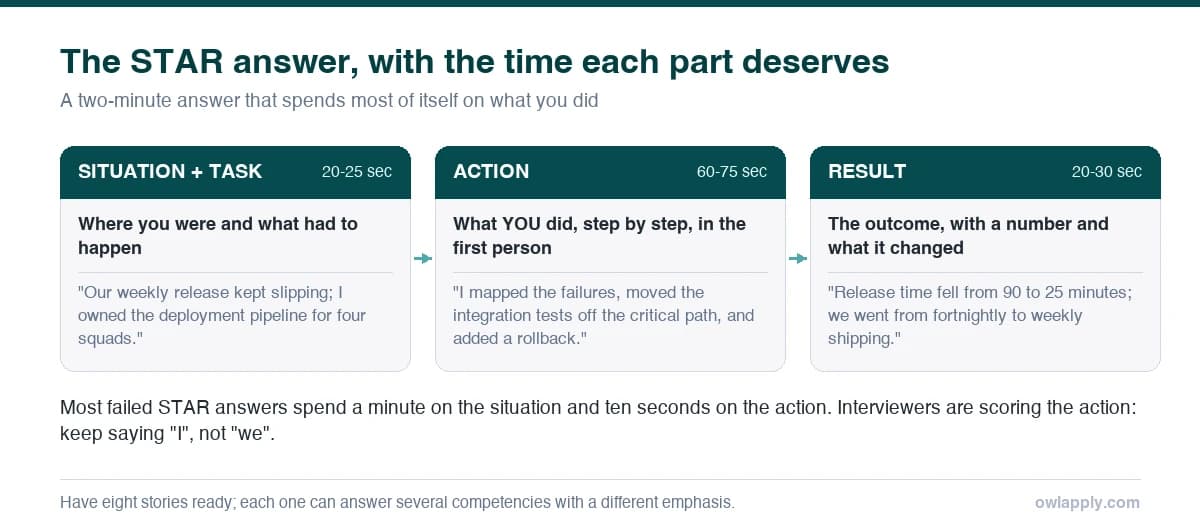
The action is the part being scored, and it is the part most candidates cut short.
Most weak answers spend 60% on Situation. Flip it.
Part
What to say
Share of a 90-second answer
Situation
One or two sentences of context: where, when, the stakes
10–15%
Task
What you specifically were responsible for
10%
Action
What you did, step by step, in the first person: I decided, I wrote, I called
50–60%
Result
What happened, with a number, and one line on what you learned or changed since
20–25%
Say "I" in the Action part even when the work was a team effort; interviewers are scoring your contribution and will ask what the others did if they want to. If the result was bad, say so and spend the last line on what you changed: an honest failure with a fix scores higher than a vague success.
40 behavioral interview questions by competency
Teamwork and collaboration
Tell me about a time you worked with someone difficult.
Describe a time you had to rely on a team to deliver.
Give an example of a time you disagreed with a colleague. What happened?
Tell me about a time you helped a teammate who was struggling.
Describe a project where your role was not clear at the start.
Leadership and influence
Tell me about a time you led without formal authority.
Describe a time you had to persuade a manager or senior stakeholder.
Give an example of a decision you made that was unpopular.
Tell me about a time you delegated something important.
Describe how you handled an underperforming team member.
Problem solving and judgement
Tell me about a complex problem you solved. How did you approach it?
Describe a time you had to make a decision with incomplete information.
Give an example of a time you found a mistake nobody else had noticed.
Tell me about a time a process was not working and what you did.
Describe a time you had to learn something quickly to get a job done.
Pressure, deadlines and prioritisation
Tell me about a time you had too much to do and not enough time.
Describe a time you missed a deadline.
Give an example of how you handled a sudden change in priorities.
Tell me about the most stressful situation you have handled at work.
Describe a time you had to say no to a request.
Failure, mistakes and feedback
Tell me about a time you failed.
Describe a mistake you made and how you handled it.
Give an example of critical feedback you received and what you did with it.
Tell me about a time you were wrong.
Describe a goal you did not meet.
Initiative and ownership
Tell me about a time you went beyond your job description.
Describe something you started that nobody asked you to.
Give an example of a time you improved something that was already working.
Tell me about a time you took ownership of a problem that was not yours.
Describe a time you set a goal and achieved it.
Customers and stakeholders
Tell me about a time you dealt with an angry customer or client.
Describe a time you had to deliver bad news.
Give an example of a time you exceeded a customer's expectations.
Tell me about a time you had to balance competing stakeholder demands.
Describe a time you had to explain something technical to a non-technical audience.
Adaptability and change
Tell me about a time you had to adapt to a significant change at work.
Describe a time you worked outside your comfort zone.
Give an example of a time you had to work with a new tool or process quickly.
Tell me about a time your plan did not work and you had to change course.
Describe how you handled a period of uncertainty at work.
Six STAR answer examples
STAR example: difficult colleague (teamwork)
Situation: On a 4-month billing migration, the senior engineer on the legacy side rejected every pull request from my team with one-line comments, and we were a week behind by month two.
Task: I owned the integration layer and the delivery date.
Action: I asked him for a 30-minute call instead of replying in the PR. It turned out he had been burned by an undocumented change two years earlier and wanted a migration runbook. I wrote a two-page runbook with him, agreed a review checklist, and we moved reviews to a daily 15-minute slot.
Result: Review turnaround dropped from 3 days to same-day, we recovered the week and shipped on the original date, and he asked to keep the checklist for other teams. What I changed: I now ask for the call before the third rejected PR, not after.
STAR example: missed deadline (pressure)
Situation: In year-end close I had 14 client books to finish in nine working days, and two of the largest arrived three days late.
Task: All 14 were mine, and the filing deadline did not move.
Action: I re-sequenced the work by deadline and size, blocked mornings for the two large books, asked my manager for a junior to do bank reconciliations on the six smallest, and told the two late clients in writing that their filings would be last and why.
Result: 13 of 14 were filed on time; one was filed a day late with the client's agreement and no penalty. Since then I ask for client data two weeks earlier and send a reminder at one week, and last year all 16 were on time.
STAR example: decision with incomplete information (judgement)
Situation: A checkout conversion drop of 20% appeared overnight on a Friday, and the analytics pipeline that would normally explain it was itself delayed.
Task: As the product analyst on call, I had to recommend whether to roll back the Thursday release.
Action: I pulled raw event logs for a 10% sample, split by payment method, and found the drop was entirely in one gateway and only on mobile. That pointed at a timeout, not the release. I recommended not rolling back and escalated to the payments team with the sample.
Result: They found a 5-second timeout introduced by the gateway's update, fixed it in two hours, and conversion recovered by Saturday. Rolling back would have cost a week of features and not fixed it. I documented the sample query as the first check for future drops.
STAR example: failure (honest)
Situation: In my second month as a DevOps engineer I pushed a configuration change to a production service without a review, believing it was trivial.
Task: I was responsible for the deployment pipeline for that service.
Action: The change took the service down for 20 minutes during business hours. I rolled it back, posted in the incident channel with what I had done, and wrote the post-mortem the same day, including a proposal to add config changes to the mandatory-review list.
Result: The proposal was adopted; no config-related incidents in the 14 months since. The honest part is that the outage was my fault; what I would do differently is what I now do: nothing reaches production without a second pair of eyes, however small.
STAR example: leading without authority (influence)
Situation: Three product teams each ran their own onboarding emails, and customers were getting duplicates.
Task: Nobody owned the problem; I was a marketing executive with no authority over any of the teams.
Action: I pulled send logs to show 31% of new customers received three or more emails in week one, presented it to the three product managers in one meeting, and proposed a single onboarding sequence with a slot for each team. I built the first version myself and ran it as a two-week test.
Result: Unsubscribes in week one fell 40% and activation rose 6%; the shared sequence became the standard and I was asked to own it. I learned that a number and a working prototype persuade faster than a proposal document.
STAR example: angry customer (customers)
Situation: A restaurant guest's anniversary booking had been given away because of a double entry in the reservations system, and he was shouting at the host stand on a full Saturday.
Task: As the floor manager, I had to resolve it without losing the table's neighbours or the guest.
Action: I took him away from the stand, apologised without explaining the system, offered the private room that was free until 9 pm with the first course on the house, and personally seated them.
Result: They stayed, spent 240 dollars, and left a review naming me. The next week I added a duplicate-check step to the reservations opening checklist, and we have not had a double booking since.
Build a bank of eight stories that cover every question
You do not need forty answers; you need eight stories, each usable for three or four questions. Pick them from the last five years: one difficult person, one deadline crunch, one failure with a fix, one decision without full information, one time you led without a title, one customer or stakeholder problem, one thing you started yourself, and one big change you adapted to. Write each as a STAR paragraph with the number in the Result, then practise telling each in 90 seconds. The AI mock interview asks behavioral questions for your target role and scores whether your answer had a specific Action and a measurable Result.
Do this
A specific situation with a date and stakes
"I" in the Action part
A number in the Result
An honest failure with what changed
90 seconds, then stop
Avoid this
"Usually what I do is…" (hypothetical, not behavioral)
"We" throughout, with no visible personal contribution
A result like "it went well"
A failure that is secretly a success
A four-minute story with no ending
Practise STAR answers with follow-up questions
The AI interviewer asks behavioral questions, probes the Action part the way a real interviewer does, and scores each answer on structure and specificity.
Questions that ask for a specific example from your past ("Tell me about a time…", "Describe a situation where…") to predict how you will behave in the role. They are scored on whether you describe a real situation, your own actions and a result.
A four-part structure for answering behavioral questions: Situation (context), Task (your responsibility), Action (what you did, step by step), Result (what happened, with a number). Spend most of the time on Action and always finish with the Result.
Sixty to ninety seconds. Long enough for a real Action section; short enough to leave room for follow-up questions, which are where interviewers confirm the story is yours.
Use the closest story from your bank and say so: "I have not had exactly that situation; the closest was…". Never invent one; follow-up questions expose invented examples quickly. For freshers, projects, campus roles and part-time work are valid sources.
Eight, each covering three or four question types: difficult person, deadline, failure, decision under uncertainty, leading without authority, customer problem, initiative, and change. Practise them out loud until each fits in 90 seconds.
Yes, when asked. An honest failure with what you changed afterwards scores higher than a vague success, and refusing to name one reads as low self-awareness.