


The best questions to ask an interviewer are the ones whose answers would change how you do the job or whether you take it: what the first 90 days look like, how success is measured, why the role is open, what the team is stuck on right now. Interviewers remember candidates by these questions more than by most answers, because a specific question proves you listened and thought. Below are 50 questions to ask in an interview, grouped by what you need to find out, with the three to pick for each round, the ones to hold until the offer, and the ones that quietly cost people the job.
The three questions to ask in every interview
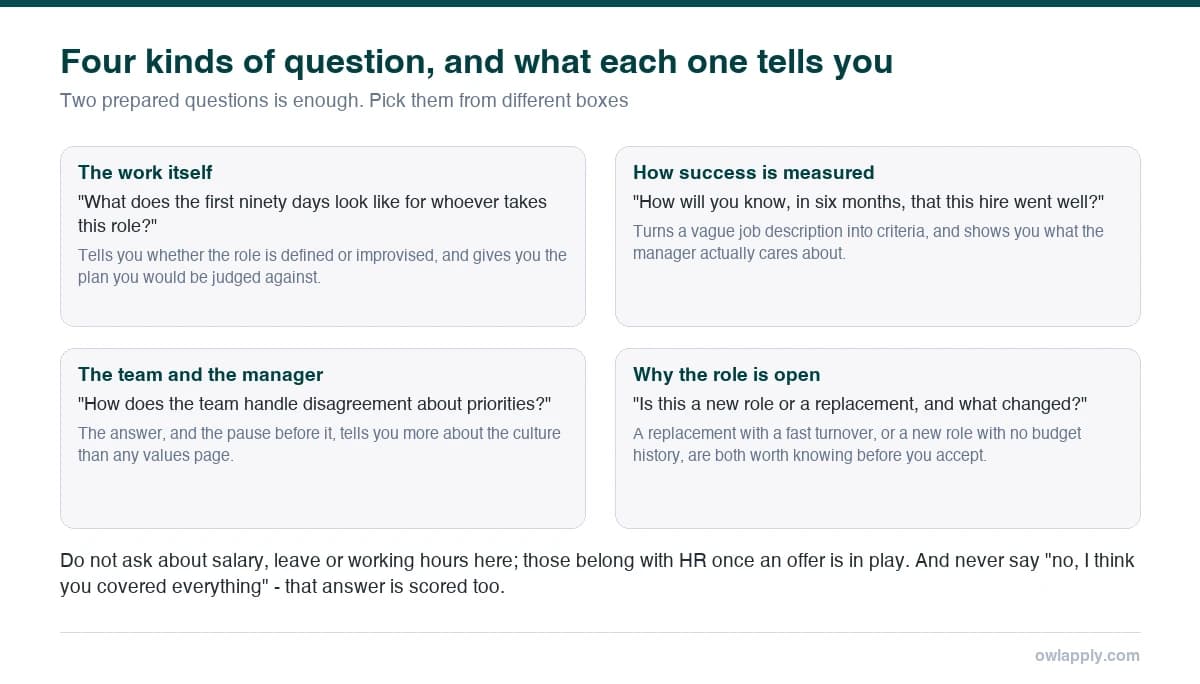
- "What would the first 90 days in this role look like, and what would you want done by the end of them?" It tells you what the job actually is, and it lets you close by connecting your experience to that first deliverable.
- "How is performance measured for this role, and how often is it reviewed?" The answer reveals whether targets exist, whether they are realistic, and how the company treats people who miss them.
- "Why is the position open?" Growth, backfill or turnover, and if turnover, why. Ask it plainly; the tone of the answer is data.
Questions to ask about the role
- What does a typical week look like for this position?
- Which parts of the role take the most time, and which matter most?
- What are the biggest challenges someone in this role faces in the first six months?
- What tools and systems will I use day to day?
- How much of the work is independent versus collaborative?
- What would make someone exceptional in this role rather than just competent?
- Is this a new position or a replacement, and what did the previous person move on to?
- How has this role changed in the last two years?
Questions to ask about the team and manager
- Who would I report to, and how do they like to work with their team?
- How large is the team, and how is work divided?
- How does the team handle disagreement about priorities?
- What is the team's biggest priority this quarter?
- How does the team give and receive feedback, formally and informally?
- Who would I work with most outside the immediate team?
- How long has the current team been together?
- What does the manager consider their own biggest challenge right now?
Questions to ask about growth and development
- What does the career path from this role usually look like?
- How do people in this role develop new skills, and is there a budget for it?
- Can you give an example of someone who joined at this level and progressed?
- How are promotions decided, and how often?
- Would I have opportunities to work on projects outside my core responsibilities?
- How does the company support people who want to move between teams?
Questions to ask about the company and culture
- What is the company most focused on this year?
- How would you describe the culture in three specific examples rather than adjectives?
- What do people who leave the company usually say they wanted that they did not get?
- How are decisions made here: by consensus, by managers, by data?
- What has changed for the better in the last year, and what still needs to?
- How does the company handle remote or hybrid work in practice, not on paper?
- What is something the company gets wrong that you wish it would fix?
Questions to ask in a second or final interview
- Based on our conversations so far, is there any concern about my fit that I can address now?
- What would your expectations of me be in the first month, quarter and year?
- Which of the projects we discussed would I own first?
- Who else would be involved in the decision, and what matters most to them?
- If I were to receive an offer, what would the next steps and timeline be?
- What is the one thing that would make you confident you had hired the right person?
Questions to ask HR or the recruiter (logistics)
- What are the next steps in the process, and when should I expect to hear back?
- How many stages are there, and who will I meet?
- Is there anything you need from me to move forward: references, portfolio, documents?
- What is the expected start date?
- Is the salary range for this role something you can share at this stage?
- What does the onboarding process look like?
Questions to hold until you have an offer
Leave policy, remote days, notice period negotiation, exact benefits, bonus structure and start-date flexibility are legitimate questions, and asking them before an offer signals that you are negotiating terms before you have proved value. Ask about salary range only if the recruiter has not raised it and the process is past the first round; phrase it as alignment ("so we are not wasting each other's time") rather than as a demand.
Questions that quietly cost people the job
Do this
- Questions that reference something the interviewer said earlier
- Questions whose answers you could not have found on the website
- Questions about outcomes, priorities and how success is measured
- Two or three well-chosen questions, asked with a follow-up
Avoid this
- "What does your company do?" (you should know)
- "How soon can I get promoted?" in a first interview
- "How much vacation do I get?" before an offer
- "No, I think you covered everything."
- Ten questions read from a list without listening to the answers
How to ask them (and what to do with the answers)
Pick three before the interview, then replace one with a question that came from the conversation itself; that is the one they remember. Take a note of the answers: the 90-day answer becomes the first line of your thank-you email ("Based on what you said about the migration, here is how I would approach the first month"), and the performance-measurement answer becomes the basis for your salary negotiation. If you want to practise asking and answering out loud, the AI mock interview runs a full round, including your questions at the end, and scores how specific they are.
Questions to ask an interviewer: quick answers
Rehearse the whole round, including your questions
The AI interview tool runs a realistic interview for your target role, scores each answer, and lets you practise the closing questions until they sound like you.
Practise with the AI interviewer