


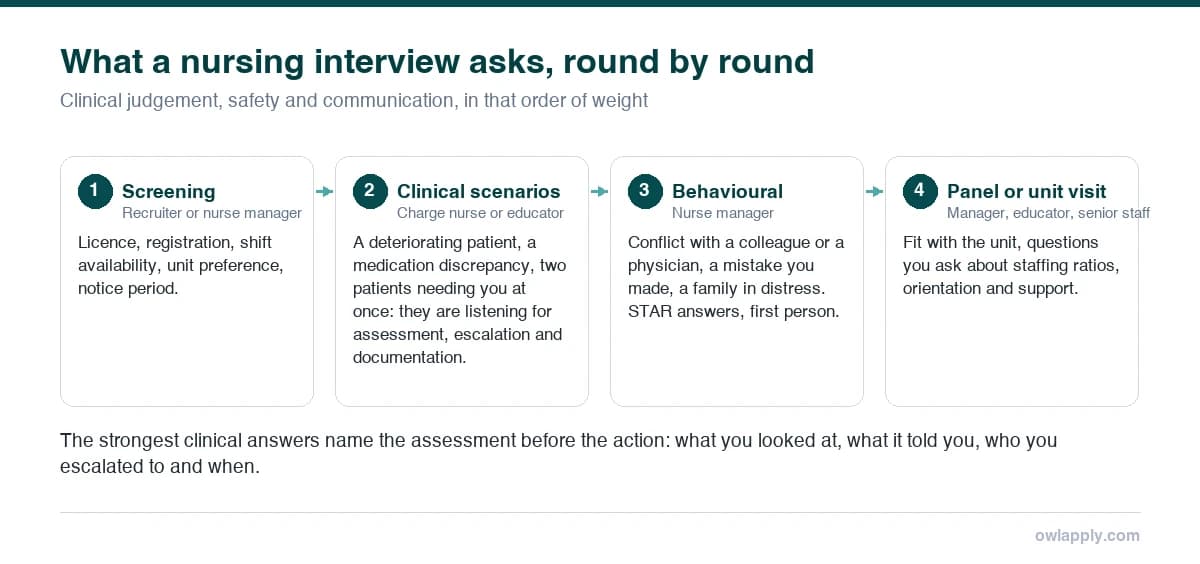
Nursing interview questions come in three kinds: clinical scenarios that test judgement and prioritisation ("a patient's blood pressure is dropping and the doctor is not answering"), behavioural questions about patients, families and colleagues ("tell me about a time you disagreed with a physician"), and fit questions about the unit, shifts and why you want to work there. Nurse managers score the clinical answers on whether you assess before you act and escalate at the right point, and the behavioural ones on patient safety, communication and whether you can say "I was wrong". Below are 40 nursing interview questions with sample answers for new graduates and experienced nurses, the answer frameworks that apply (ABCDE for scenarios, STAR for behavioural, SBAR for anything about handover), and the questions to ask the unit manager. Where an answer turns on unsafe staffing or scope of practice, it helps to know the professional position behind it: the American Nurses Association’s position statements set out what nurses are expected to escalate and why.
Clinical scenario questions (with a framework that always works)
For any "what would you do if" question, answer in the order you would act: assess (ABCDE or the unit's equivalent), act within your scope, escalate with SBAR, document. Interviewers are checking that you do not skip assessment and that you know when to call for help; they are not looking for heroics.
Clinical scenario questions and sample answers
Behavioural nursing interview questions (STAR)
- Tell me about a time you disagreed with a physician. Describe the clinical concern, what you checked, how you raised it (SBAR), and the outcome for the patient. The point is patient advocacy with evidence, not conflict.
- Describe a time you dealt with an aggressive patient or relative. De-escalation steps, when you called for support, and what you did afterwards for the patient's care.
- Tell me about a time you made a mistake. A real one, what you did in the first ten minutes, how you reported it, what changed. See the medication-error answer above.
- Describe a time you had to deliver bad news or support a grieving family. What you said, what you did not say, who else you involved, how you followed up.
- Give an example of when you went beyond your role for a patient. Something small and specific beats something dramatic: the phone call you made, the discharge you delayed by an hour.
- Tell me about a time you worked short-staffed. How you prioritised, what you delegated, what you escalated, and what you documented about the staffing.
- Describe a time you received critical feedback from a senior nurse. What it was, what you changed, evidence that it stuck.
- Tell me about a time you had to learn a new procedure or system quickly. How you learned it, who you asked, how you checked yourself before doing it unsupervised.
Fit and motivation questions
- Why do you want to work on this unit? Name the specialty, the patient group and something specific about the unit (its size, a programme, its reputation). "I want ICU" is not an answer to "why this ICU".
- Why nursing? One honest sentence about the moment you decided, then what keeps you in it. Avoid "I like helping people" on its own.
- How do you cope with the emotional demands of the job? Name real things: debriefs, a colleague you talk to, exercise, boundaries around shifts. "I just get on with it" worries managers.
- Are you comfortable with nights, weekends and 12-hour shifts? Answer honestly with any constraints stated once. A rota problem discovered after the offer is worse than one discussed now.
- Where do you see yourself in five years? A specialty, a qualification (a critical-care course, a mentorship certificate, nurse practitioner training) or a charge-nurse role, tied to this unit.
- What are your strengths and weaknesses as a nurse? Strength with a clinical example; weakness that is real and being worked on ("I used to over-document; I now use the unit's templates and finish notes on time").
Questions new graduate nurses should expect
- Tell me about your clinical placements. Which did you enjoy most, and why?
- Describe a time on placement when you were out of your depth. What did you do?
- How do you plan to manage the transition from student to registered nurse?
- What did you learn from your preceptor or mentor?
- How do you approach a skill you have practised only in simulation?
- What would you do if you were asked to do something you have not been signed off on?
- How do you keep up to date with evidence and guidelines?
- Tell me about a patient who taught you something.
New graduates are scored on honesty about limits and willingness to ask. "I would not do it unsupervised; I would ask to observe first, then be supervised, then be signed off" is the right shape for the sign-off question.
Questions to ask the nurse manager
- What is the nurse-to-patient ratio on day and night shifts, and how often is it exceeded?
- How long is orientation, and how is a new nurse's preceptor chosen?
- What does the unit do after a serious incident or a death?
- How are shift swaps and rota requests handled?
- What education and specialty courses does the unit support, and how do people get on them?
- What is the staff turnover on the unit in the last year?
Rehearse clinical and behavioural answers before the panel
The AI interview tool asks nursing scenario and STAR questions for your unit type, listens to your answer, and scores whether you assessed, acted, escalated and documented.
Practise a nursing interview