
Home
  • Resumes & CVs
    Resume TemplatesView all
    Simple
    Minimal layouts that keep every recruiter focused on your content.
    Professional
    Boardroom-ready templates that spotlight experience and leadership.
    Modern
    Fresh, contemporary designs for innovative roles and companies.
    Creative
    Bold visuals and unique layouts crafted for design-forward careers.
    ATS Friendly
    Structured specifically to clear every Applicant Tracking System.
    Resume Builder
    Resume Builder
    Drag, drop, and export a job-ready resume with instant AI suggestions.
    See all resume examples
    Resume Examples
    Browse our ready-to-use resume examples and create your professional resume in minutes
  • AI Career Tools
    AI Career ToolsView all AI tools
    Keyword Optimizer
    Inject recruiter-approved keywords and rise to the top of ATS results.
    AI Resume Builder
    Generate a polished resume with AI-written bullets and proven layouts.
    Resume Translator
    Translate your resume into any language without losing nuance.
    Resume Summary
    Craft attention-grabbing summaries tailored to each role.
    Resume Bullet Point Generator
    Turn achievements into punchy bullet points in seconds.
    Cover Letter Generator
    Create pitch-perfect letters that mirror every job posting.
    Job Application Autofill
    Auto-complete repetitive application fields across top job boards.
    Resume Checker
    Audit structure, keywords, and impact with instant AI feedback.
    Resume Builder
    Resume Builder
    Drag, drop, and export a job-ready resume with instant AI suggestions.
    Chrome browser
    Firefox browser
    Opera browser
    Safari browser
    Install OwlApply Extension
    Autofill job forms, create tailored resumes, and score postings directly from Chrome.
  • Cover Letters
    Cover Letter TemplatesView all
    Simple
    Clean layouts ideal for traditional teams and entry-level roles.
    Professional
    Classic business styling that reinforces authority and credibility.
    Modern
    Sleek designs that feel right at home in tech and high-growth companies.
    Creative
    A unique canvas to showcase personality without sacrificing polish.
    Cover Letter Builder
    Cover Letter Builder
    Pair your resume with a tailored letter in minutes using guided prompts.
    Chrome browser
    Firefox browser
    Opera browser
    Safari browser
    Install OwlApply Extension
    Autofill job forms, create tailored resumes, and score postings directly from Chrome.
  • Resources
    ResourcesView all
    OwlApply Extension
    Autofill applications, generate cover letters, and track every job from your browser.
    Job Interview
    Scripts, frameworks, and confidence boosters for every interview format.
    Cover Letter
    Story-driven templates and tactics for memorable cover letters.
    Career
    Navigate negotiations, promotions, and pivots with expert advice.
    Resume
    Step-by-step guidance to craft a standout resume in any industry.
    Resume Builder
    Resume Builder
    Drag, drop, and export a job-ready resume with instant AI suggestions.
    Chrome browser
    Firefox browser
    Opera browser
    Safari browser
    Install OwlApply Extension
    Autofill job forms, create tailored resumes, and score postings directly from Chrome.
  • Pricing
EnglishBahasa IndonesiaBahasa MelayuČeštinaDanskDeutschEestiEspañolFilipinoFrançaisHrvatskiItalianoKiswahiliLatviešuLietuviųMagyarNederlandsNorskPolskiPortuguês (Brasil)Português (Portugal)RomânăSlovenčinaSlovenščinaSrpskiSuomiSvenskaTiếng ViệtTürkçeΕλληνικάБългарскиРусскийУкраїнськаעבריתالعربيةفارسیไทย日本語繁體中文한국어
My AccountBuild Resume
EnglishBahasa IndonesiaBahasa MelayuČeštinaDanskDeutschEestiEspañolFilipinoFrançaisHrvatskiItalianoKiswahiliLatviešuLietuviųMagyarNederlandsNorskPolskiPortuguês (Brasil)Português (Portugal)RomânăSlovenčinaSlovenščinaSrpskiSuomiSvenskaTiếng ViệtTürkçeΕλληνικάБългарскиРусскийУкраїнськаעבריתالعربيةفارسیไทย日本語繁體中文한국어
  • Resumes & CVs
    Simple

    Minimal layouts that keep every recruiter focused on your content.

    Professional

    Boardroom-ready templates that spotlight experience and leadership.

    Modern

    Fresh, contemporary designs for innovative roles and companies.

    Creative

    Bold visuals and unique layouts crafted for design-forward careers.

    ATS Friendly

    Structured specifically to clear every Applicant Tracking System.

    View all
  • AI Career Tools
    Keyword Optimizer

    Inject recruiter-approved keywords and rise to the top of ATS results.

    AI Resume Builder

    Generate a polished resume with AI-written bullets and proven layouts.

    Resume Translator

    Translate your resume into any language without losing nuance.

    Resume Summary

    Craft attention-grabbing summaries tailored to each role.

    Resume Bullet Point Generator

    Turn achievements into punchy bullet points in seconds.

    Cover Letter Generator

    Create pitch-perfect letters that mirror every job posting.

    Job Application Autofill

    Auto-complete repetitive application fields across top job boards.

    Resume Checker

    Audit structure, keywords, and impact with instant AI feedback.

    View all AI tools
  • Cover Letters
    Simple

    Clean layouts ideal for traditional teams and entry-level roles.

    Professional

    Classic business styling that reinforces authority and credibility.

    Modern

    Sleek designs that feel right at home in tech and high-growth companies.

    Creative

    A unique canvas to showcase personality without sacrificing polish.

    View all
  • Resources
    OwlApply Extension

    Autofill applications, generate cover letters, and track every job from your browser.

    Job Interview

    Scripts, frameworks, and confidence boosters for every interview format.

    Cover Letter

    Story-driven templates and tactics for memorable cover letters.

    Career

    Navigate negotiations, promotions, and pivots with expert advice.

    Resume

    Step-by-step guidance to craft a standout resume in any industry.

    View all
  • Pricing
My AccountBuild Resume
  1. Home
  2. Blog
  3. Job Interview
  4. Project Manager Interview Questions and Answers (2026)
Eliz Yavas
Written by Eliz Yavas

Project Manager Interview Questions and Answers (2026)

Practice With the AI Interview Tool
Last updated: October 16, 2026
30 minute read
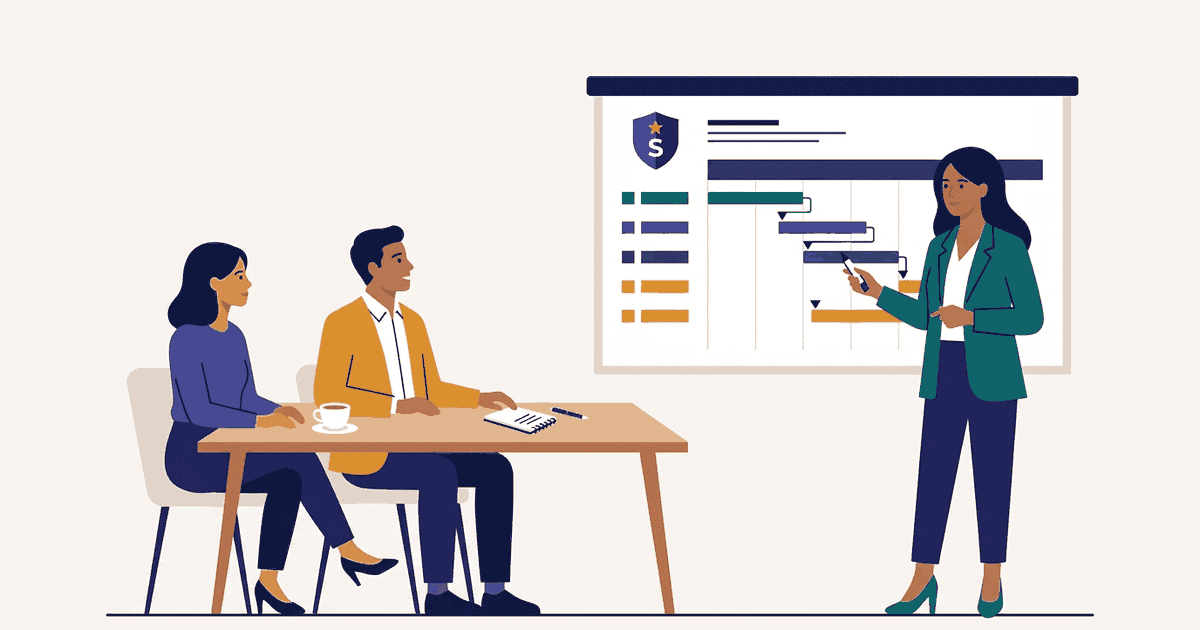
A project manager at a whiteboard with a timeline, a budget figure and a risk list, facing two interviewers
  • What interviewers are assessing in a project manager
  • The 10 most common project manager interview questions
  • •"Tell me about yourself."
  • •"Walk me through a project you managed from start to finish."
  • Behavioral project manager interview questions with STAR answers
  • •"How do you handle scope creep? Give an example."
  • •"Tell me about a project that failed or went badly."
  • •"Tell me about a difficult stakeholder."
  • •"How do you handle an underperforming team member?"
  • •"Tell me about a conflict between team members."
  • •"How do you prioritize when everything is urgent?"
  • •"Tell me about a time you missed a deadline."
  • •"Tell me about a time you led without authority."
  • •"How do you manage a remote or distributed team?"
  • Situational and scenario-based project manager questions
  • •"Your project is three weeks behind schedule. What do you do?"
  • •"You discover the project will be 15% over budget."
  • •"Your sponsor wants a major change two weeks before launch."
  • •"Your team says the deadline is impossible."
  • •"Your lead developer resigns mid-project."
  • •"A vendor tells you a delivery will be two weeks late."
  • •"You inherit a failing project. What do you do in your first two weeks?"
  • •"A stakeholder asks you to report the project as green when it is not."
  • Technical project management interview questions
  • •"What is the difference between Agile and Waterfall, and how do you choose?"
  • •"Explain Scrum. What does a Scrum Master do compared with a project manager?"
  • •"What is the critical path, and how do you calculate it?"
  • •"What is earned value? How would you calculate CPI and SPI?"
  • •"How do you identify and manage risk?"
  • •"How do you build and control a project budget?"
  • •"How do you manage stakeholders?"
  • •Other technical questions to prepare
  • •"Do you have a PMP? Is it required?"
  • Entry-level project manager interview questions
  • IT and technical project manager interview questions
  • Construction, senior and other project manager interviews
  • What are the top 5 skills of a project manager?
  • •Is 90% of a project manager's job communication?
  • •What are the 5 C's or 7 C's of project management?
  • Interview questions to ask a project manager candidate
  • Questions to ask in a project manager interview
  • What the 2026 job market looks like
  • Mistakes that weaken a project manager interview
  • Practice your answers out loud
  • Project manager interviews: more questions
  • •How should I prepare for a project manager interview?
  • •How long should my answers be?
  • •Can I get a project manager job without a PMP?
  • •What if I have no project management experience?
  • •Is there a PDF of project manager interview questions and answers?
  • •Do project manager interviews include a case study or presentation?
  • •What salary should I ask for as a project manager?
  • •Should I send a thank-you note after a PM interview?

Project manager interview questions in 2026 test four things: whether you have actually delivered projects (behavioral questions about scope, budget and stakeholders), how you would handle a problem on their project (situational questions), whether you know the methods (Agile, Scrum, Waterfall, risk, budget control), and whether you fit the team. The strongest answers walk through one real project with numbers: budget, team size, dates planned versus actual.

Below are the questions with full sample answers you can copy and adapt: 10 behavioral STAR answers, 8 situational answers, technical questions with worked examples (critical path, earned value, risk register, Agile versus Waterfall, Scrum), variants for entry-level and IT project managers, a list for hiring managers who want questions to ask a project manager candidate, and the questions you should ask at the end.
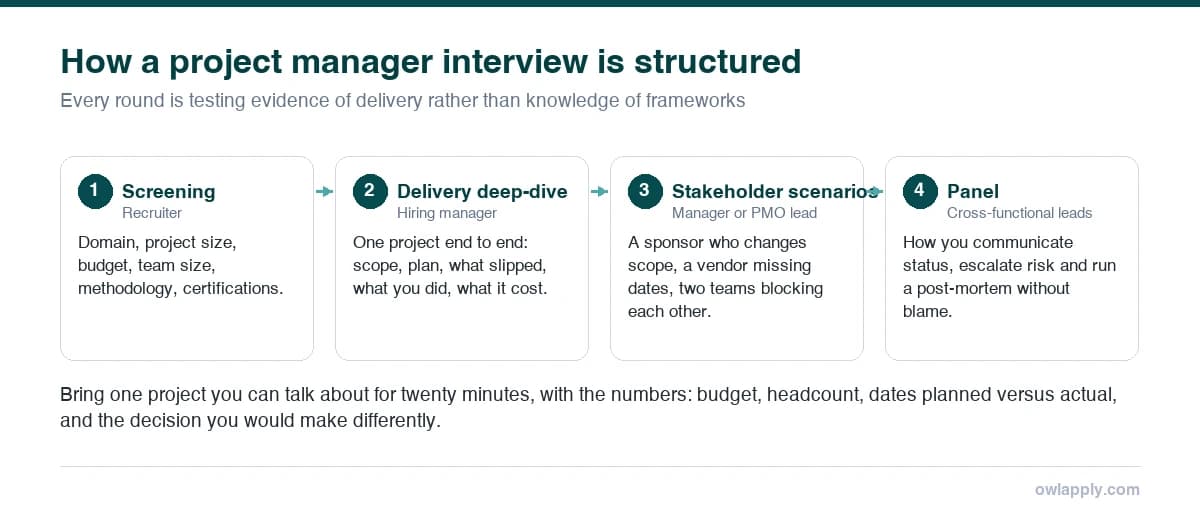
The four rounds of a project manager interview: recruiter screening, a delivery deep-dive with the hiring manager, stakeholder scenarios, and a cross-functional panel
Most PM interviews move from screening to a deep-dive on one project, then scenarios and a panel. Bring one project you can discuss for twenty minutes.

What interviewers are assessing in a project manager

Hiring managers are looking for evidence that you can deliver through other people, not that you can recite a framework. The US Bureau of Labor Statistics lists the qualities project management specialists need as analytical, communication, critical-thinking, interpersonal, organizational, problem-solving and time-management skills. Each question type tests a different part of that list:

Question typeExampleWhat a strong answer shows
Behavioral (past)"Tell me about a project that went over budget."A real project, your own actions, a measurable result, what you would change
Situational (hypothetical)"Your sponsor wants a new feature two weeks before launch."Impact analysis, options, a decision path that goes through change control
Technical (methods)"How do you calculate the critical path?" "What is CPI?"You can do the arithmetic and explain what you would do with the answer
Fit and motivation"Why project management?" "Why this company?"Interest in the domain and a working style that matches theirs
Questions for them"What does success look like at six months?"That you are judging the project's health as well

The 10 most common project manager interview questions

The ten questions you are most likely to be asked are: tell me about yourself, walk me through a project you managed, how do you handle scope creep, tell me about a project that failed, how do you prioritize, how do you manage stakeholders, how do you handle an underperforming team member, which methodologies do you use and when, how do you manage risk, and how do you keep a project on budget. Each is answered below.

#QuestionAnswer on this page
1Tell me about yourself.Sample answer
2Walk me through a project you managed from start to finish.Sample answer
3How do you handle scope creep?Sample answer
4Tell me about a project that failed or went wrong.Sample answer
5How do you prioritize when everything is urgent?Sample answer
6How do you manage difficult stakeholders?Sample answer
7How do you handle an underperforming team member?Sample answer
8Agile or Waterfall: how do you choose?Sample answer
9How do you identify and manage risk?Sample answer
10How do you keep a project on budget?Sample answer

"Tell me about yourself."

Give a 60-second summary built around the project constraints the job cares about: the size and type of projects you run, your methods, one result with numbers, and why this role is next. There are more structures in tell me about yourself sample answers.

Sample answer: project manager
I'm a project manager with six years in B2B software, the last three running customer implementation projects of between $150,000 and $600,000 with teams of five to twelve people across engineering, data migration and training. I run most projects as a hybrid: a fixed plan and budget for the client, with two-week sprints inside the build phase. The project I'm proudest of is a migration for a 2,000-user healthcare client that we delivered two weeks early and 6% under budget, mostly because we found a data-quality problem in week two instead of week ten. I'm PMP certified, and I'm applying here because you're moving from single-client projects to a program of rollouts, which is the scale I want to work at next.

"Walk me through a project you managed from start to finish."

This is the deep-dive question, and the hiring manager will interrupt with follow-ups, so pick a project you know in detail. Cover the goal, scope, team, method, budget and dates, the biggest problem and what you did, and the result versus plan. Keep the first pass to about two minutes and let them dig.

Sample answer: project walk-through
Goal: replace a warehouse management system across three distribution centers without stopping shipments. Budget $420,000, nine months, a core team of eight plus the vendor. Plan: I split it into a pilot site and two rollouts. We ran the build in sprints with the vendor, but each go-live was a fixed date agreed with operations, because peak season couldn't move. Problem: in month four, integration testing showed the carrier label printing failed for one in twenty orders. I didn't want to slip the pilot, so I set up a daily 15-minute triage with the vendor and our integration developer, moved the label fix onto the critical path and pushed two lower-priority reports to after go-live with the operations director's agreement. Result: the pilot went live one week late, the other two sites on time, and the project closed at $431,000, 2.6% over, mostly from the extra vendor days. If I did it again, I'd run end-to-end label tests in month two, not month four.

Behavioral project manager interview questions with STAR answers

Behavioral questions ask what you did, so answer with STAR (Situation, Task, Action, Result). Spend most of the time on the action, use "I" for your decisions, and finish with a number. For the general method, see behavioral interview questions and the STAR method.

"How do you handle scope creep? Give an example."

STAR answer: scope creep
S: Halfway through a website rebuild, the marketing director asked for a customer portal with logins "since we're rebuilding anyway". T: It was a reasonable request, but it wasn't in scope, and the launch date was tied to a product announcement. A: I didn't say yes or no in the meeting. I logged it as a change request, and within two days my lead developer and I estimated it at five weeks and about $38,000. I took the director three options: add it and move the launch, launch on time and deliver the portal as phase two, or launch with a simple 'request access' form now. I put the trade-offs in one page for the sponsor. R: The sponsor chose phase two. We launched on the announcement date, and the portal went live seven weeks later as its own small project with its own budget.

Why it works: it shows a formal change process without sounding bureaucratic, quantifies the impact, and lets the sponsor decide. PMI's own sample PMP question on this situation says the same: evaluate the impact and follow the change control process.

"Tell me about a project that failed or went badly."

STAR answer: a project that went wrong
S: I ran the launch of a mobile app for a retail client with a fixed date for a holiday campaign. T: I was responsible for the plan and the vendor relationship. A: I trusted the vendor's weekly 'green' status for too long. When I finally asked to see a working build in week eight, the payment integration wasn't started. I escalated the same day, cut the scope to the features that mattered for the campaign, added a second vendor developer, and moved to twice-weekly demos instead of status reports. R: We launched ten days late and missed the first campaign week, which cost the client real sales. Since then I ask for working demos, not status reports, from week two of any vendor project, and I put that in the contract.

Why it works: it is a real failure, you own your part, and the lesson is a concrete change in how you work. Avoid a failure that was entirely someone else's fault.

"Tell me about a difficult stakeholder."

STAR answer: difficult stakeholder
S: On a CRM rollout, the head of sales skipped every steering meeting and then criticized decisions in front of his team. T: Sales adoption was the main success measure, so I needed him on board. A: I asked for 20 minutes one to one and asked what he was worried about. It turned out he expected the new CRM to add data entry for his reps. I brought two of his top reps into the design of the opportunity screen and changed the steering meeting to a 30-minute slot he could attend. R: He attended every meeting after that, his team helped test, and 92% of the sales team was logging opportunities in the new system within six weeks of launch.

"How do you handle an underperforming team member?"

STAR answer: underperformance
S: A senior analyst on my team kept missing deadlines on data mapping, which blocked two developers. T: I don't manage people's careers as a PM, but I'm responsible for the schedule, so I needed to fix the blockage without damaging the relationship. A: I talked to her privately first and asked what was going on. She was also covering a production support rota that nobody had told me about. I spoke with her line manager, agreed she'd be off the rota for three weeks, and broke her mapping work into daily deliverables so we'd both see problems early. R: The mapping was finished in two and a half weeks and the developers were unblocked. I now ask about other commitments when I staff a project.

"Tell me about a conflict between team members."

STAR answer: team conflict
S: Our QA lead and lead developer disagreed about whether a release was ready; the argument was getting personal in standups. T: I needed a decision before the release window and a team that could still work together. A: I moved the discussion out of standup and asked each of them to list the open defects they considered blockers. Seen side by side, they disagreed on only three of 41. We agreed criteria for a release blocker together, applied them to those three, and fixed the one that met them. R: We released two days later than planned with no critical defects in the first month, and we still use those blocker criteria.

"How do you prioritize when everything is urgent?"

Sample answer: prioritization
I sort by impact on the project goal and by deadline, and I make the trade-offs visible rather than deciding them silently. In practice that means three questions: which of these is on the critical path, which has a fixed external date, and which can only be done by one person. Last quarter I had a client escalation, a slipping integration and a steering committee pack due on the same day. The integration was on the critical path, so I spent the morning unblocking it. The escalation got a same-day call with a written follow-up. The steering pack I cut to one page and sent at 6 p.m. instead of noon, after telling the sponsor in advance.

"Tell me about a time you missed a deadline."

STAR answer: missed deadline
S: A data center move was planned over one weekend. T: I was the project manager, responsible for the cutover plan. A: On Saturday afternoon, a storage array failed its checks after the move. At the agreed go/no-go point at 8 p.m., I recommended rolling back rather than keep trying through the night, because our rollback window closed at 2 a.m. I informed the business owners straight away with a new date. R: Systems were back on the old site by Sunday morning with no data loss. We did the move two weeks later, successfully. The go/no-go checkpoint, agreed with the sponsor in advance, is what made the rollback a decision instead of a panic.

"Tell me about a time you led without authority."

STAR answer: influence without authority
S: I needed the security team to review our architecture, but they had a six-week queue and no reason to prioritize us. T: Without their sign-off we couldn't go live. A: I met their lead and asked what made reviews slow. Most submissions arrived incomplete. I had our architect fill in their checklist fully, booked a 45-minute walkthrough instead of a written back-and-forth, and offered to share our documentation as an example for other teams. R: The review was completed in eight days, and their lead used our submission as a template for other project teams.

"How do you manage a remote or distributed team?"

Sample answer: remote team
I set a small number of fixed rhythms and write everything down. On my last project the team was split between Austin, Kraków and Bangalore. We had one 30-minute overlap a day for the standup, a written weekly status in the same template every Friday, and a decision log anyone could read. I rotated meeting times once a month so the same people weren't always on at 9 p.m. Most problems in distributed teams are about information arriving late, so I measure that: if someone finds out about a decision in a meeting rather than the log, I've failed.

Situational and scenario-based project manager questions

Situational questions describe a problem and ask what you would do. Interviewers want a sequence: understand the facts, assess the impact on scope, time, cost and quality, generate options, involve the right decision maker, then communicate and document. Give a decision, not a list of possibilities.

"Your project is three weeks behind schedule. What do you do?"

Sample answer: behind schedule
First I'd find out why and whether the delay is on the critical path: three weeks on a task with five weeks of float is a different problem from three weeks on the critical path. Then I'd look at the options: fast-tracking, which means running tasks in parallel that we'd planned in sequence; crashing, which means adding people or overtime to critical tasks, at a cost; cutting or deferring scope; or moving the date. I'd take the sponsor a recommendation with the cost and risk of each option, not just the bad news. And I'd fix whatever caused the slip, because if it was an estimate problem, the rest of the plan probably has the same problem.

"You discover the project will be 15% over budget."

Sample answer: over budget
I'd check the forecast first: is 15% based on what we've spent so far, or on a real estimate of the remaining work? I'd use earned value to see whether we're overspending, behind, or both. Then I'd look for the cause, such as rates, rework or scope that grew without a change request. I'd go to the sponsor early with a revised estimate and options: reduce scope, phase the delivery, use contingency reserve if we have it, or ask for more funding with a business case. Waiting until we've actually spent the money removes most of those options.

"Your sponsor wants a major change two weeks before launch."

Sample answer: late change request
I'd treat it as a change request, not a yes or a no. I'd ask what problem the change solves and whether it has to be in the launch, then get an estimate from the team on the effect on date, cost and risk, especially testing time. I'd give the sponsor the options: launch on time without it, launch on time with a smaller version, or move the date. If they choose to add it, I'd update the plan, the risk register and everyone affected in writing.

"Your team says the deadline is impossible."

Sample answer: impossible deadline
I'd ask them to show me why, task by task, rather than argue about the total. Often the problem is a few specific tasks or a dependency. Then I'd look for what can change: scope, sequence, people or the date. I'd take the sponsor the realistic options with the team's estimate behind them. Committing to a date the team doesn't believe in only moves the bad news later.

"Your lead developer resigns mid-project."

Sample answer: losing a key person
I'd use the notice period for a handover plan: documentation of the work in progress, pairing with whoever will take over, and the decisions only they know about. I'd tell the sponsor the risk and the likely schedule impact straight away, and work with the line manager on a replacement or a contractor. Then I'd add single points of failure to the risk register for the rest of the project, because if one person leaving can stop us, others can too.

"A vendor tells you a delivery will be two weeks late."

Sample answer: vendor delay
I'd find out the real cause and whether two weeks is reliable, then check the impact: is that delivery on the critical path, and do we have float or schedule reserve? I'd look at options with the team, such as resequencing work, a partial delivery or another supplier, and I'd check what the contract says about delays. Then I'd tell the sponsor with the impact and my recommendation, rather than hoping the vendor catches up.

"You inherit a failing project. What do you do in your first two weeks?"

Sample answer: taking over a troubled project
I'd spend the first week listening and reading: the charter, the plan, the budget, the risk log, and one-to-one conversations with the sponsor, the team leads and the main stakeholders. I want to know what success means to the sponsor today, which may have changed. In the second week I'd re-baseline: a realistic estimate of the remaining work, the top five risks, and a recovery plan with options. I'd present that to the sponsor with a clear recommendation, even if it means saying the original date is gone. Then I'd set a simple reporting rhythm so everyone can see progress against the new plan.

"A stakeholder asks you to report the project as green when it is not."

Sample answer: honest status
I wouldn't. I'd talk to them privately and explain that a false status takes away the time we need to fix the problem and puts both of us at risk later. I'd offer to report it as amber with a clear recovery plan, which is often what they are really worried about. If they insisted, I'd escalate to the sponsor. Status reports are only useful if people trust them.

Why it works: it refuses without drama and offers a better route. Honesty is one of the four values in PMI's Code of Ethics and Professional Conduct, alongside responsibility, respect and fairness.

Technical project management interview questions

Technical questions check that you can use the tools, not just name them. Answer with a short definition, then an example of when you used it.

"What is the difference between Agile and Waterfall, and how do you choose?"

Waterfall (predictive) plans the whole project up front and moves through phases in sequence; Agile delivers in short iterations and expects requirements to change. Choose Waterfall when requirements are stable and changes are expensive (construction, regulated hardware), Agile when the product will be shaped by user feedback (software), and hybrid when you need both.

Waterfall (predictive)AgileHybrid
PlanningDetailed plan and baseline up frontHigh-level roadmap, detailed planning each iterationFixed milestones, iterative delivery between them
ChangeThrough formal change controlExpected; the backlog is reprioritizedChange control at milestone level, backlog inside
DeliveryOne delivery at the end of each phaseWorking increment every iterationIncrements plus planned releases
Best whenRequirements are fixed, rework is expensiveRequirements will change with feedbackFixed date or budget with an uncertain solution
Typical exampleOffice fit-out, ERP finance close processMobile app, internal toolClient implementation with a contract date
Sample answer: choosing a methodology
I choose based on how stable the requirements are and how expensive change is. For a data center move, I'd run a detailed predictive plan, because the cutover can't be iterated. For a new customer portal, I'd run Scrum, because we'll learn what users need from the first release. Most of my projects are hybrid: the client contract has fixed milestones and a budget, and inside the build phase the team works in two-week sprints with a prioritized backlog.

"Explain Scrum. What does a Scrum Master do compared with a project manager?"

According to the 2020 Scrum Guide, a Scrum Team has three accountabilities (one Scrum Master, one Product Owner and Developers), five events (the Sprint, Sprint Planning, the Daily Scrum, the Sprint Review and the Sprint Retrospective) and three artifacts, each with a commitment: the Product Backlog (Product Goal), the Sprint Backlog (Sprint Goal) and the Increment (Definition of Done). Sprints are one month or less, and the Daily Scrum is 15 minutes. Scrum has no project manager role: the Scrum Master coaches the team and removes impediments, the Product Owner owns the backlog. In many companies a project manager works alongside, managing budget, contracts, dependencies on other teams and reporting to stakeholders.

"What is the critical path, and how do you calculate it?"

The critical path is the longest sequence of dependent tasks through the project; it sets the shortest possible duration, and any delay on it delays the finish. Calculate it by adding up the durations along each path through the dependency network and taking the longest.

Path A-B-D-F = 3 + 5 + 4 + 2 = 14 days (critical). Path A-C-E-F = 3 + 2 + 3 + 2 = 10 days, so C and E have 4 days of float.
TaskDurationDepends on
A. Requirements3 daysNone
B. Build back end5 daysA
C. Design screens2 daysA
D. Integrate4 daysB
E. Build front end3 daysC
F. Test and release2 daysD and E

The interview follow-up is usually "so what?": you would watch B and D most closely, a one-day slip on either moves the release, and you could delay the front-end work by up to four days without affecting the date.

"What is earned value? How would you calculate CPI and SPI?"

Earned value management compares the value of work actually done (EV) with the planned value (PV) and the actual cost (AC). The cost performance index CPI = EV / AC and the schedule performance index SPI = EV / PV; below 1.0 means over budget or behind schedule. Here is a worked example you can talk through:

MeasureFormulaExampleMeaning
Budget at completion (BAC)Total approved budget$200,000The plan
Planned value (PV)Budgeted cost of work scheduled to date$100,000 (50% planned by month 3)Where we should be
Earned value (EV)% actually complete × BAC$80,000 (40% complete)Value delivered
Actual cost (AC)What was spent$95,000Money gone
Cost varianceEV − AC−$15,000Over budget
Schedule varianceEV − PV−$20,000Behind schedule
CPIEV ÷ AC0.8484 cents of value per dollar spent
SPIEV ÷ PV0.80Progressing at 80% of the planned rate
Estimate at completionBAC ÷ CPI$237,500Forecast final cost if efficiency stays the same

A good answer goes one step further: "With a CPI of 0.84, I'd tell the sponsor the forecast is about $237,500 unless something changes, and I'd find out whether the overrun comes from rates, rework or scope."

"How do you identify and manage risk?"

Identify risks with the team and stakeholders at the start and at every phase, log them in a risk register with probability, impact, an owner and a response, and review the top risks every week. Responses to threats are usually avoid, transfer, mitigate or accept; for opportunities, exploit, share, enhance or accept.

Risk register entry (example)
Risk ID: R-07 Description: If the payment provider's sandbox is not available by 15 March, integration testing will start late, delaying launch. Probability: Medium (3/5) Impact: High (4/5) Score: 12 Owner: Integration lead Response (mitigate): Build against the provider's mock API from 1 March; confirm sandbox date in writing at the weekly vendor call. Trigger: No sandbox credentials by 8 March. Contingency: Move payment testing to the next sprint and test other flows first; inform the sponsor. Status: Open, reviewed weekly
Sample answer: risk management
I run a risk workshop at kickoff with the team and key stakeholders and write each risk as cause, event and effect, so it's specific enough to act on. Each one gets a probability, an impact, an owner and a response, and I review the top ten in the weekly team meeting, not just at the monthly steering committee. On my last project, the top risk was that the client's IT team would be late with network changes. We mitigated it by booking their change slots at kickoff, and when they slipped anyway, we had a trigger date and a contingency plan ready, so it cost us three days rather than three weeks.

"How do you build and control a project budget?"

Sample answer: budget control
I build the budget bottom-up from the work breakdown structure: effort estimates per work package, rates, materials, licenses, vendor costs, then a contingency reserve for identified risks, sized from the risk register. The sponsor approves the baseline. To control it, I track actuals against the baseline monthly, use earned value on larger projects so I can see cost and schedule together, and route every scope change through change control with a cost estimate. If the forecast moves more than our agreed threshold, say 5%, I tell the sponsor with options rather than waiting for the month-end report.

"How do you manage stakeholders?"

Identify everyone affected, map them by power and interest, and plan how you will engage each group: manage closely the people with high power and high interest, keep satisfied those with high power and low interest, keep informed those with high interest and low power, and monitor the rest. Then agree how often and in what form each group hears from you, and check that it is working.

Other technical questions to prepare

QuestionShort answer
What is a work breakdown structure (WBS)?A hierarchical breakdown of the total scope into deliverables and work packages small enough to estimate and assign.
What is a RACI matrix?A table showing who is Responsible, Accountable, Consulted and Informed for each deliverable or decision. Only one person is Accountable.
What is the triple constraint?Scope, time and cost: changing one affects the others, and quality depends on all three.
Fast-tracking vs crashing?Fast-tracking runs sequential tasks in parallel (more risk); crashing adds resources to critical tasks (more cost).
What is a project charter?The document that authorizes the project, names the sponsor and PM, and sets objectives, high-level scope, budget and success criteria.
Velocity and burndown?Velocity is the work a team completes per sprint, used for forecasting; a burndown chart shows the work remaining against time.
What is Kanban?A flow method: visualize work on a board, limit work in progress, and manage the flow rather than fixed iterations.
Which tools do you use?Name the ones you know (for example Jira, MS Project, Smartsheet, Asana) and what you used them for, then say you adapt to the team's tool.

"Do you have a PMP? Is it required?"

Answer honestly, and if you do not have it, say what you are doing about it. According to PMI, the PMP exam has 180 questions in 240 minutes, split across People (33%), Process (41%) and Business Environment (26%). To sit it you need 35 hours of project management training (or an active CAPM) plus experience leading projects: 3 years with a bachelor's degree, 4 with an associate's degree, 5 with a high school diploma, or 2 with a degree from a PMI-accredited program. Holders earn 60 professional development units every three years to keep it. Many PM postings list PMP as preferred rather than required; the interview will still test the experience behind it.

Entry-level project manager interview questions

For entry-level, junior PM and project coordinator roles, interviewers do not expect a list of large projects. They want organization, follow-through and communication, shown through school projects, events, part-time work or projects you led informally in another job. Typical questions:

  • Why do you want to be a project manager?
  • Tell me about a project you organized, even if it wasn't your job title.
  • How do you keep track of tasks and deadlines?
  • What would you do if a team member didn't deliver their part on time?
  • Which project management tools have you used?
  • What do you know about Agile or Scrum?
  • Are you working toward a certification such as the CAPM?
Sample answer: entry-level, no PM title
I haven't had the title yet, but I've been doing the work. As an operations assistant, I coordinated our office move for 60 people: I built the task list with the facilities manager, ran a 15-minute check-in every Monday for six weeks, kept the budget in a shared sheet and handled the IT and furniture vendors. We moved over one weekend and everyone had a working desk on Monday, within the $45,000 budget. That's when I realized I like the coordination more than the operations work. I've since completed the 35 hours of project management training, and I'm studying for the CAPM. I'd like to start as a coordinator here because your PMO runs a lot of small projects at once, which is the fastest way to learn.

For the résumé side, the entry-level project management résumé examples and project coordinator résumé examples show how to present informal projects as experience.

IT and technical project manager interview questions

IT, software and technical project manager interviews add questions about the software delivery life cycle and about working with engineers. You do not need to code, but you need to understand what engineers are telling you.

  • How do you work with engineers on estimates you can't check yourself?
  • How do you handle technical debt competing with new features?
  • Walk me through a release you managed, including rollback.
  • How do you manage dependencies on other teams or platforms?
  • A production incident hits during your release week. What do you do?
  • How do you translate technical risk for a non-technical sponsor?
  • What does your ideal Definition of Done include?
Sample answer: estimates from engineers
I don't second-guess the numbers; I ask questions that expose the assumptions. What's the riskiest part? What would make this take twice as long? Has anyone done something similar here? I prefer relative estimates from the people doing the work, and then I track how they compare to actuals over a few sprints, so the forecast improves from data rather than pressure. When I need a date for a sponsor, I give a range with the main assumption stated, like 'six to eight weeks, if the vendor API behaves as documented'.
Sample answer: technical debt
I make it visible and give it a budget. I ask the tech lead to list the debt items with the risk each one carries, for example slower releases or incidents, and we agree with the product owner on a fixed share of each sprint for it. When a debt item directly threatens a deadline or stability, I treat it as a project risk and take it to the sponsor like any other risk.

See the technical project manager résumé examples for how to show delivery metrics in an IT context.

Construction, senior and other project manager interviews

RoleQuestions you will also getWhat they listen for
Construction project managerHow do you manage subcontractors? How do you handle a change order? Tell me about a safety incident on site.Contracts and change orders, safety culture, schedule recovery, cost control
Engineering project managerHow do you manage design reviews and technical risk? How do you handle a failed test?Stage gates, requirements traceability, working with specialists
Senior project / program managerHow do you manage a portfolio of projects with shared resources? How do you report to executives?Benefits realization, governance, influencing at executive level
AI or data project managerHow do you plan a project when you don't know if the model will work?Experiments with go/no-go points, data quality risk, iterative scope
Agile or Scrum rolesHow do you handle a Product Owner who changes priorities mid-sprint?The Scrum Guide's rules, coaching rather than commanding

What are the top 5 skills of a project manager?

The top five skills interviewers look for in a project manager are communication, planning and organization, risk and problem solving, stakeholder management (influencing without authority), and leadership of a team you often do not manage directly. They match the qualities the BLS lists for the occupation; show each one with an example rather than naming it.

Is 90% of a project manager's job communication?

It is a well-known rule of thumb rather than a measured figure: no study sets the share at exactly 90%. The point behind it is sound, though. Most of the work is status, negotiation, escalation and keeping people aligned, so interviewers listen closely to how clearly you explain your answers.

What are the 5 C's or 7 C's of project management?

There is no official list: PMI's standards do not define "5 C's" or "7 C's", and trainers use different versions (communication, collaboration, clarity, commitment and control are common picks). If you are asked, say that, then name the two or three that matter most in your own work and give an example. The interviewer is testing your thinking, not your memory of a slogan.

Interview questions to ask a project manager candidate

If you are hiring a project manager, ask for evidence of delivery and listen for specifics. These questions separate experienced PMs from people who have studied the vocabulary:

QuestionA strong answer includesWarning sign
Walk me through your last project's budget versus actual.Numbers, the reason for the variance, what they did about it"We were basically on budget" with no figures
Tell me about a project that failed.Their own part in it and a changed habitBlaming the client or the team
How did you find out your last project was in trouble?A specific signal and how earlyFinding out at the deadline
Show me how you report status.A clear format and honest ambers and redsEverything was always green
How do you handle a change request from the sponsor?Impact analysis and a decision by the sponsorSaying yes to keep them happy
What would you do in your first 30 days here?Listening, reviewing the plan and risks, re-baselining if neededChanging tools and processes immediately

Questions to ask in a project manager interview

Ask questions that show you are already thinking about how to deliver their projects. For a longer list, see questions to ask the interviewer.

  1. How is success measured for this role in the first six months?
  2. What does the current project portfolio look like, and which project is most at risk?
  3. What methodology do teams use, and how much can a PM adapt it?
  4. How much authority will I have over budget and scope decisions?
  5. Who are the key stakeholders, and how do they prefer to be updated?
  6. What tools does the team use for planning and reporting?
  7. What happened to the last person in this role?
  8. What is the biggest challenge the team is facing right now?

What the 2026 job market looks like

The Bureau of Labor Statistics counted 1,094,300 project management specialist jobs in the US in 2025, with a median annual pay of $102,320 in May 2025. It projects 7% employment growth from 2025 to 2035 and about 76,500 openings a year on average. The typical entry-level education is a bachelor's degree.

Project management specialists in the US (BLS, page modified August 27, 2026)

$102,320
median annual pay, May 2025
1,094,300
jobs in 2025
7%
projected growth, 2025 to 2035
76,500
average openings per year

Your résumé lists the skills. The interview has to prove them.

In the 33,746 résumés run through the free OwlApply résumé checker, 80.9% listed skills that never appear anywhere in the experience, projects or summary, and 58.2% were advised to add quantified achievements (ATS résumé statistics, September 2026). Project manager résumés often say "stakeholder management, Agile, risk management" in a skills list and nothing more. Expect the interviewer to ask for the evidence, and have a budget, a team size and a date ready for each skill you claim. The project manager résumé examples show the same skills written as results.

Mistakes that weaken a project manager interview

Do this

  • Use one or two real projects with budget, team size and dates
  • Say "I" for your own decisions
  • Show a decision path: impact, options, sponsor decision
  • Admit a failure and the habit it changed
  • Explain methods with an example of when you used them
  • Ask about authority, stakeholders and the riskiest project

Avoid this

  • Don't describe every project you have ever run
  • Don't hide behind "we" so the interviewer cannot see your part
  • Don't say yes to every scope change to sound flexible
  • Don't claim a project that was always green
  • Don't recite definitions with no example
  • Don't criticize a former sponsor, client or team

Practice your answers out loud

Project answers tend to run long when spoken: the walk-through becomes five minutes, and the result gets lost. Say your main stories out loud with a timer, about two minutes each, and check that every one ends on a number.

The OwlApply AI mock interview lets you rehearse this as a spoken interview. Choose the interview type (HR, behavioral, technical or hiring manager) and one of 42 languages, and add your résumé and the job posting so the questions fit the role. The interviewer asks follow-ups the way a real one would, such as asking for an example when an answer stays vague, and does not coach you during the session. Afterwards you get a report built from the full transcript, with each answer scored and a stronger suggested version. If you have never done an interview on OwlApply, your first three-minute session costs nothing. Ten-minute sessions are part of the Pro plan: you can try Pro for 7 days for $2.95, which includes two sessions, then $17.49 a month unless you cancel.

Expert tip
Prepare one project as a one-page fact sheet before the interview: goal, budget planned and actual, team size, dates planned and actual, the biggest problem, what you did, and what you would change. Most deep-dive questions are answered from that page, and having the numbers ready is what makes you sound like the person who ran the project.
OwlApply Team
Career Development Platform

Rehearse your project story before the panel

Run a spoken mock interview for the PM role you are applying to, then read your scored report with a stronger version of each answer. Your first three-minute session is free.

Practice my interview

Project manager interviews: more questions

How should I prepare for a project manager interview?
Pick two projects and write the facts for each: goal, budget, team, dates, the main problem and the result. Prepare STAR stories for scope change, failure, conflict and stakeholders, review the basics (critical path, earned value, risk, Agile and Waterfall), research the company's projects, and write your own questions.
How long should my answers be?
About one to two minutes for behavioral answers and up to two minutes for the project walk-through. Give the summary first and let the interviewer ask for detail.
Can I get a project manager job without a PMP?
Yes. Many postings list the PMP as preferred, and the PMP itself requires years of project experience before you can sit the exam. For entry-level roles, the CAPM or project management training plus evidence of projects you organized is a common route.
What if I have no project management experience?
Use projects you led without the title: events, office moves, process changes, system rollouts, or academic projects. Describe them with the same structure as a PM would: scope, plan, people, budget, risks and result.
Is there a PDF of project manager interview questions and answers?
You do not need one. The sample answers on this page are plain text you can copy into your notes and rewrite with your own projects and numbers, which works better than memorizing someone else's answers.
Do project manager interviews include a case study or presentation?
Some do, especially for senior roles: a short case with a troubled project, or a presentation of a past project. Use the same structure as the situational answers here: facts, impact, options, recommendation.
What salary should I ask for as a project manager?
Research the posted range and local data first. The BLS median for project management specialists was $102,320 in May 2025, but pay varies widely by industry, location and certification, so use it as context rather than a target.
Should I send a thank-you note after a PM interview?
Yes, the same day: a short email that mentions one project or challenge you discussed. Avoid the common thank-you email mistakes.
Share article

Launch your resume in 15 minutes

Pick a proven layout, let AI suggest winning bullet points, and export a polished resume before your coffee cools.

Build my resume

Launch your resume in 15 minutes

Pick a proven layout, let AI suggest winning bullet points, and export a polished resume before your coffee cools.

Build my resume

Connect with OwlApply

Follow on LinkedInWatch on YouTubePin on PinterestJoin us on InstagramLike on FacebookFollow on XFollow on MediumFollow on TikTok
Build Resume
EnglishBahasa IndonesiaBahasa MelayuČeštinaDanskDeutschEestiEspañolFilipinoFrançaisHrvatskiItalianoKiswahiliLatviešuLietuviųMagyarNederlandsNorskPolskiPortuguês (Brasil)Português (Portugal)RomânăSlovenčinaSlovenščinaSrpskiSuomiSvenskaTiếng ViệtTürkçeΕλληνικάБългарскиРусскийУкраїнськаעבריתالعربيةفارسیไทย日本語繁體中文한국어

JOB SEEKERS

  • Build Resume
  • Resume Examples
  • Resume Templates
  • Cover Letter Templates
  • Job Search Helper
  • Job Tracker

CAREER RESOURCES

  • Resume Help
  • Job Interview
  • Career
  • Cover Letter
  • OwlApply Extension
  • Blog

AI TOOLS

  • Cover Letter Builder
  • AI Resume Optimizer
  • Job Application Autofill
  • AI Resume Builder
  • ATS Resume Checker
  • All AI Tools

SUPPORT

  • Pricing
  • FAQ
  • Contact Us
  • Terms of Service
  • Privacy Policy
  • Cookie Policy
  • Right of Withdrawal

Copyright 2026 OwlApply. All rights reserved.

Launched on Fazier