"Tell me about yourself" is asking for a 60–90 second summary of who you are professionally, why you are sitting in that chair, and what makes you the right person for this role. It is not an invitation to narrate your life story, and it is not a trick question. The answer that works has three parts in a fixed order: present (your current role and what you do in it, with one number), past (the one or two experiences that led here), future (why this role, and the one thing you would bring). Below is that structure with sample answers for freshers, experienced professionals, career changers, managers and people returning after a break, the mistakes that turn the question into a long silence, and a way to rehearse it until it sounds like you and not a script.
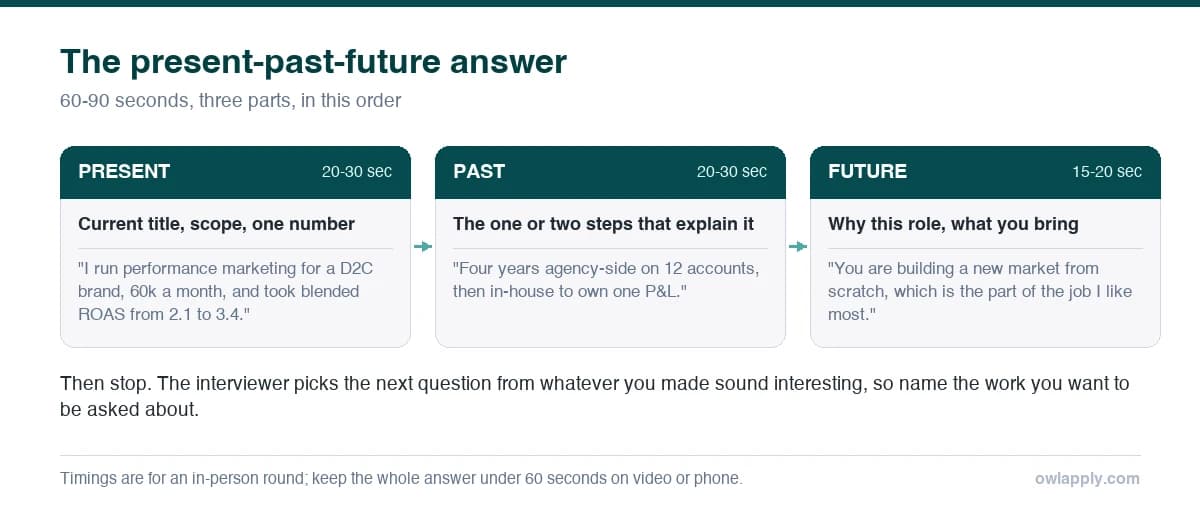
The present-past-future structure (and the timing)
Sixty to ninety seconds, three parts, in this order, then stop and let them choose the next question.
Total: 60–90 seconds. Stop and let them ask the next question.
Part
What to say
Time
Present
Your current title, scope and one result with a number. For freshers: your degree and your strongest project or internship
20–30 seconds
Past
The one or two earlier experiences that explain how you got here; skip anything that does not connect
20–30 seconds
Future
Why this role and this company, and the single thing you would bring on day one
15–20 seconds
The interviewer uses this answer to decide where to dig, so it should point at the things you want to be asked about. Say the number you are proudest of; leave out the job you would rather not discuss (it is on the resume; they will ask if they care).
"Tell me about yourself" sample answers
Fresher / recent graduate
Sample answer: fresher (software)
I graduated in June with a B.Tech in Computer Science from MIT-WPU, with an 8.4 CGPA. The work I am proudest of is a placement portal I built with two classmates in Spring Boot and React; about 1,200 students and 35 recruiters used it this year, and it cut the placement cell's manual scheduling by around six hours per drive. Before that I spent two months as an intern at Zensar, where two of my bug fixes went to production, which taught me what code review at a real company looks like. I am applying here because this role is backend-heavy and on Java, which is exactly where my projects are, and I would bring the habit of writing tests before I ask for a review.
Experienced professional (3–8 years)
Sample answer: experienced (marketing)
I am a performance marketing manager at a D2C skincare brand, where I run about 60 lakh rupees a month across Google and Meta with a team of three; last year we took blended ROAS from 2.1 to 3.4 while doubling spend. I got here through an agency route: four years at a mid-size agency where I handled 12 accounts and learned to run experiments properly, before moving in-house to own one P&L. I am interested in this role because you are building the marketing function for a new market from scratch, and the part of my job I like most is the first year of a channel, when the measurement and the creative testing are still being set up.
Career changer
Sample answer: career change (teacher to instructional designer)
I have spent five years teaching secondary mathematics, the last two as head of department, where I redesigned our Year 9 curriculum and raised the average assessment score by 12 points. Along the way I found that the part I was best at was designing the learning, not delivering it: I built our department's first online module during the pandemic, and it is still in use. Over the past year I completed a Google Certified Educator credential and two Articulate Storyline courses and built a portfolio of three e-learning modules. This role is the natural next step: it needs someone who understands assessment design and can build in Storyline, and I can do both.
Manager / senior
Sample answer: manager (operations)
I currently lead branch operations for a private bank in the Kolkata region: 12 direct reports, a 40,000-account portfolio, and responsibility for service quality and compliance. In the last two years we cut customer complaints by 31% and passed three internal audits with no major findings. I came up through the operations side, starting as a service officer and moving into team lead and then branch roles, which is why I still spend time on the floor. I am talking to you because the regional operations manager role here covers eleven branches, and the thing I have done well twice now, standardising a process across teams that each did it their own way, is what that role needs.
Returning after a career break
Sample answer: returning after a break
I am a marketing professional with four years of brand experience at an FMCG company, where I managed a personal-care brand with a 9 crore rupee budget. I took an eighteen-month break to care for a parent, and during it I kept my Google Ads and Meta certifications current and ran a freelance campaign for a local retailer this spring that returned 3.2x on spend. I am ready to come back full-time, and this role appeals because it is brand-led with a performance component, which is the mix I was doing before and have kept my hand in since.
No work experience at all
Sample answer: no experience (any graduate)
I finished my B.A. in English in May. I do not have a job on my resume yet, but I have two things that I think matter for this role: I wrote for the college news site for three years and edited it in my final year, so I am used to deadlines and to being edited, and I type 50 words a minute with good accuracy, which I know matters for a support role. I am applying here because you train people properly, and I would rather start somewhere with a real process than somewhere that does not have one.
The five mistakes that turn this answer into a problem
Starting with childhood, school or family. The interviewer wants the last three to five years, not the first twenty.
Reading the resume aloud. They have it. Pick the two things you want them to ask about.
No number. One quantified result in the present part changes how the rest of the interview goes.
No ending. Finish with why this role, then stop. Trailing off invites an awkward silence.
Personal details. Marital status, religion, hobbies (unless directly relevant) are not part of the answer and can put the interviewer in a difficult position.
What the interviewer is scoring while you talk
Nobody marks this answer out of ten, but every interviewer is deciding four things in the first minute, and knowing which four is what separates a prepared answer from a rehearsed one.
The same four apply to a fresher and to a director; only the content changes.
What they are judging
What it sounds like when you get it right
What loses it
Relevance
Everything you mention could plausibly appear in the job description
A tour of jobs that have nothing to do with this one
Specificity
One number, one named tool, one concrete outcome
"Passionate", "hard-working", "team player" with nothing behind them
Structure
Three clear parts; the listener can follow without effort
A single paragraph that circles back on itself
Self-awareness
You stop at ninety seconds and hand the conversation back
Two and a half minutes and a trailing "…so, yeah"
Seed the follow-up questions you want
This answer sets the agenda for the next ten minutes. Interviewers pick their second question from whatever you made sound interesting, which means you can choose, in advance, what you would like to be asked about. Name the project you can talk about for five minutes. Do not name the six-month contract you would rather explain later.
A number invites the method question. Say "took blended ROAS from 2.1 to 3.4" and the next question is almost always "how did you do that" — the question you want.
A named tool invites a depth question. Mention dbt, Workday or Storyline only if you are happy to be asked how you used it.
A transition invites the "why did you leave" question. If you mention a move, have the one-sentence reason ready in the same breath.
Silence about something is not a red flag. Your resume is in front of them; anything you skip can be asked about later, which is a better moment to explain it than your opening sixty seconds.
"Walk me through your resume" and the other versions of this question
The same request arrives under several names. The structure holds for all of them; only the emphasis moves.
If you are unsure which one you were asked, answer the default and watch their pen: if they start writing dates, they wanted the resume walk.
How it is asked
What they actually want
What changes in your answer
"Tell me about yourself"
A professional summary with a reason for being here
Nothing — this is the default answer
"Walk me through your resume"
The path, in order, with the logic between jobs
Spend longer on past; explain each move in one clause
"Introduce yourself"
Often asked by HR in a screening round
Shorter, 45–60 seconds, heavier on the future part
"Tell me about your background"
Frequently a technical interviewer warming up
Lead with the stack or domain, not the job title
"So, what's your story?"
A founder or senior leader testing how you think
Same three parts, more voice, one line on what you are optimising for now
Build your own answer in twenty minutes
Write the present part first, with the number. Current title, scope, one result you can defend. Two sentences.
Add only the past that explains the present. One or two steps, each with the reason it led here. Leave the rest on the resume.
Write the future against the posting. Name the requirement you are strongest on and the part of the job you want to do. One sentence each.
Read it aloud with a timer. Over ninety seconds, cut the past first. Most first drafts lose twenty seconds there and improve.
Record it once and listen. You are checking for filler at the start ("so, basically, um"), a missing ending, and whether the number survived the nerves.
Fill-in skeleton: your answer in three parts
PRESENT
I am a [title] at [company], where I [scope: team size, budget, portfolio, region].
In the last [period] I [result with a number].
PAST
I came to this through [previous role/education], where I [one thing that explains the move].
[Optional second step, one clause on why you moved.]
FUTURE
I am interested in this role because [the specific thing in the posting].
The part I would bring on day one is [your strongest matching requirement].
Tailoring the answer to the role in two minutes
Read the posting's first three requirements. Your present section should name the one you meet most strongly, with its number. Your future section should name the one you are most excited to do. Everything else stays the same. For a video or telephonic round keep the whole answer under 60 seconds; for a panel, address the person who asked and glance at the others during the future part.
Say it out loud before you say it in the room
The AI interview tool asks "tell me about yourself", listens, and scores your answer on structure, length and specificity, then asks the follow-ups a real interviewer would.
How long should my "tell me about yourself" answer be?
Sixty to ninety seconds in person, under sixty on the phone or video. Long enough for present, past and future; short enough that the interviewer decides the next question rather than waiting for you to finish.
Should I talk about personal life or hobbies?
No, unless a hobby is directly relevant (a running blog for a content role, a chess rating for a quant role). Keep the answer professional; personal details can create bias and are not what the question is for.
What is the best way to start the answer?
With your current role or, for freshers, your degree and strongest project: "I am a performance marketing manager at…" or "I graduated in June with…". Avoid "Well, as you can see from my resume…".
How is "tell me about yourself" different from "walk me through your resume"?
"Walk me through your resume" wants chronology, role by role, with a reason for each move, usually two to three minutes. "Tell me about yourself" wants a summary that ends with why this role, in about a minute.
What if I have a gap or a job I do not want to discuss?
Leave it out of this answer; it belongs on the resume and the interviewer will ask if it matters to them. When they do, answer in one sentence with what you did during the gap and that you are ready now.
How do I start the answer without sounding rehearsed?
Start with the present tense and a fact: "I am a [title] at [company], where I run …". Openers like "Well, where do I begin" or "As you can see from my resume" waste the first five seconds, which is the part the interviewer remembers most clearly.
Is it acceptable to look at notes?
On a video call, a bulleted card beside the camera is fine and nobody can tell, provided you are not reading sentences. In person, do not hold notes for this question; if you need the structure, write present-past-future in the corner of your notepad.
What if I am asked this again by a second interviewer?
Give the same three parts, but change which example you expand. Panels compare notes, and a consistent story with a different illustration reads as depth rather than repetition.
Should I mention notice period, salary or visa status here?
No. Those belong to the questions that ask for them, usually with HR. Putting them in your opening answer signals that logistics matter more to you than the work, and it costs you the seconds you needed for a result.