


HR interview questions test fit, motivation and logistics, not technical skill: who you are ("tell me about yourself"), why this company, your strengths and weaknesses, where you see yourself, why you are leaving, and practical questions on salary, notice period, relocation, shifts and bonds. Below are the 50 questions asked most in 2026, with copyable sample answers for freshers and experienced candidates, the India-specific CTC and notice period questions, and what to ask HR at the end.
What is the HR round in an interview?
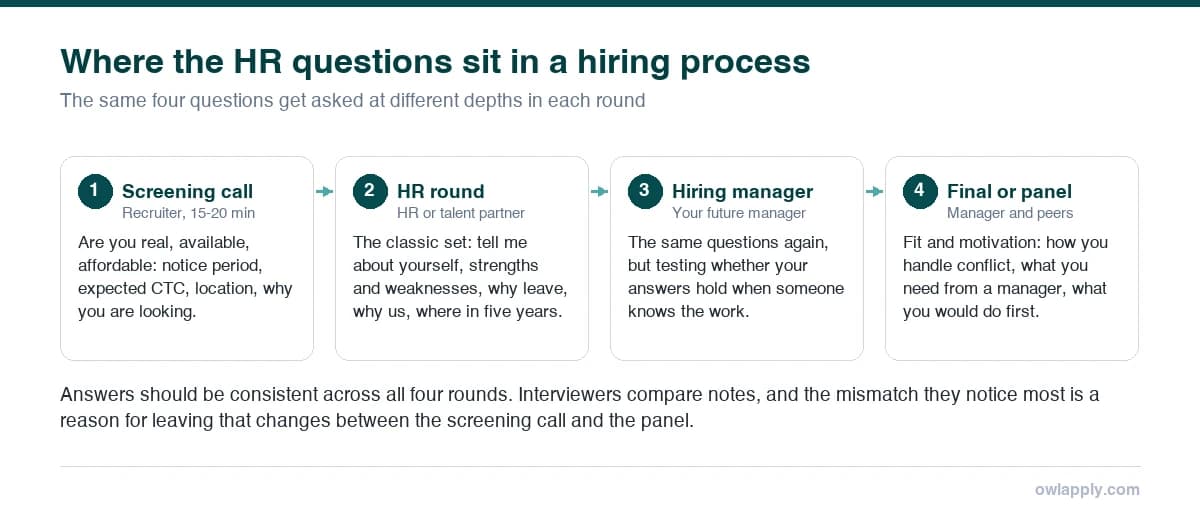
The HR round is the part of the hiring process run by human resources (HR) or a recruiter, where the company checks whether you fit the role, the team and the terms of the job, rather than whether you can do the technical work. In campus placements it usually comes after the aptitude test, group discussion and technical round; for experienced hires it can come first, as a screening call, or last, before the offer.
HR stands for human resources, so "HR round" simply means the human resources interview. It is often shorter than the technical round (15 to 30 minutes is common), but it is not a formality. Offers are lost here on salary mismatch, notice period, relocation, unexplained gaps and answers that contradict the résumé.
| What HR is checking | Questions that test it | What a good answer shows |
|---|---|---|
| Communication | Tell me about yourself; walk me through your résumé | You can explain your own background clearly in about a minute |
| Motivation and research | Why this company; what do you know about us; why this role | You read the job posting and the company's site and can connect them to you |
| Stability | Why are you leaving; where in five years; explain this gap | A forward-looking reason and a plan that includes this company |
| Self-awareness | Strengths and weaknesses; a failure; handling pressure | Specific examples, and what you changed afterwards |
| Terms and logistics | Current and expected CTC; notice period; relocation; shifts; bond | Accurate numbers, reasoned expectations, constraints stated once and early |
How to answer HR interview questions
Answer HR questions in two parts: a direct answer in the first sentence, then one specific example or fact that proves it. Keep most answers to 30 to 60 seconds, use numbers where you have them, stay consistent with your résumé, and never criticise a previous employer. For "tell me about a time" questions, use the STAR structure (situation, task, action, result).
- Answer first, explain second. "Yes, I am open to relocating to Hyderabad" before the reasons, not after.
- One example per claim. "I am good under pressure" means nothing; "I closed our quarter-end reconciliation in two days when we were two people short" proves it.
- Know your own numbers. CTC, notice period, joining dates, CGPA, gap dates. Guessing here looks careless, and HR will check.
- Be consistent. HR compares your answers with your résumé, your application form and what you told the technical panel.
- Be honest about constraints. If you cannot do night shifts or relocate, say so once, early, and politely. It is better than a withdrawn offer.
Why HR asks for examples: what our résumé data shows
The 20 most common HR interview questions with sample answers
These are the questions you are most likely to hear in an HR round, in roughly the order they tend to come. Each one has what HR is checking and a sample answer to adapt; where freshers and experienced candidates need different answers, both are given. Names, places and numbers are illustrative: put your own facts in.
1. Tell me about yourself
What HR is checking: whether you can summarise your background clearly in about a minute and connect it to this job.
Use present, past, future: what you do now (or your degree and best project), the one or two steps that got you here, and why this role is next. Keep it to 60 to 90 seconds. For the full method and 16 sample answers, see how to answer "tell me about yourself".
2. Why do you want to work for our company?
What HR is checking: whether you researched the company, or would say the same thing to anyone.
Name two specific things about the company (a product, a client base, a training programme, a recent expansion, the team you would join) and connect each to your own goals. "Reputed company" and "good work culture" are the answers HR hears most and believes least.
3. Why should we hire you?
What HR is checking: whether you understood the job and can back your fit with evidence.
Name the two or three things the job needs, prove you have done them with one example and a number, and finish with one thing you add that others might not. Keep it to about a minute. For the formula and 14 full examples, see how to answer "why should we hire you?".
4. What are your strengths?
What HR is checking: self-awareness, and whether your strengths are useful for this job.
Give two or three strengths that match the job posting, each with a short example. If you are asked for three strengths, pick one about how you work (organised, reliable), one about people (clear communicator, calm with customers) and one specific to the role (good with numbers, quick with new software).
5. What is your greatest weakness?
What HR is checking: honesty, and whether you work on your weaknesses.
Name a real weakness that is not central to the job, say what it cost you once, and explain what you now do about it. Avoid strengths in disguise ("I am a perfectionist", "I work too hard"); HR has heard them thousands of times and reads them as evasion.
6. Where do you see yourself in five years?
What HR is checking: ambition, realism, and whether you plan to stay.
Describe the skills and responsibility you want to have, in a direction this company can offer. Avoid naming a job title that is your interviewer's, saying you want to do an MBA or move abroad soon, or saying you do not know.
7. Why are you leaving your current job?
What HR is checking: whether you are running from a problem you will bring with you.
Give one forward-looking reason: more responsibility, a different kind of work, a domain you want to move into, a relocation. Never criticise your manager or company, even if it is true. If you were laid off, say so plainly in one sentence and move to what you want next.
8. Why did you choose this course or branch? (freshers)
What HR is checking: whether you make decisions deliberately, and whether your interest in this job is real.
Give a one-line honest reason, then connect it to the job. If you are moving away from your branch (mechanical engineer into IT, for example), say what changed and show something you did about it.
9. What do you know about our company?
What HR is checking: preparation. This question is almost always asked in campus placements.
Cover what the company does, who its customers are, one recent development and how the role you are applying for fits. Read the company's "About" page, its latest annual report or press release, and the job posting itself. Thirty seconds is enough.
10. How do you handle pressure or tight deadlines?
What HR is checking: whether you stay organised and calm, with proof.
11. Tell me about a time you failed
What HR is checking: honesty, ownership and learning.
Use STAR: a real failure, your part in it, what you did then, and what you do differently now. Choose something with a lesson, not a disaster. More examples are in our guide to behavioural interview questions with STAR answers.
12. Are you willing to relocate?
What HR is checking: whether placement in another city or office will be a problem after the offer.
Say yes or no clearly. If yes, say it without conditions you have not mentioned. If it depends, state the condition once ("Yes, within South India" or "Yes, after my sister's wedding in January"). Do not say yes in the interview and refuse the posting later; that is the most common way offers get withdrawn.
13. Are you comfortable with night or rotational shifts?
What HR is checking: availability. Common for support, BPO, operations and global IT roles.
14. What are your salary expectations?
What HR is checking: whether you know the market and whether your expectation fits the budget.
Freshers in campus placements usually have a fixed package, so say you are comfortable with it. Experienced candidates should give a range based on market data for the role and city and on your current pay, with a one-line reason. If you can, ask for the budgeted range first.
15. What is your current CTC, and why such a big hike?
What HR is checking: whether your expectation is reasonable, and whether your numbers are accurate.
In India, current CTC is usually asked and often verified against payslips or a background check, so state it exactly, including the fixed and variable parts. If your expected hike is large, justify it with the change in scope, a market rate for the role, or a counter-offer, not with personal needs.
16. What is your notice period? Can you join earlier?
What HR is checking: when you can start, and whether you will actually join.
Give the notice period exactly as it is in your appointment letter or company policy, and what is realistic. If you can negotiate an early release or a notice buyout, say so, but only if it is true. If you have already resigned, give your last working day.
17. Are you willing to sign a service agreement or bond?
What HR is checking: whether you will leave soon after the company has paid for your training.
Some employers, especially in Indian IT services and training-heavy roles, ask freshers to sign a service agreement that requires them to stay a set period or repay part of the training cost. Before you answer yes, ask for the terms: duration, amount, whether it reduces over time, and what triggers it. Then answer honestly.
18. Can you explain this gap in your education or career?
What HR is checking: whether the gap hides a problem, and whether you used the time.
One or two neutral sentences on why, one on what you did during it, and one on why you are ready now. Do not over-explain or apologise. A gap year for competitive exams, health, family or a layoff is common, and HR mostly wants to hear that it is behind you.
19. Do you have any other offers?
What HR is checking: how likely you are to join, and how fast they need to move.
20. Do you have any questions for us?
What HR is checking: interest, and whether you thought about the job.
Always ask one or two. Good questions for HR are about the role, the team, training and the next steps, not about leave policy in the first interview. See the list in the section on questions to ask HR below.
HR interview questions for freshers
Freshers get the same core questions as everyone else, plus questions about college, projects and attitude. The classic campus-placement questions below are asked because they have no obvious right answer: HR is listening for how you think, not for a perfect line.
| Question | What HR is listening for | Short sample answer |
|---|---|---|
| Tell me about your final-year project. | Can you explain your own work? | "We built an attendance system using face recognition. I wrote the backend in Python and the database. Four classrooms used it for two semesters." |
| What is the difference between hard work and smart work? | Practical judgement | "Hard work is putting in the hours; smart work is choosing what to spend them on. In my project, automating our test data saved us a week of manual entry. You need both." |
| What is the difference between confidence and overconfidence? | Self-awareness | "Confidence is knowing what I can do and saying so. Overconfidence is skipping the check because I assume I am right. I try to be confident and still check." |
| Why should we hire a fresher with no experience? | Do you know what the job involves? | "I can already do two things in your posting, SQL and Excel reporting, and I learn quickly: I picked up Power BI in two weeks for my project." |
| What if you are placed in a technology or domain you did not want? | Flexibility | "I would take it and do it well. Every domain teaches something, and after a year I would ask about internal movement if it still made sense." |
| How long would you stay with us? | Stability | "As long as I am learning and contributing. I am looking for a company to grow with, not a first stop." |
| What are your hobbies? | Nothing deep; a sense of who you are | "I play cricket for my college team and I run its social media page, which grew to 3,000 followers." |
| Rate yourself out of 10 in [skill]. | Honesty | "About a 6 in Java. I am comfortable with core Java and collections, and I am still learning multithreading." |
If your résumé is your first one, the résumé format for freshers guide shows how to present projects and internships so that HR asks you about the right things.
HR interview questions for experienced candidates
With experience, HR spends less time on motivation and more on your career story, compensation, notice period and whether your past moves make sense.
- Walk me through your career. In date order, one or two lines per role, with the reason for each move, ending with why this role. Under two minutes.
- What has been your biggest achievement in your current role? One result with a number and what you personally did. Not what the team did.
- Why have you changed jobs so often? Give the reason for each move briefly and show a pattern (each move added something), then say why you plan to stay here.
- Why have you not been promoted? Give a structural reason (a flat team, a hiring freeze) and evidence of performance, such as ratings or expanded scope. Never a complaint.
- How would your manager describe you? Two adjectives, each with a short story. HR may well call that manager.
- How many people have you managed? The exact number, direct or indirect, and one thing about how you run a team.
- When was your last hike, and how much? Exact month and percentage. HR will see your payslips.
- Have you ever been asked to leave a job? If yes, one honest sentence and what you learned; HR usually finds out in the background check anyway.
These questions overlap with the hiring manager's. For the "tell me about a time" questions that often follow, use the STAR method.
Salary, notice period, relocation and bond: how these questions work in India
Indian HR rounds spend more time on terms of employment than most US interviews, and the vocabulary is different. Knowing the terms and having your numbers ready avoids the most common reasons for an offer to stall.
| Term | What it means | How to handle it |
|---|---|---|
| CTC (cost to company) | Your total annual cost to the employer: fixed pay, variable pay and benefits such as employer PF contributions and gratuity | Know your fixed, variable and in-hand monthly figures separately. Quote CTC when asked for CTC, and ask for the fixed component of any offer |
| Expected CTC | What you want in the new role | A range with a reason (scope, market rate for the role and city), not a percentage you need for personal reasons |
| Notice period | How long you must work after resigning, as set by your appointment letter or company policy | State it exactly. Mention early release or buyout only if you have checked it is possible |
| Notice buyout | Paying (or the new employer paying) your current employer for the unserved notice days | Ask the new employer whether they reimburse it before you commit |
| Relieving letter | Confirmation from your previous employer that you left properly | Many employers ask for it at joining. Leave on good terms and serve your notice to get it |
| Service agreement or bond | A commitment to stay for a period, often with a repayment if you leave early | Ask for the duration, amount and whether it reduces over time before agreeing |
| Background verification | Checks of your education, previous employment, CTC and sometimes references | Make sure every date and number you give matches your documents |
Salary structures may also look different from a few years ago. India's four labour codes came into effect on 21 November 2025 (Press Information Bureau), and the Code on Wages uses a single definition of wages for statutory calculations: allowances above 50% of total pay are counted back as wages (Ministry of Labour compliance handbook, 2026). Many employers have restructured CTC as a result, which can change PF contributions and take-home pay. When you compare an offer with your current salary, compare the fixed pay and the monthly in-hand amount, not just the CTC figure.
Salary questions in US HR interviews
In the US, the HR or recruiter screen usually covers salary expectations, work authorisation, start date and location or remote preferences. Two things are different from India. First, many states require a pay range in job postings: New York, for example, requires employers with four or more employees to include a range of pay in advertised jobs (New York State Department of Labor), so check the posting before you name a number. Second, some states and cities restrict questions about your salary history; Colorado's Equal Pay for Equal Work Act, for example, says employers may not seek a prospective employee's wage history (Colorado Department of Labor and Employment). Where that applies, answer with your expected range instead of your current pay.
What are the 5 hardest HR interview questions?
The five HR questions candidates find hardest are "What is your greatest weakness?", "Why are you leaving your current job?", "What are your salary expectations?", "Explain this gap in your résumé" and "Why should we hire you?". They are hard because there is an obvious wrong answer and no obvious right one. Each has a short answer pattern:
| Question | Answer pattern | Sample above |
|---|---|---|
| What is your greatest weakness? | Real weakness, the cost, what you do about it now | Question 5 |
| Why are you leaving? | One forward reason, no criticism | Question 7 |
| What are your salary expectations? | A researched range with a reason, or the fixed package | Question 14 |
| Explain this gap | Why, what you did, why you are ready now | Question 18 |
| Why should we hire you? | Their need, your proof, your edge | Question 3 |
30 more HR interview questions to prepare
Prepare a two-sentence answer with one example for each of these. Together with the 20 above, they cover nearly everything an HR round asks.
HR questions 21 to 50
- What motivates you?
- Do you prefer working alone or in a team?
- How do you prioritise when everything is urgent?
- How do you handle criticism of your work?
- Tell me about a conflict with a colleague and how you resolved it.
- What did you like most about your last job (or internship)?
- What did you like least?
- Describe your ideal work environment.
- How do you define success?
- What are your short-term and long-term goals?
- Tell me about a time you showed leadership.
- Tell me about a time you went beyond your role.
- How do you keep your skills up to date?
- What would you do in your first 30 days here?
- How would your friends or classmates describe you?
- What makes you angry, and how do you deal with it?
- Would you lie for the company?
- Are you comfortable with travel?
- Are you comfortable with our working hours or hybrid policy?
- Are you planning higher studies in the next few years?
- What would you do if you got a better offer after joining?
- How do you handle repetitive work?
- What do you know about our competitors?
- Who has inspired you, and why?
- What was the toughest decision you have made?
- Would you be comfortable reporting to someone younger than you?
- Are you overqualified for this role?
- Can we contact your current employer for a reference?
- Rate me as an interviewer.
- When can you start?
Questions to ask HR at the end of the interview
Ask one or two questions that show you are thinking about doing the job well. In an HR round, questions about the process, training and team are safe and useful. Save detailed leave, perks and work-from-home questions for after the offer, unless they are deal-breakers.
- What does the first month look like for someone in this role?
- How is training organised for new joiners, and how long does it last?
- How is performance reviewed in the first year?
- Which team would I join, and who would I report to?
- How are freshers allocated to projects or locations?
- What are the next steps in the process, and when should I expect to hear back?
- Is there anything in my background you would like me to clarify?
For a longer list, including questions for hiring managers and panels, see questions to ask the interviewer.
How to pass an HR interview
To pass an HR interview, prepare short answers with examples for the 20 common questions, research the company, know your exact numbers (CTC, notice period, dates), stay consistent with your résumé, state any constraints honestly, and ask one or two good questions at the end. Most candidates who fail the HR round do so on preparation and consistency, not on personality.
Do this
- Research the company and the role before the interview
- Answer in the first sentence, then give one example
- Know your CTC, notice period and dates exactly
- Give a forward-looking reason for leaving
- State constraints (location, shifts, bond) once and early
- Ask one or two questions about the role or training
Avoid this
- Don't criticise your current or previous employer
- Don't give a weakness that is a strength in disguise
- Don't guess numbers HR will verify later
- Don't say yes to relocation or a bond you will refuse later
- Don't recite memorised answers word for word
- Don't ask about leave and perks before anything else
For what tends to go wrong in later rounds, see the interview mistakes that cost offers.
HR round vs technical round vs managerial round
| Round | Who runs it | What it tests | Typical questions |
|---|---|---|---|
| Technical | Engineers, specialists | Whether you can do the work | Coding, domain knowledge, case problems, your project in depth |
| Managerial or hiring manager | Your future manager | How you work, judgement, team fit | Scenarios, past decisions, how you handle conflict or priorities |
| HR | HR or a recruiter | Fit, motivation, terms of employment | Tell me about yourself, why us, strengths, salary, notice period, relocation |
Practise HR questions out loud
Reading sample answers helps you decide what to say. Saying them out loud is what shows you whether an answer takes 40 seconds or three minutes, and whether you can still give it when someone interrupts with a follow-up.
The OwlApply AI mock interview has an HR interview type among its four (HR, behavioural, technical and hiring manager), in 42 languages. You can add your résumé and the job posting so the questions refer to your background. The interviewer asks follow-ups the way a real one would and does not coach you during the session; afterwards you get a report from the full transcript, with each answer scored and a suggested stronger version. If you have never done an interview on OwlApply, your first three-minute session costs nothing. Ten-minute sessions are part of the Pro plan: you can try Pro for 7 days for $2.95, which includes two sessions, then $17.49 a month unless you cancel.
Practise your HR round before the real one
Choose the HR interview type, add the job posting, and answer out loud. Your scored report shows a stronger version of each answer. Your first three-minute session is free.
Start a practice HR interview