Sterile processing technician resume examples: 12 one-page samples from Tech I to CRCST, lead, supervisor and manager, matched to 465 US employers' postings.
This page has 12 one-page sterile processing technician resume examples: Sterile Processing Technician I, sterilization and dental sterilization technicians starting out, sterile processing technicians, Tech II, certified technicians and coordinators with a few years in the SPD, and Tech III, educator, lead, supervisor and manager resumes at the top. Each one is matched to 2,293 US sterile processing postings from 465 employers, and the note under each sample explains why its certificates, tray volumes and accuracy results come first. If you work in the OR itself, see the surgical technologist resume examples.
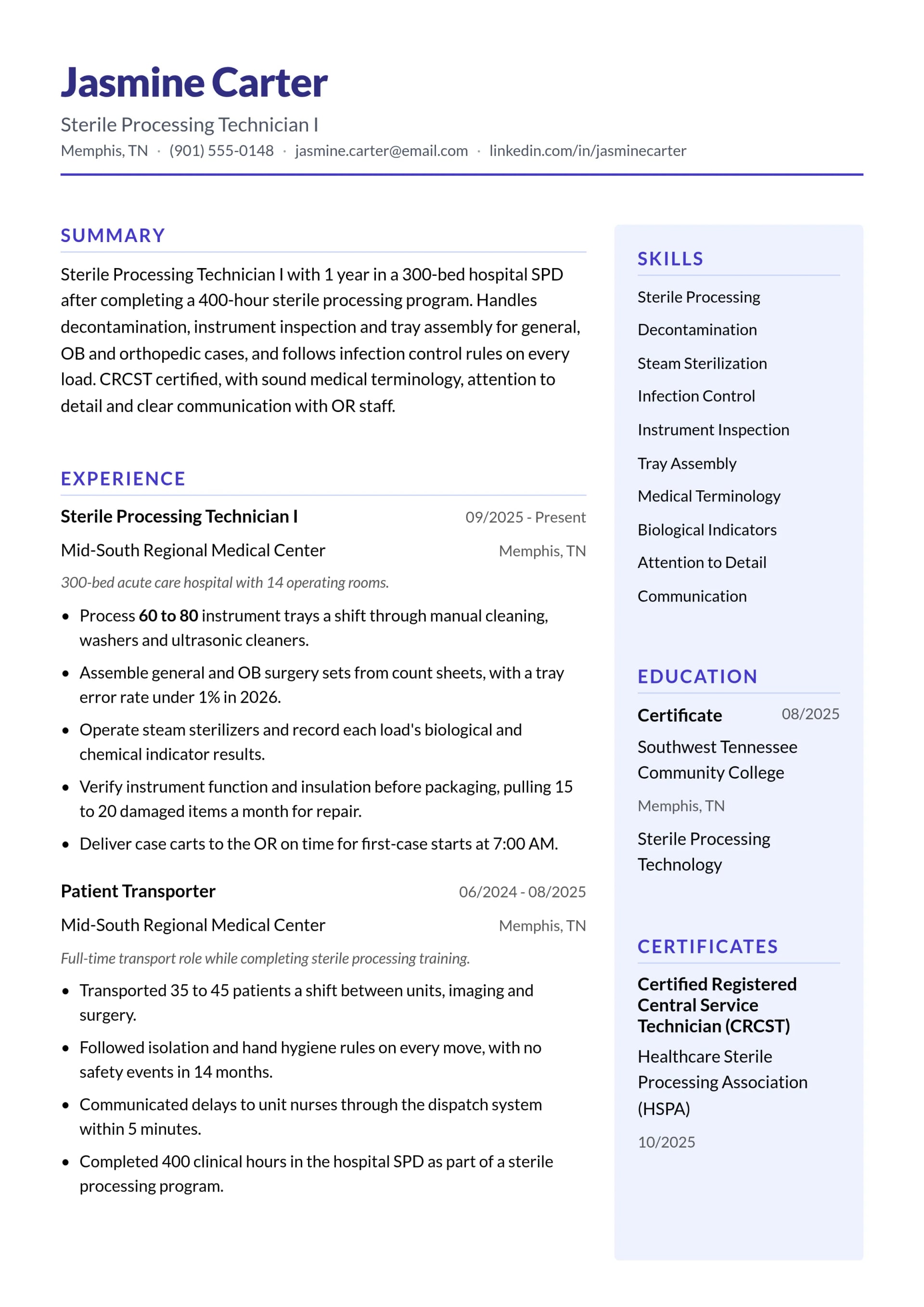
Sterile processing postings most often ask for CRCST or CSPDT certification and hands-on cleaning, inspection, decontamination and sterilization of surgical instruments, so the CRCST sits in certificates and every bullet shows that work with volumes such as 60 to 80 trays a shift. One year in the SPD and a completed sterile processing certificate fit the entry level and the 1 year employers usually ask for.
Why this resume works:
Process 60 to 80 instrument trays a shift through manual cleaning, washers and ultrasonic cleaners.
Assemble general and OB surgery sets from count sheets, with a tray error rate under 1% in 2026.
Operate steam sterilizers and record each load's biological and chemical indicator results.
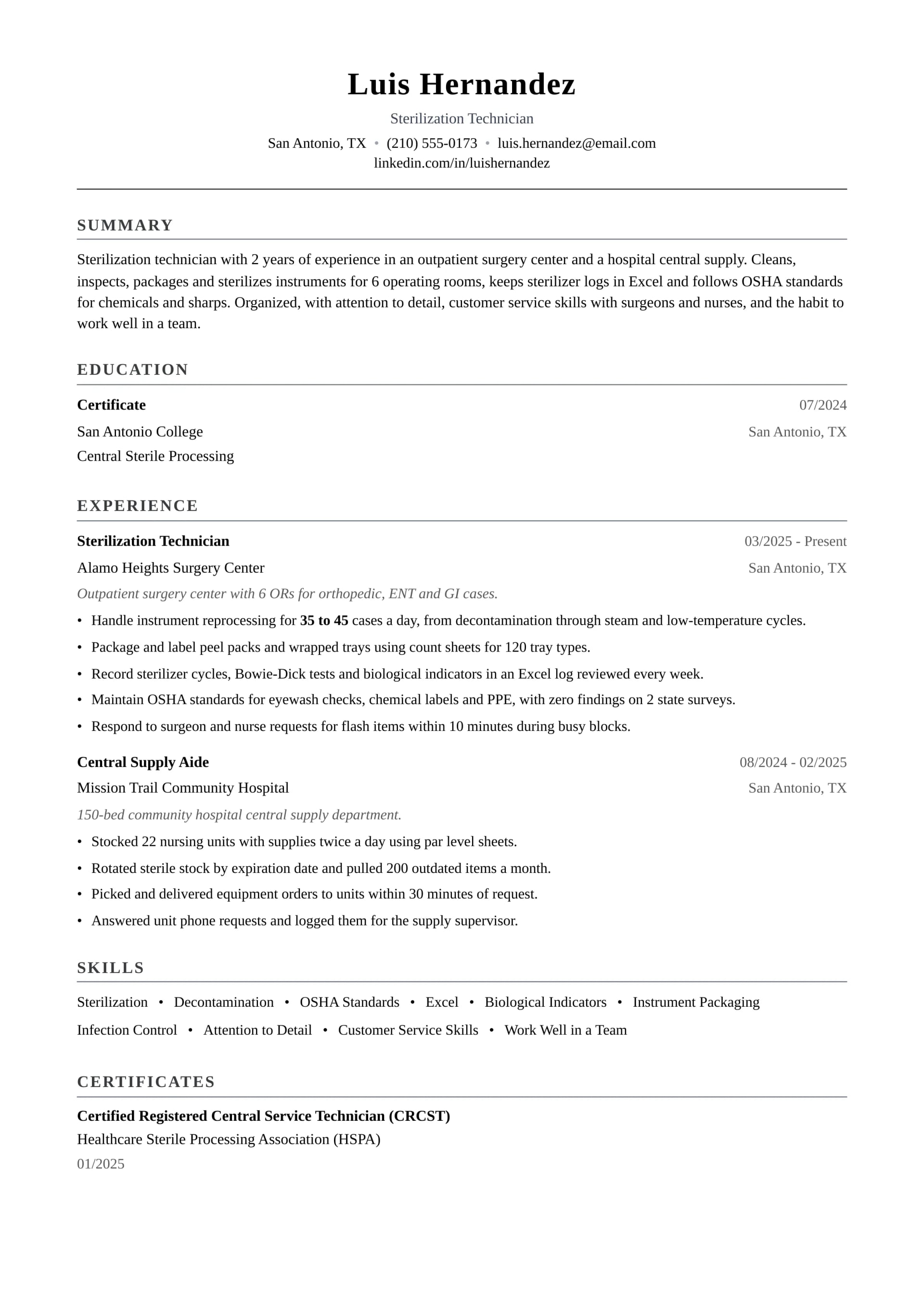
Sterilization technician postings ask for attention to detail, communication, organization, Excel, customer service skills and OSHA standards, and each one appears in a bullet, such as an Excel sterilizer log and zero findings on 2 state surveys. The CRCST certificate employers require and 2 years of instrument work fit the entry level and the 1 year usually asked.
Why this resume works:
Handle instrument reprocessing for 35 to 45 cases a day, from decontamination through steam and low-temperature cycles.
Package and label peel packs and wrapped trays using count sheets for 120 tray types.
Record sterilizer cycles, Bowie-Dick tests and biological indicators in an Excel log reviewed every week.
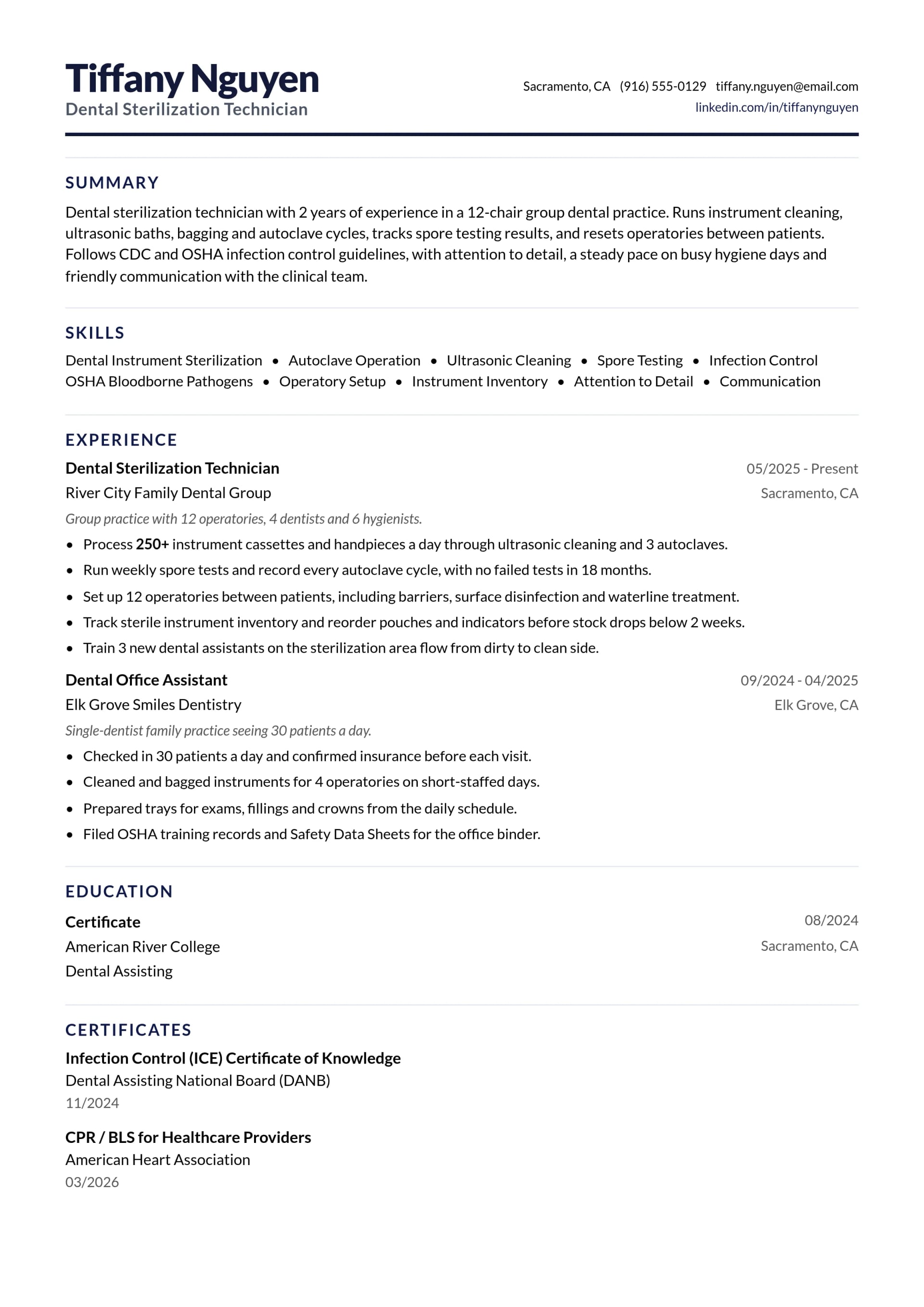
Dental sterilization roles center on cleaning, bagging and autoclaving instruments under CDC and OSHA infection control rules, and every bullet shows that work with numbers such as 250+ cassettes a day and no failed spore tests in 18 months. The DANB infection control credential and BLS card sit in certificates, which is where dental offices check first.
Why this resume works:
Process 250+ instrument cassettes and handpieces a day through ultrasonic cleaning and 3 autoclaves.
Run weekly spore tests and record every autoclave cycle, with no failed tests in 18 months.
Set up 12 operatories between patients, including barriers, surface disinfection and waterline treatment.
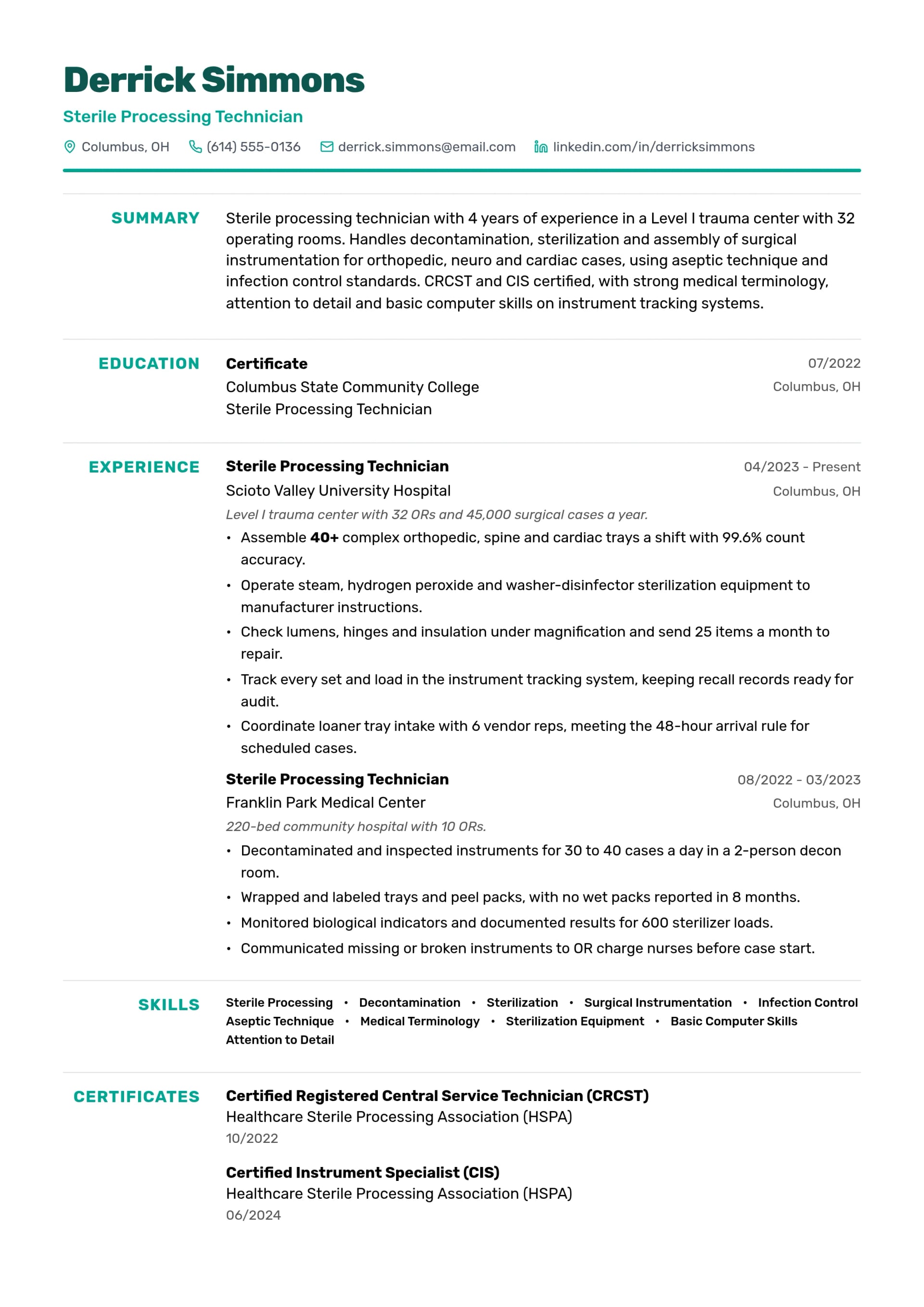
Sterile processing technician postings name attention to detail, sterile processing, decontamination, sterilization, infection control and surgical instrumentation, and the resume uses each with trauma-center volumes such as 40+ complex trays a shift at 99.6% count accuracy. The CRCST that employers require and 4 years of SPD work clear the 2-year bar many postings set.
Why this resume works:
Assemble 40+ complex orthopedic, spine and cardiac trays a shift with 99.6% count accuracy.
Operate steam, hydrogen peroxide and washer-disinfector sterilization equipment to manufacturer instructions.
Check lumens, hinges and insulation under magnification and send 25 items a month to repair.
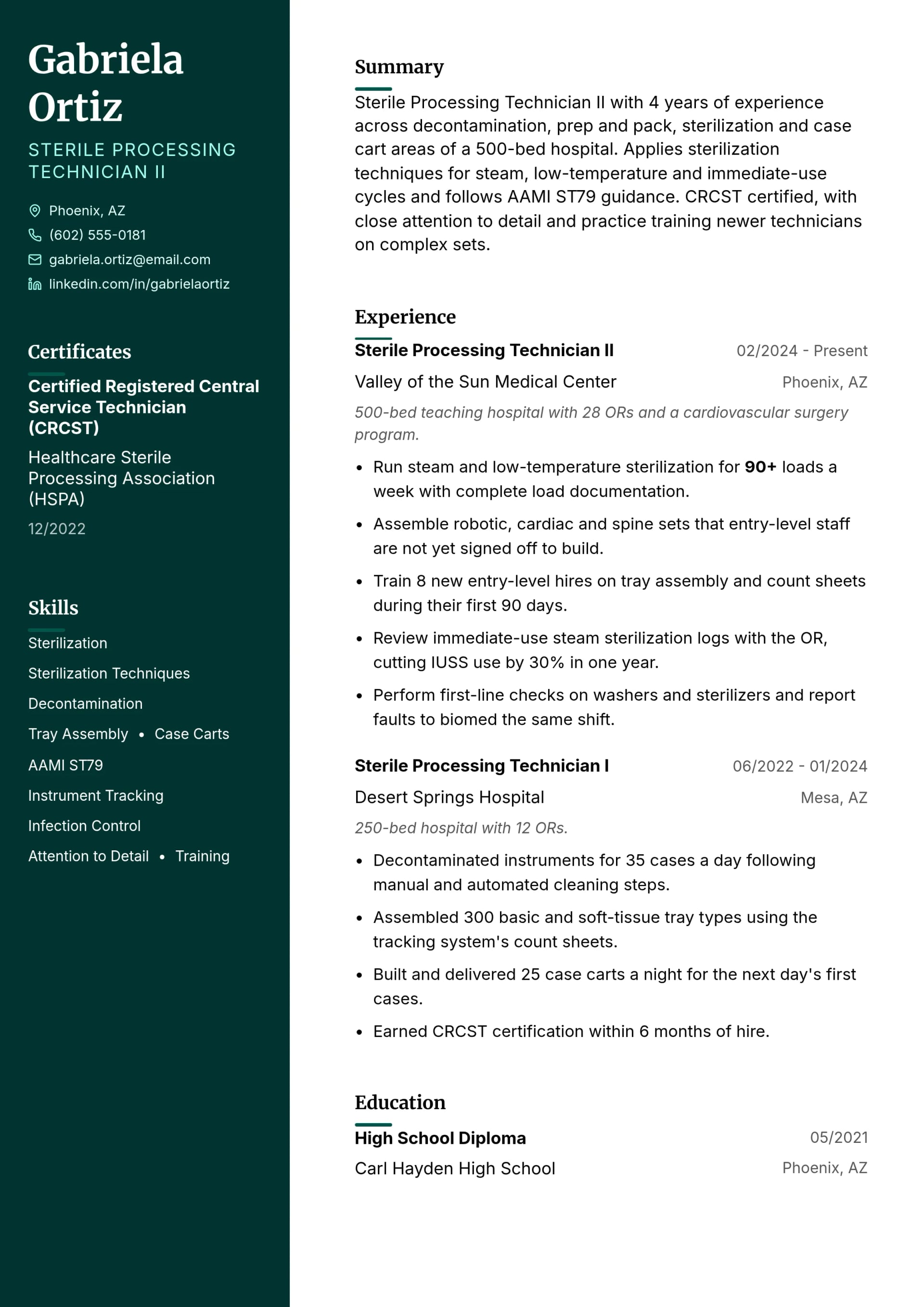
Tech II postings ask for attention to detail, sterilization and sterilization techniques, and the resume shows those skills at a step above entry level, such as 90+ weekly loads and building robotic and cardiac sets. The high school diploma that half of employers require is listed, and the CRCST and 4 years across every SPD area support the move up to Tech II.
Why this resume works:
Run steam and low-temperature sterilization for 90+ loads a week with complete load documentation.
Assemble robotic, cardiac and spine sets that entry-level staff are not yet signed off to build.
Train 8 new entry-level hires on tray assembly and count sheets during their first 90 days.
Certified Sterile Processing Technician Resume Example
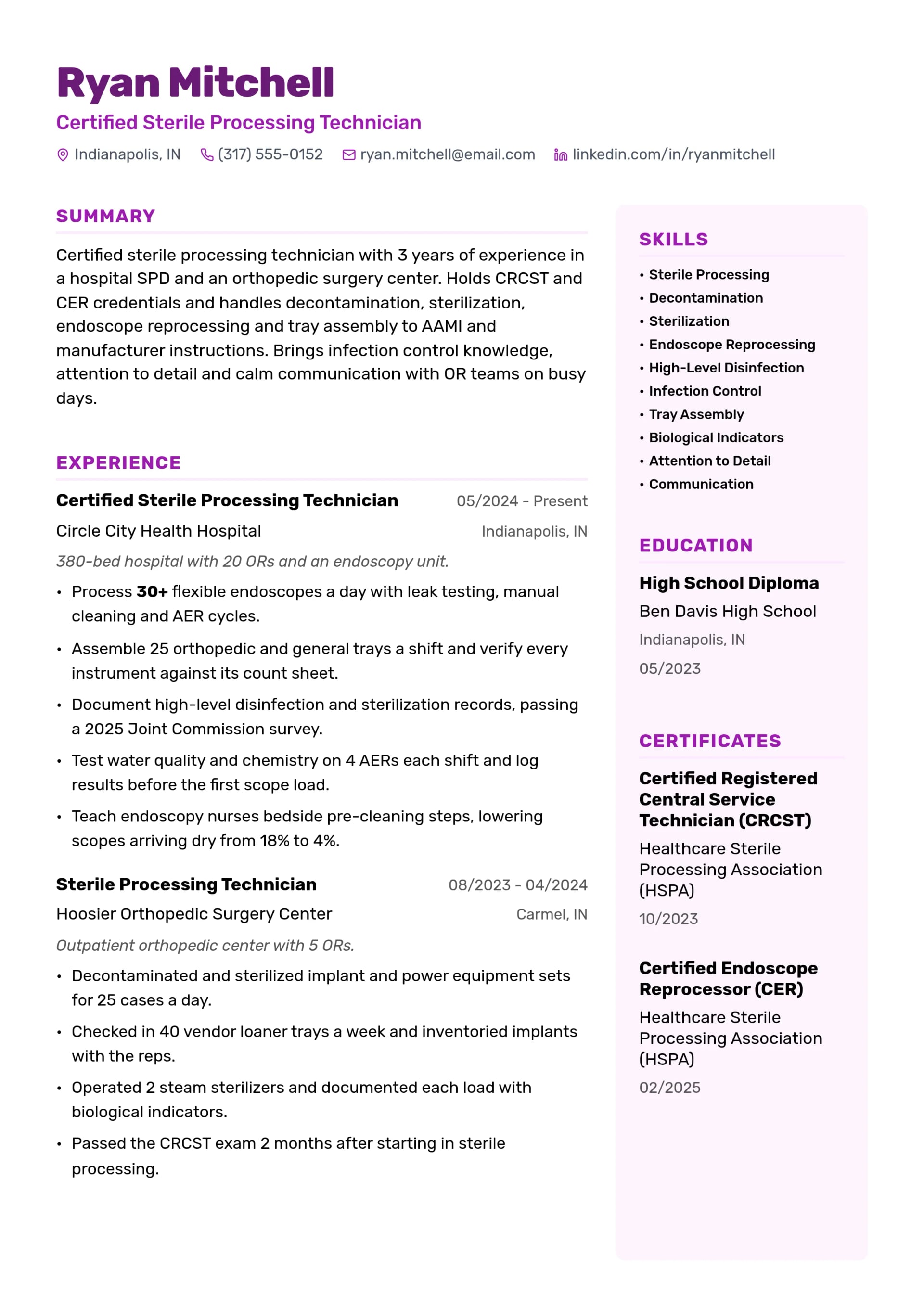
Certified technician postings require a current CRCST or CSPDT, so both HSPA credentials lead the certificates section, and the bullets cover the cleaning, decontamination, sterilization and documentation duties employers list most. Results such as 30+ scopes a day and a clean 2025 Joint Commission survey show 3 years of real SPD work behind the credential.
Why this resume works:
Process 30+ flexible endoscopes a day with leak testing, manual cleaning and AER cycles.
Assemble 25 orthopedic and general trays a shift and verify every instrument against its count sheet.
Document high-level disinfection and sterilization records, passing a 2025 Joint Commission survey.
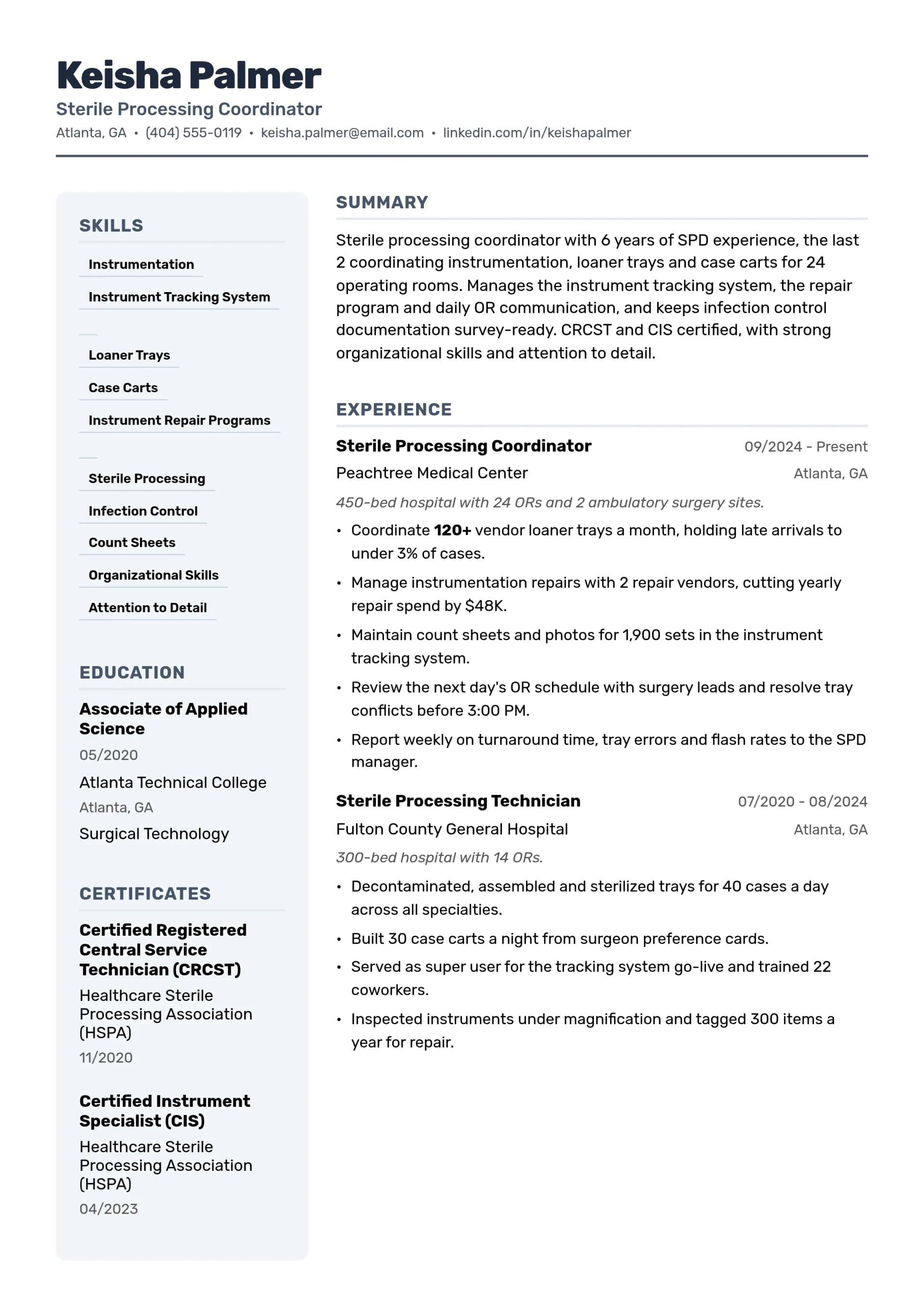
Coordinator postings ask for instrumentation knowledge, and this resume leads with it: 120+ loaner trays a month, 1,900 sets in the tracking system and $48K less repair spend. Six years in SPD with CRCST and CIS credentials go past the 2 years employers usually ask for and show the organizational skills the role needs.
Why this resume works:
Coordinate 120+ vendor loaner trays a month, holding late arrivals to under 3% of cases.
Manage instrumentation repairs with 2 repair vendors, cutting yearly repair spend by $48K.
Maintain count sheets and photos for 1,900 sets in the instrument tracking system.
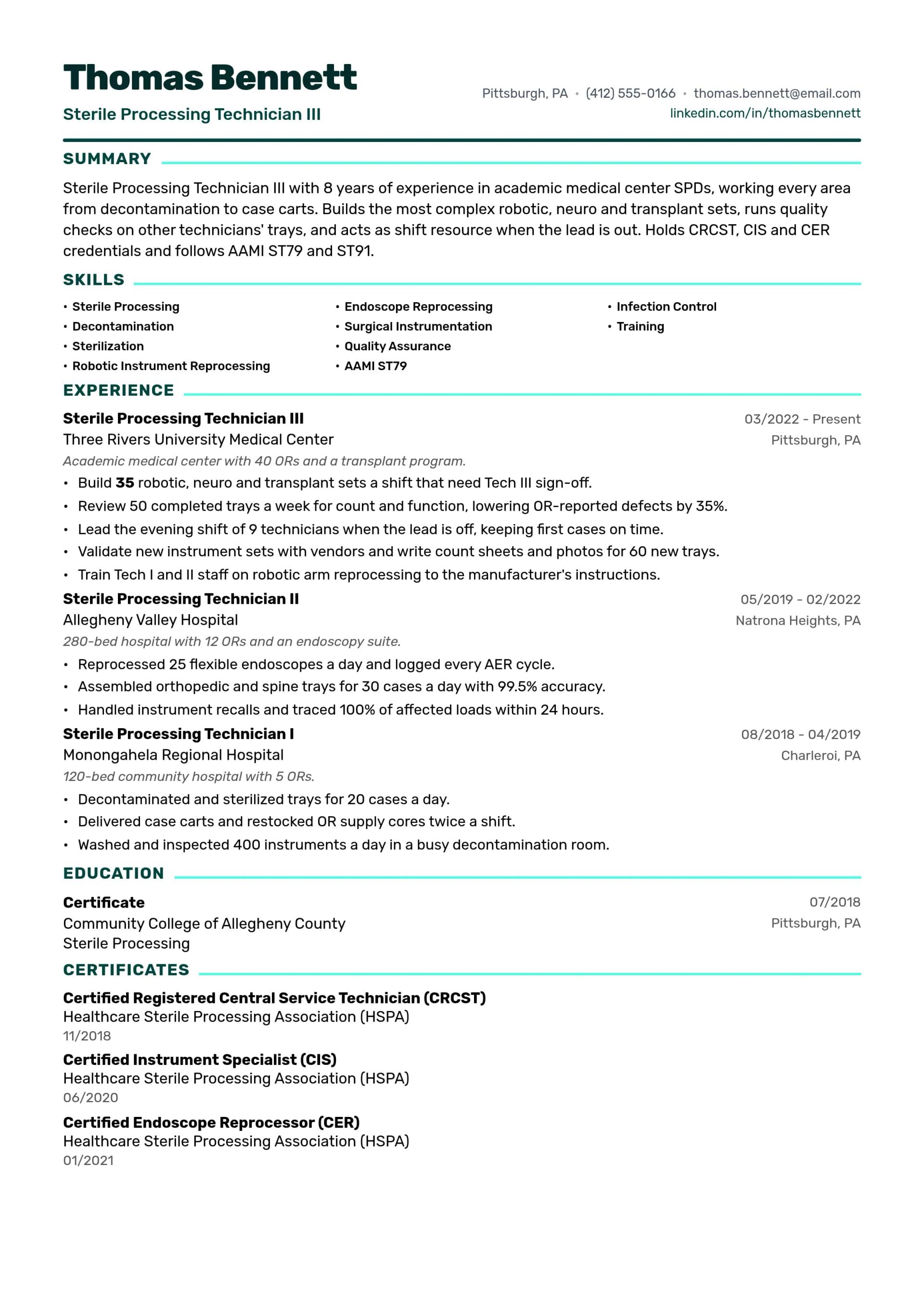
Tech III postings ask for about 3 years of sterile processing and the skill to handle the hardest sets, and this resume shows 8 years with robotic, neuro and transplant trays and a 35% drop in OR-reported defects. The CRCST, CIS and CER credentials sit in certificates, which covers the certification most employers require plus the specialties senior technicians are trusted with.
Why this resume works:
Build 35 robotic, neuro and transplant sets a shift that need Tech III sign-off.
Review 50 completed trays a week for count and function, lowering OR-reported defects by 35%.
Lead the evening shift of 9 technicians when the lead is off, keeping first cases on time.
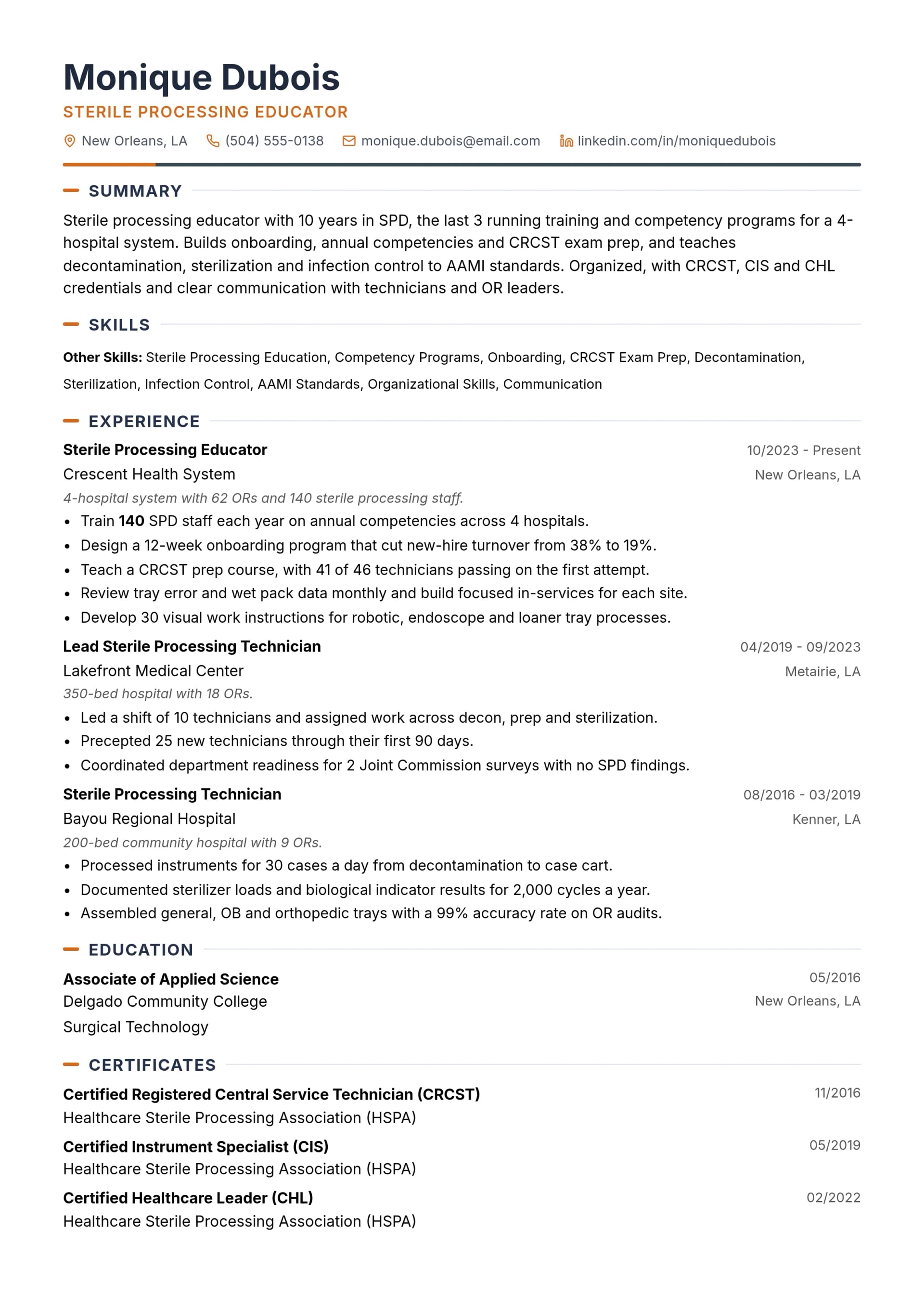
Educator postings look for organized trainers with about 3 years of sterile processing behind them, and this resume shows 10 years in SPD plus training results such as 41 of 46 first-attempt CRCST passes. Onboarding, competencies and in-services built from tray error data show the teaching work employers hire an SPD educator to do.
Why this resume works:
Train 140 SPD staff each year on annual competencies across 4 hospitals.
Design a 12-week onboarding program that cut new-hire turnover from 38% to 19%.
Teach a CRCST prep course, with 41 of 46 technicians passing on the first attempt.
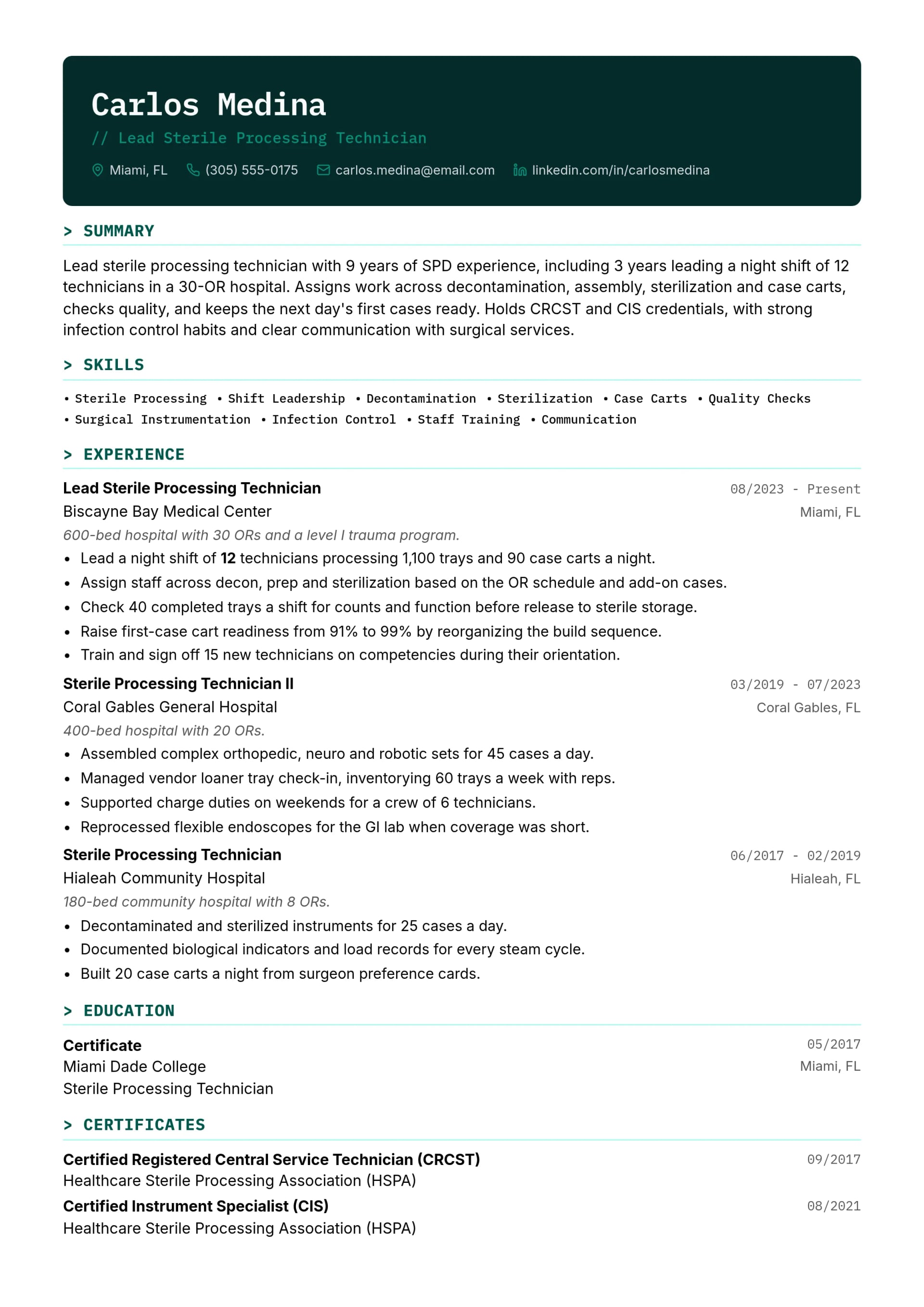
Lead technician postings want an experienced, certified technician who can run a shift, so the resume opens with leading 12 technicians through 1,100 trays a night and a rise in first-case readiness from 91% to 99%. The CRCST employers require and the CIS show the instrument depth that lets a lead check other technicians' work.
Why this resume works:
Lead a night shift of 12 technicians processing 1,100 trays and 90 case carts a night.
Assign staff across decon, prep and sterilization based on the OR schedule and add-on cases.
Check 40 completed trays a shift for counts and function before release to sterile storage.
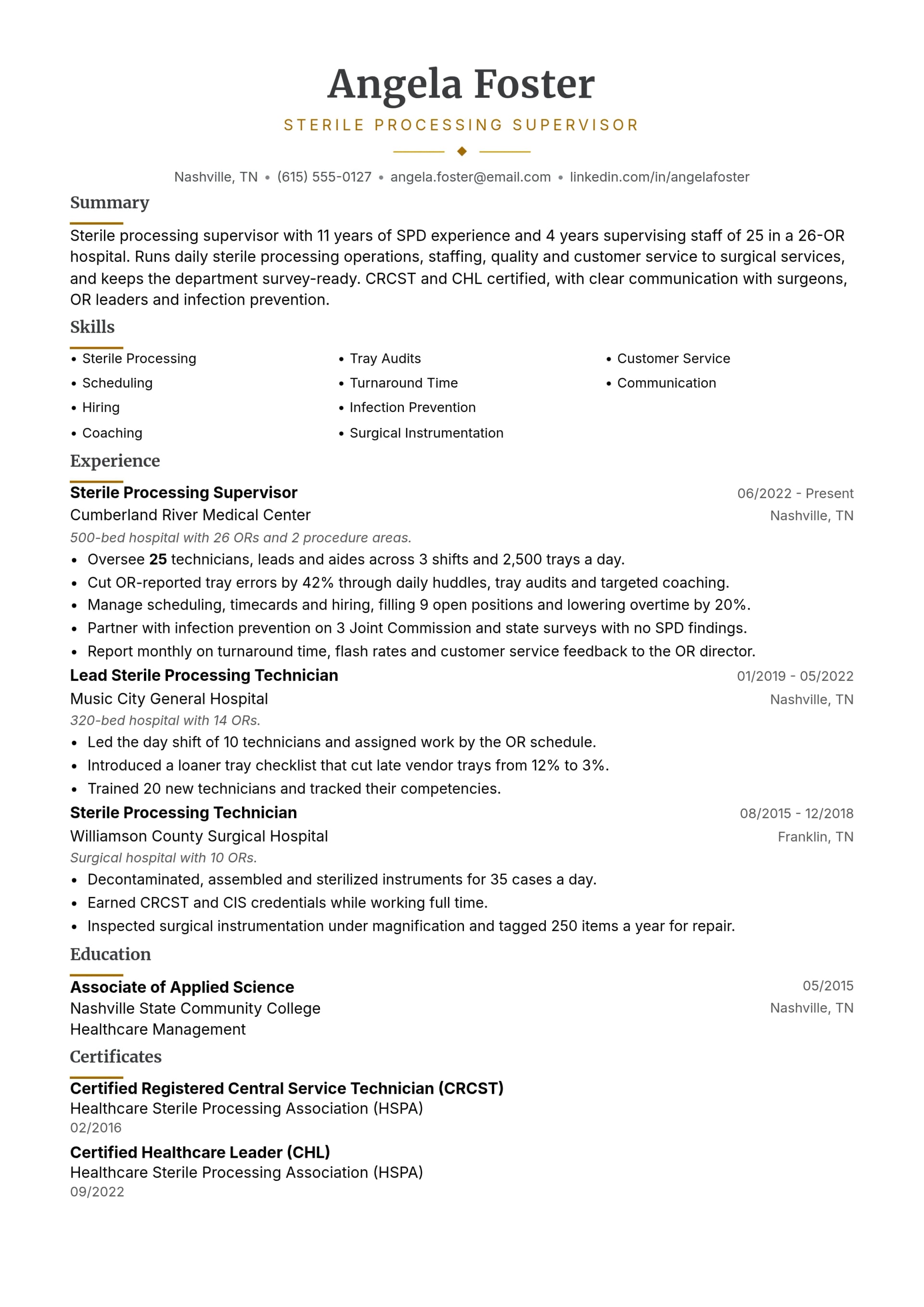
Supervisor postings name sterile processing, customer service and communication, and the resume backs each with management results such as 42% fewer tray errors and monthly customer service reporting to the OR director. Eleven years in SPD, 4 of them supervising, plus CRCST and CHL credentials match the 3 years and certification employers usually ask for.
Why this resume works:
Oversee 25 technicians, leads and aides across 3 shifts and 2,500 trays a day.
Cut OR-reported tray errors by 42% through daily huddles, tray audits and targeted coaching.
Manage scheduling, timecards and hiring, filling 9 open positions and lowering overtime by 20%.
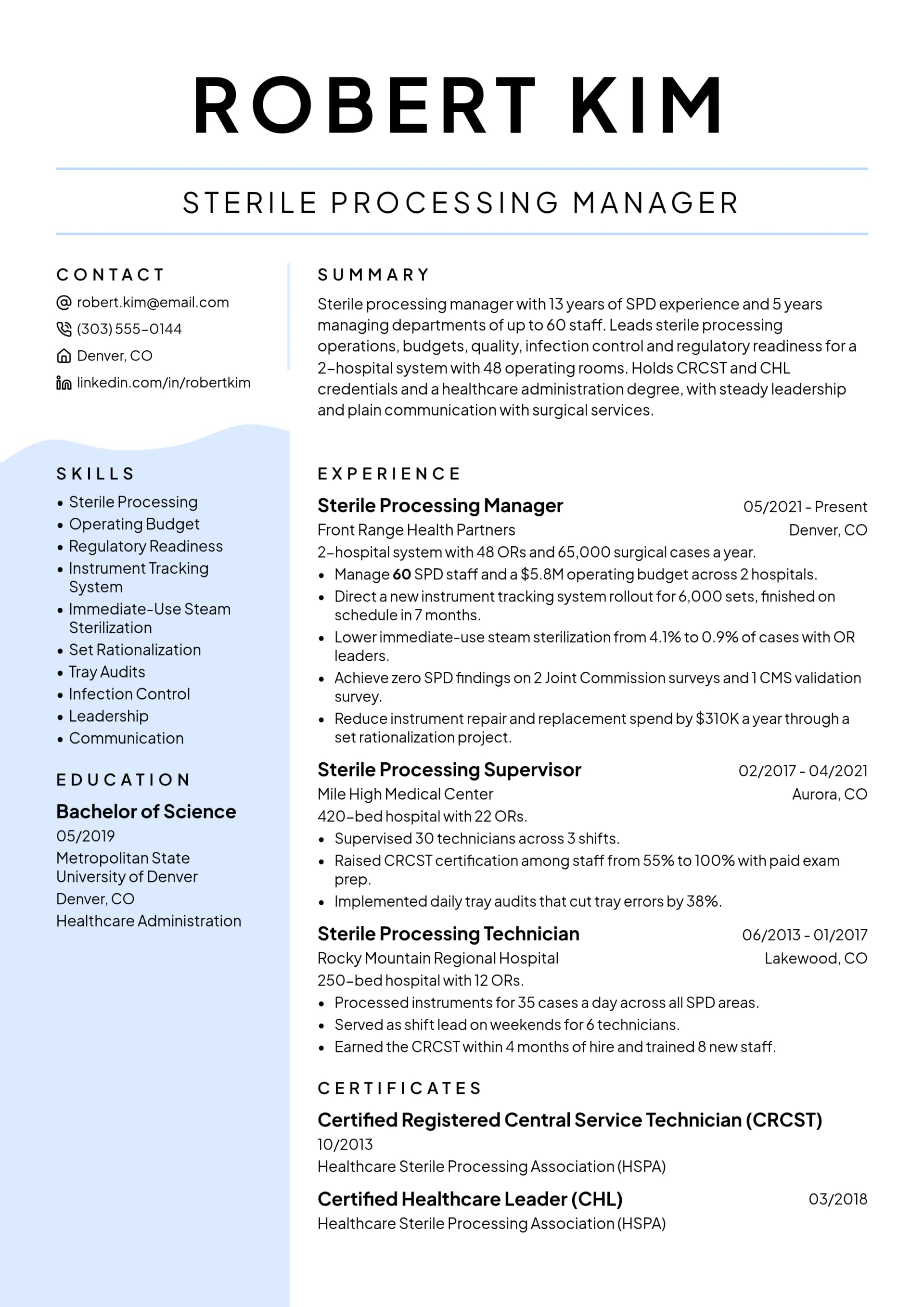
Sterile processing manager postings ask for deep sterile processing experience and certification, and this resume shows 13 years in SPD, CRCST and CHL credentials and results such as zero findings on 3 regulatory surveys. Budget, staffing and the tracking system rollout show the department management work a manager is hired for.
Why this resume works:
Manage 60 SPD staff and a $5.8M operating budget across 2 hospitals.
Direct a new instrument tracking system rollout for 6,000 sets, finished on schedule in 7 months.
Lower immediate-use steam sterilization from 4.1% to 0.9% of cases with OR leaders.
What employers ask for in sterile processing technician job postings
Sterile Processing Technician job postings in the US, October 2026
2,293
active US job postings
465
employers hiring
1 yr
median experience asked
53%
ask for 1 year or less
Technical skills and tools employers name
979 US postings that list skills. Also asked in most careers, so they rarely set a resume apart: communication, attention to detail, organizational skills, customer service.
Skill
Share of postings
sterile processing
11%
decontamination
9%
sterilization
9%
surgical instrumentation
6%
infection control
7%
medical terminology
5%
Make sure your resume shows
High school diploma or equivalent (52% of employers)
At least 2 years as a sterile processing technician (27% of employers)
Verbal and written communication skills (17% of employers)
CRCST or CSPDT certification (18% of employers)
Knowledge of infection control and sterilization techniques (13% of employers)
Attention to detail and organizational skills (10% of employers)
Basic computer skills (8% of employers)
Medical terminology and surgical instrumentation (6% of employers)
Duties to build your bullet points around
What employers write most often under responsibilities. Show each one with a result (numbers, scale, outcome), not a copy of the duty.
Clean, inspect, decontaminate and sterilize surgical instruments and equipment (37%)
Inspect equipment and keep accurate sterilization records (20%)
Follow infection control protocols and safety standards (10%)
Assemble instrument trays and sets for specific procedures (8%)
Package, wrap and label instruments for sterilization (7%)
Keep the work area clean and organized (6%)
The examples on this page, in job postings
Active US postings that use exactly this job title.
Example
US postings
Median years asked
Sterile Processing Technician I
21
1
Sterilization Technician
69
1
Dental Sterilization Technician
19
–
Sterile Processing Technician
426
1
Sterile Processing Technician II
82
1
Certified Sterile Processing Technician
90
1
Sterile Processing Coordinator
12
2.5
Sterile Processing Technician III
11
3
Sterile Processing Educator
10
3
Lead Sterile Processing Technician
6
1.25
Sterile Processing Supervisor
39
3
Sterile Processing Manager
18
2
Which job title to put on your resume: the titles employers use most, so recruiters and applicant tracking systems search for them: Sterile Processing Technician (158 employers), Sterile Processing Tech (78 employers), Sterilization Technician (35 employers), Certified Sterile Processing Technician (32 employers), Sterile Processing Supervisor (31 employers).
Source: Owlapply analysis of active US job postings, October 2026. Requirements and duties are grouped by meaning from the postings' own bullet lists and counted once per employer.
Check your sterile processing technician resume against a real job posting
Paste a sterile processing technician job posting into the job match score tool to see which of its skills your resume is missing.
Upload your resume to the ATS resume checker to read the text an applicant tracking system gets from it.
Sterile Processing Technician resume sample (text you can copy)
This is the text of the Sterile Processing Technician example above. Paste it into the resume builder and replace the details with your own.
Sterile Processing Technician resume sample
DERRICK SIMMONS
Sterile Processing Technician
Columbus, OH · (614) 555-0136 · [email protected] · linkedin.com/in/derricksimmons
SUMMARY
Sterile processing technician with 4 years of experience in a Level I trauma center with 32 operating rooms. Handles decontamination, sterilization and assembly of surgical instrumentation for orthopedic, neuro and cardiac cases, using aseptic technique and infection control standards. CRCST and CIS certified, with strong medical terminology, attention to detail and basic computer skills on instrument tracking systems.
EXPERIENCE
Sterile Processing Technician, Scioto Valley University Hospital, Columbus, OH | 04/2023 - Present
- Assemble 40+ complex orthopedic, spine and cardiac trays a shift with 99.6% count accuracy.
- Operate steam, hydrogen peroxide and washer-disinfector sterilization equipment to manufacturer instructions.
- Check lumens, hinges and insulation under magnification and send 25 items a month to repair.
- Track every set and load in the instrument tracking system, keeping recall records ready for audit.
- Coordinate loaner tray intake with 6 vendor reps, meeting the 48-hour arrival rule for scheduled cases.
Sterile Processing Technician, Franklin Park Medical Center, Columbus, OH | 08/2022 - 03/2023
- Decontaminated and inspected instruments for 30 to 40 cases a day in a 2-person decon room.
- Wrapped and labeled trays and peel packs, with no wet packs reported in 8 months.
- Monitored biological indicators and documented results for 600 sterilizer loads.
- Communicated missing or broken instruments to OR charge nurses before case start.
EDUCATION
Certificate, Sterile Processing Technician, Columbus State Community College, Columbus, OH | 07/2022
SKILLS
Sterile Processing, Decontamination, Sterilization, Surgical Instrumentation, Infection Control, Aseptic Technique, Medical Terminology, Sterilization Equipment, Basic Computer Skills, Attention to Detail
CERTIFICATIONS
Certified Registered Central Service Technician (CRCST), Healthcare Sterile Processing Association (HSPA) (10/2022)
Certified Instrument Specialist (CIS), Healthcare Sterile Processing Association (HSPA) (06/2024)
How to write a sterile processing technician resume
Write a sterile processing technician resume summary
Put CRCST or CSPDT in the first line, plus CIS, CER or CHL if you hold them; about 18% of employers require CRCST or CSPDT.
Name the setting and its size, such as a 300-bed hospital, a trauma center with its OR count, a surgery center or a dental practice.
List the areas you work: decontamination, prep and pack, sterilization, case carts or endoscope reprocessing.
If you are new, give your sterile processing program and its clinical hours.
Sterile Processing Technician I summary (entry level)
Sterile Processing Technician I with 1 year in a 300-bed hospital SPD after completing a 400-hour sterile processing program. Handles decontamination, instrument inspection and tray assembly for general, OB and orthopedic cases, and follows infection control rules on every load. CRCST certified, with sound medical terminology, attention to detail and clear communication with OR staff.
Sterile Processing Technician summary (mid level)
Sterile processing technician with 4 years of experience in a Level I trauma center with 32 operating rooms. Handles decontamination, sterilization and assembly of surgical instrumentation for orthopedic, neuro and cardiac cases, using aseptic technique and infection control standards. CRCST and CIS certified, with strong medical terminology, attention to detail and basic computer skills on instrument tracking systems.
Sterile Processing Technician III summary (senior level)
Sterile Processing Technician III with 8 years of experience in academic medical center SPDs, working every area from decontamination to case carts. Builds the most complex robotic, neuro and transplant sets, runs quality checks on other technicians' trays, and acts as shift resource when the lead is out. Holds CRCST, CIS and CER credentials and follows AAMI ST79 and ST91.
Give trays a shift or loads a week, and the specialties you build, such as orthopedic, spine, cardiac or robotic sets.
Show accuracy with numbers: count accuracy, tray error rate, OR-reported defects or items pulled for repair.
Write your documentation work, since about 20% of employers list it: biological indicators, sterilizer logs, tracking systems and survey results.
For lead, supervisor and manager roles, give staff led, trays a day, survey findings, budgets and turnaround or flash-rate results.
Sterile Processing Technician experience bullets
- Assemble 40+ complex orthopedic, spine and cardiac trays a shift with 99.6% count accuracy.
- Operate steam, hydrogen peroxide and washer-disinfector sterilization equipment to manufacturer instructions.
- Check lumens, hinges and insulation under magnification and send 25 items a month to repair.
- Track every set and load in the instrument tracking system, keeping recall records ready for audit.
- Coordinate loaner tray intake with 6 vendor reps, meeting the 48-hour arrival rule for scheduled cases.
Pick the skills for a sterile processing technician resume
Sterile processing (about 11% of postings), sterilization (about 9%), decontamination (about 9%), infection control (about 7%) and surgical instrumentation (about 6%) are named far more often here than in other jobs.
Communication (about 20%) and attention to detail (about 13%) are the soft skills employers name most; back them with OR requests answered and count accuracy.
Add the equipment and systems you run, such as steam and low-temperature sterilizers, washer-disinfectors, AERs and your instrument tracking system, plus AAMI ST79 if you work to it.
Do's and don'ts
Do this
List each certificate with its issuing body (HSPA or CBSPD) and expiry year.
Show your high school diploma or GED; about 52% of employers ask for it.
Name the sterilization methods you run: steam, hydrogen peroxide, ethylene oxide or immediate-use.
Mention clean survey results, such as Joint Commission or state surveys, with the year.
Avoid this
Don't write "sterilized instruments" without trays, loads or cases a shift.
Don't leave out your trainee or provisional status; give the date you expect to be certified.
Don't skip documentation work; recordkeeping is one of the duties employers list most.
What should I put on a sterile processing technician resume?
A short summary with your certificate and setting, each SPD job with tray volumes and accuracy results, a skills list with the equipment you run, and your education. Employers most often ask for a high school diploma or equivalent (about 52% of employers), at least 2 years as a technician (about 27%) and communication skills (about 17%).
How do I write a sterile processing technician resume with no experience?
Of the postings that state a number, the median is 1 year and about 53% ask for 1 year or less. Lead with your sterile processing program, its clinical hours and your CRCST or exam date. Add any hospital, lab, dental office or warehouse work that shows careful handling, cleaning procedures or inventory.
Do I need CRCST on my sterile processing resume?
Many employers require it: about 18% of employers ask for CRCST or CSPDT, and Certified Sterile Processing Technician is a title 32 employers use. Put it in your summary and a certifications section with its expiry. Some employers hire uncertified technicians but ask them to certify within a set time, so give your exam date if you are not certified yet.
What skills should a sterile processing technician resume list?
Communication appears in about 20% of postings and attention to detail in about 13%. Sterile processing (about 11%), sterilization and decontamination (about 9% each), infection control (about 7%) and surgical instrumentation (about 6%) are the job skills employers name. Add medical terminology, tray assembly, the sterilizers you run and your tracking system.
What goes on a sterile processing supervisor resume?
Sterile processing supervisor postings come from 31 employers and ask for a median of 3 years. Give the staff you supervise, shifts, trays a day and the results you drove, such as fewer tray errors, lower overtime or clean surveys. Keep your CRCST on the page and add CHL if you hold it.
What goes on a dental sterilization technician resume?
Show the practice size, the instruments and cassettes you process a day, your autoclave and spore testing records, and operatory setup between patients. Name the CDC and OSHA infection control rules you follow, and put DANB infection control or BLS credentials in certificates.