
Neurodiagnostic Technologist resume examples
This page has 12 one-page neurodiagnostic technologist resume examples, from a neurodiagnostic assistant and entry-level EEG, sleep and polysomnographic technicians to EEG and sleep technologists and registered senior technologists who lead a lab. Each one is checked against 1,106 US postings from 335 employers, and the note under each sample shows how it puts credentials such as the RPSGT, R. EEG T. and BLS next to study volumes and scoring accuracy.
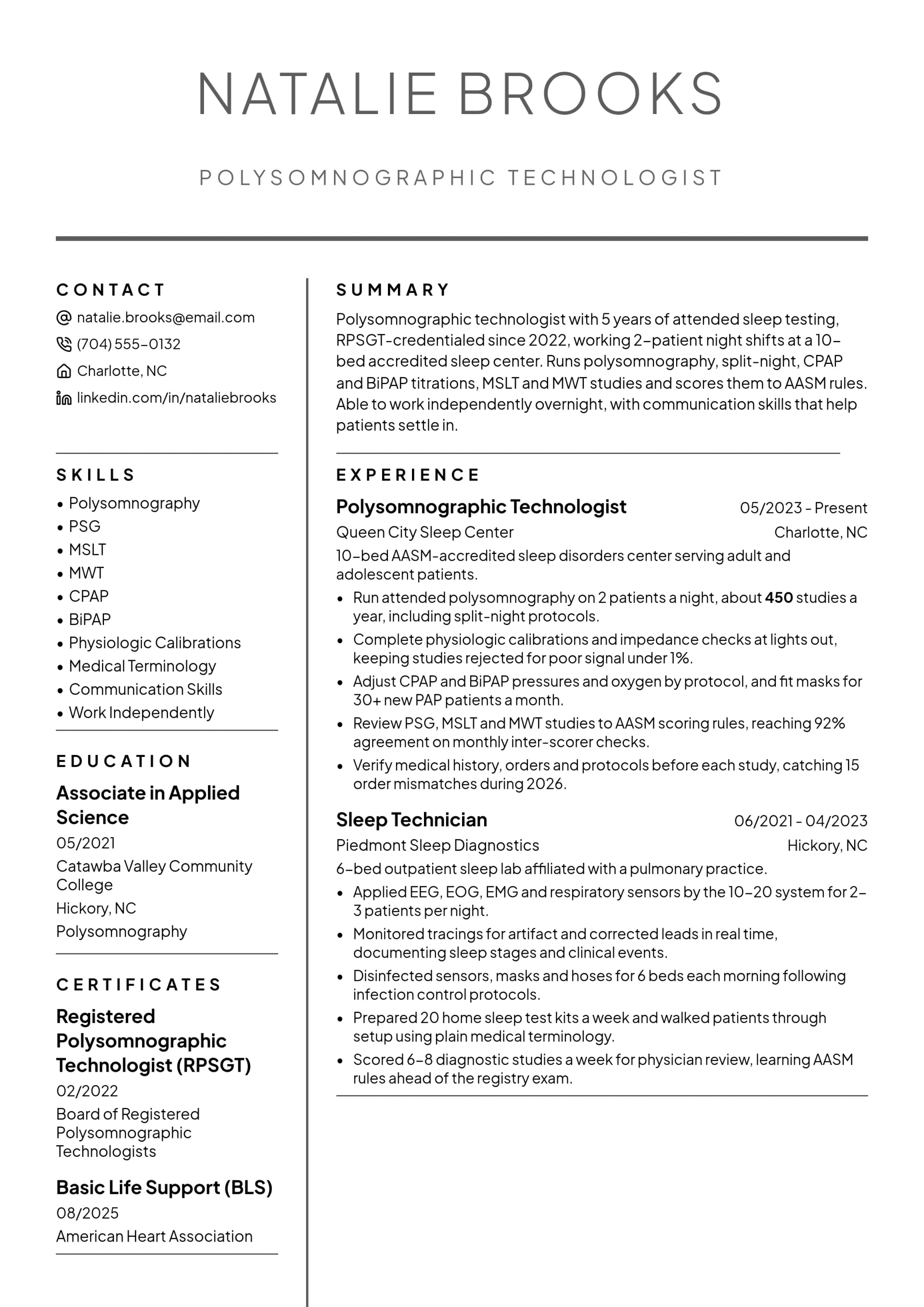
Polysomnographic Technologist Resume Example
Why this resume works:
- Run attended polysomnography on 2 patients a night, about 450 studies a year, including split-night protocols.
- Complete physiologic calibrations and impedance checks at lights out, keeping studies rejected for poor signal under 1%.
- Adjust CPAP and BiPAP pressures and oxygen by protocol, and fit masks for 30+ new PAP patients a month.
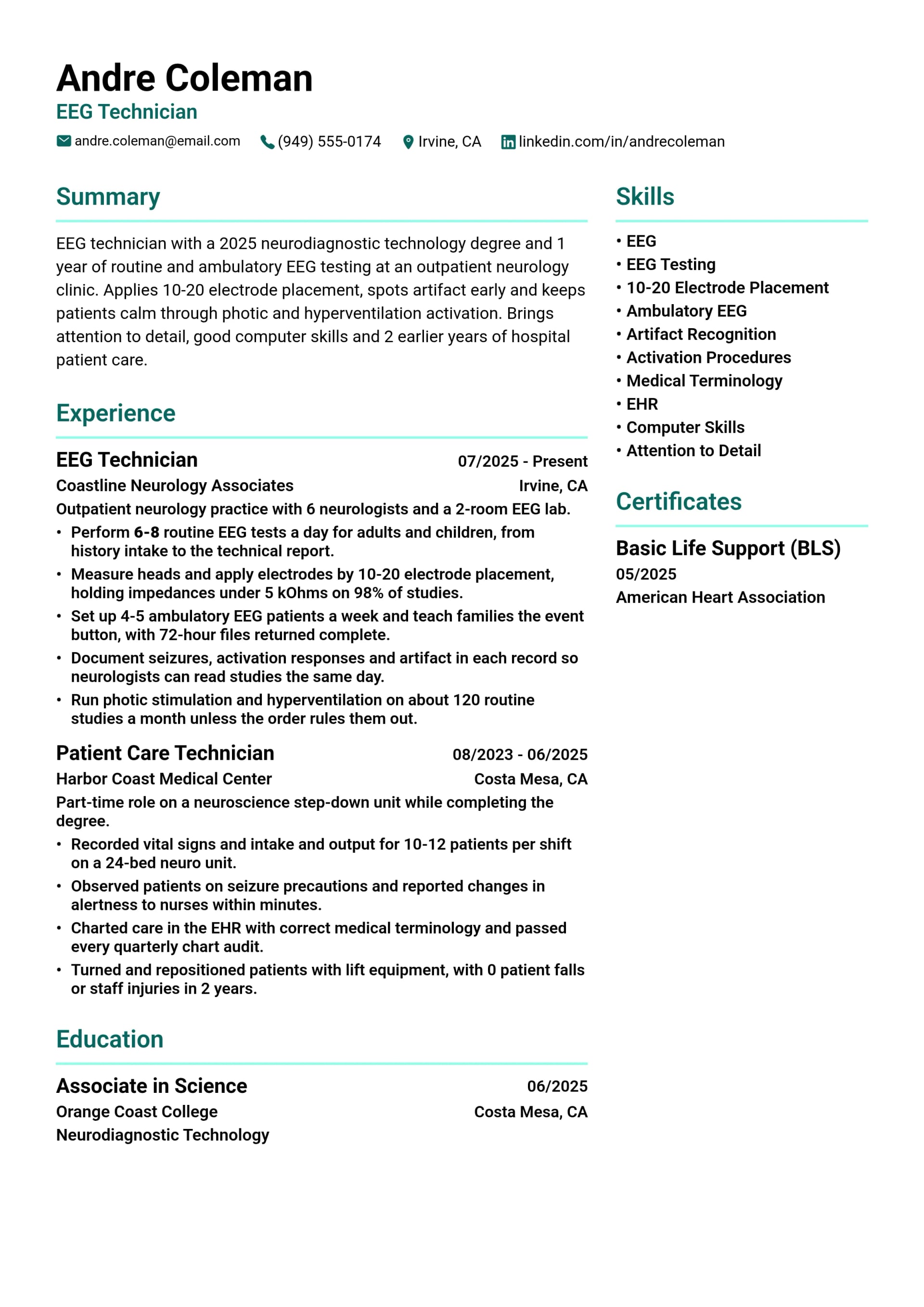
EEG Technician Resume Example
Why this resume works:
- Perform 6-8 routine EEG tests a day for adults and children, from history intake to the technical report.
- Measure heads and apply electrodes by 10-20 electrode placement, holding impedances under 5 kOhms on 98% of studies.
- Set up 4-5 ambulatory EEG patients a week and teach families the event button, with 72-hour files returned complete.
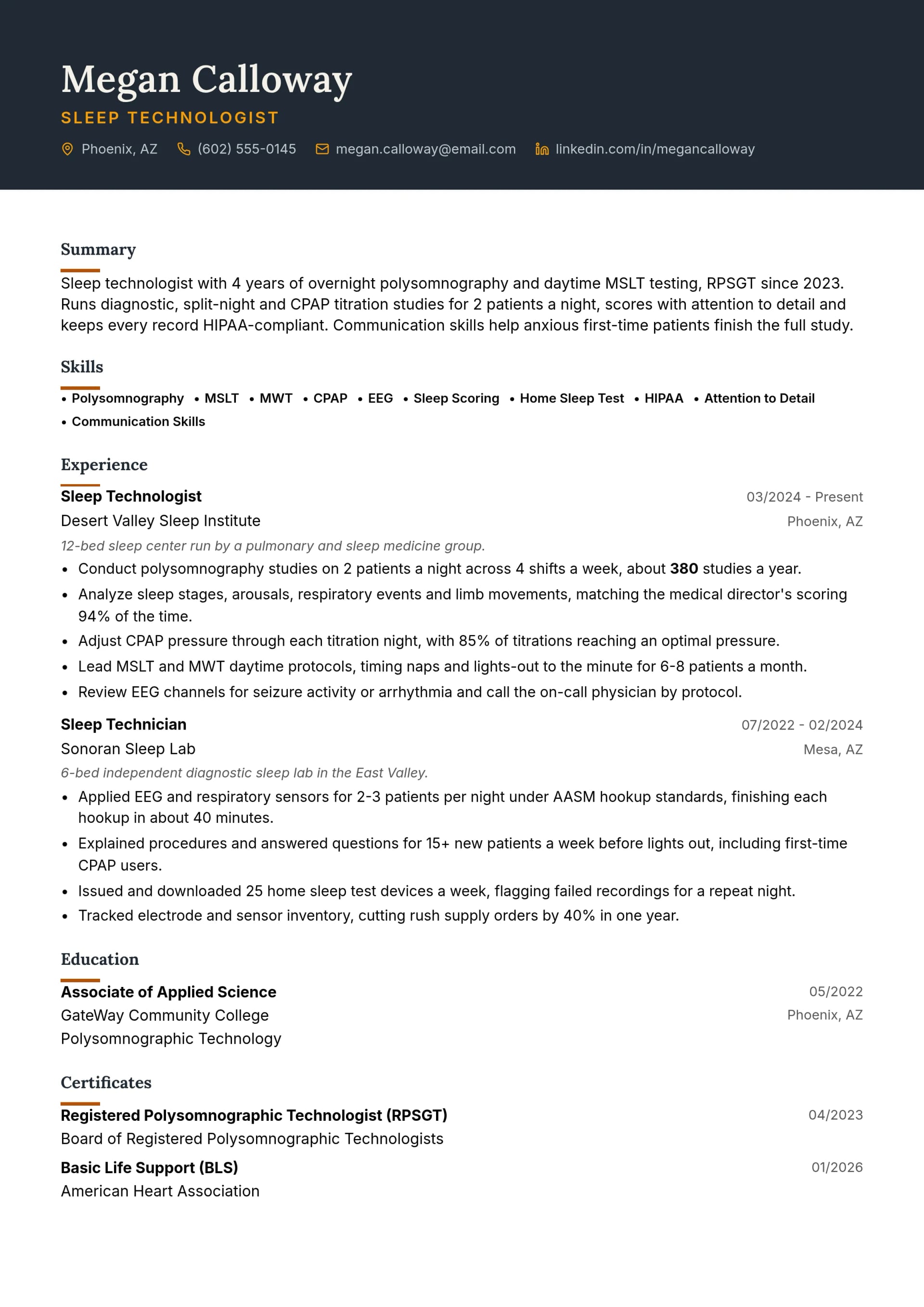
Sleep Technologist Resume Example
Why this resume works:
- Conduct polysomnography studies on 2 patients a night across 4 shifts a week, about 380 studies a year.
- Analyze sleep stages, arousals, respiratory events and limb movements, matching the medical director's scoring 94% of the time.
- Adjust CPAP pressure through each titration night, with 85% of titrations reaching an optimal pressure.
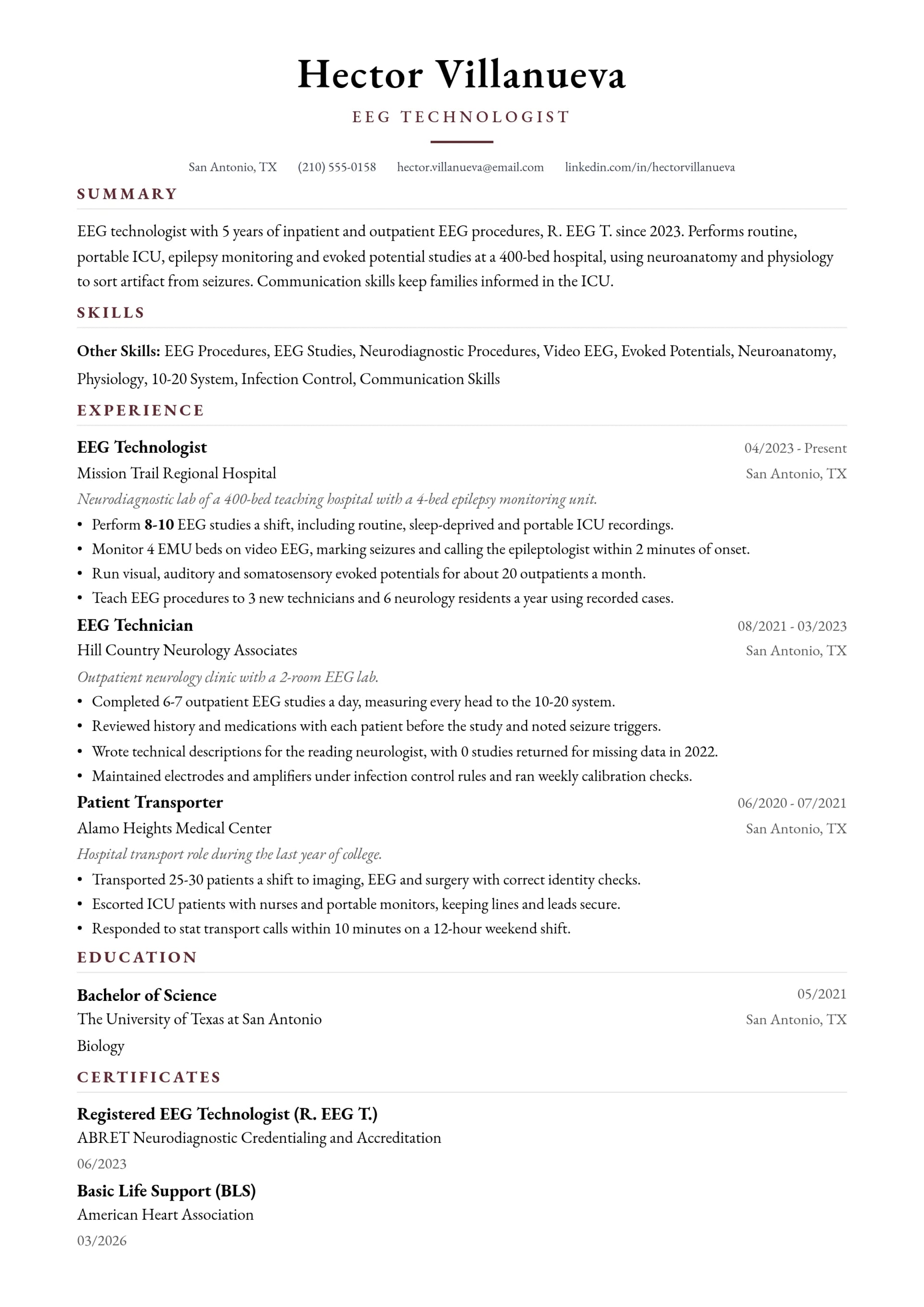
EEG Technologist Resume Example
Why this resume works:
- Perform 8-10 EEG studies a shift, including routine, sleep-deprived and portable ICU recordings.
- Monitor 4 EMU beds on video EEG, marking seizures and calling the epileptologist within 2 minutes of onset.
- Run visual, auditory and somatosensory evoked potentials for about 20 outpatients a month.
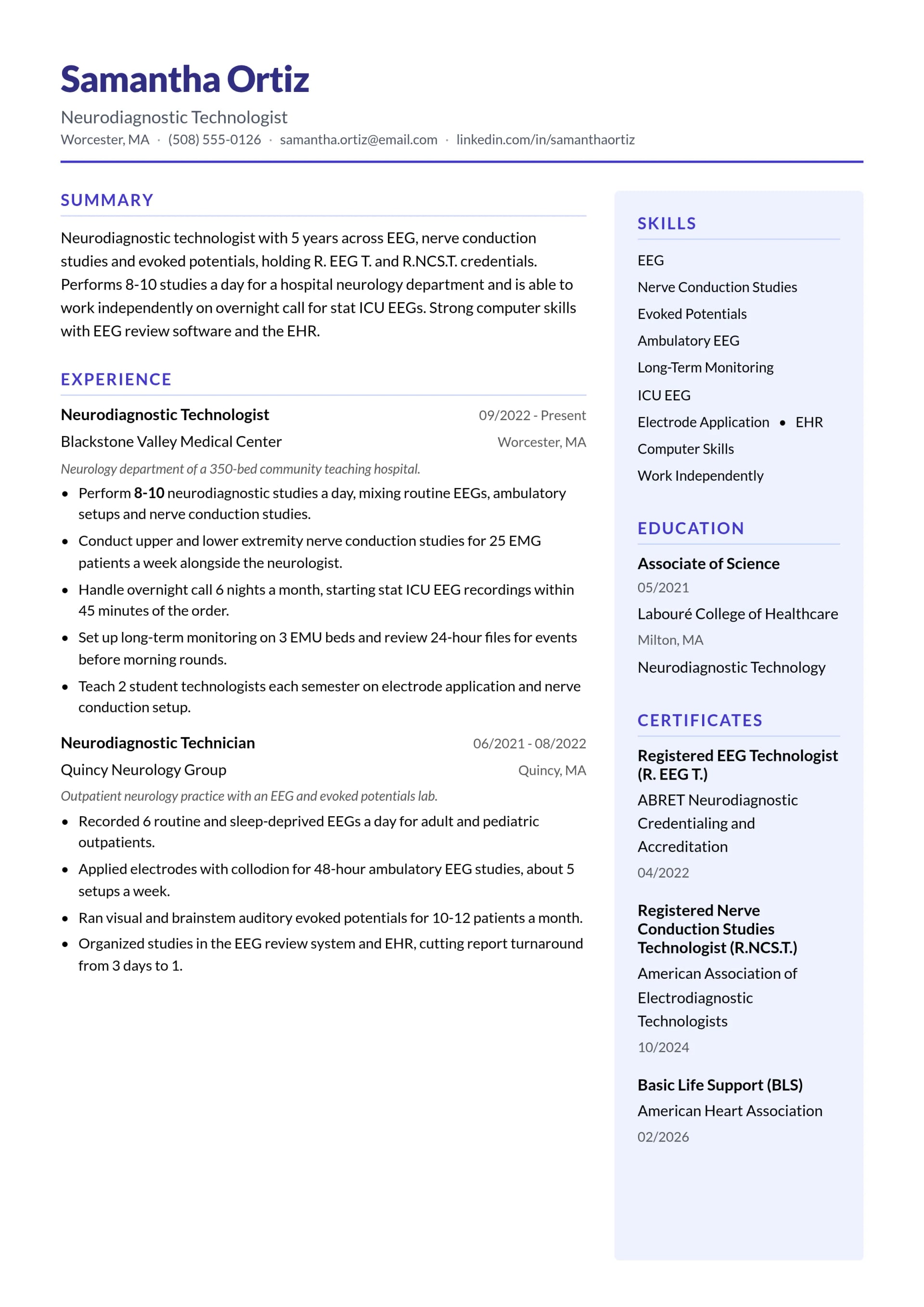
Neurodiagnostic Technologist Resume Example
Why this resume works:
- Perform 8-10 neurodiagnostic studies a day, mixing routine EEGs, ambulatory setups and nerve conduction studies.
- Conduct upper and lower extremity nerve conduction studies for 25 EMG patients a week alongside the neurologist.
- Handle overnight call 6 nights a month, starting stat ICU EEG recordings within 45 minutes of the order.
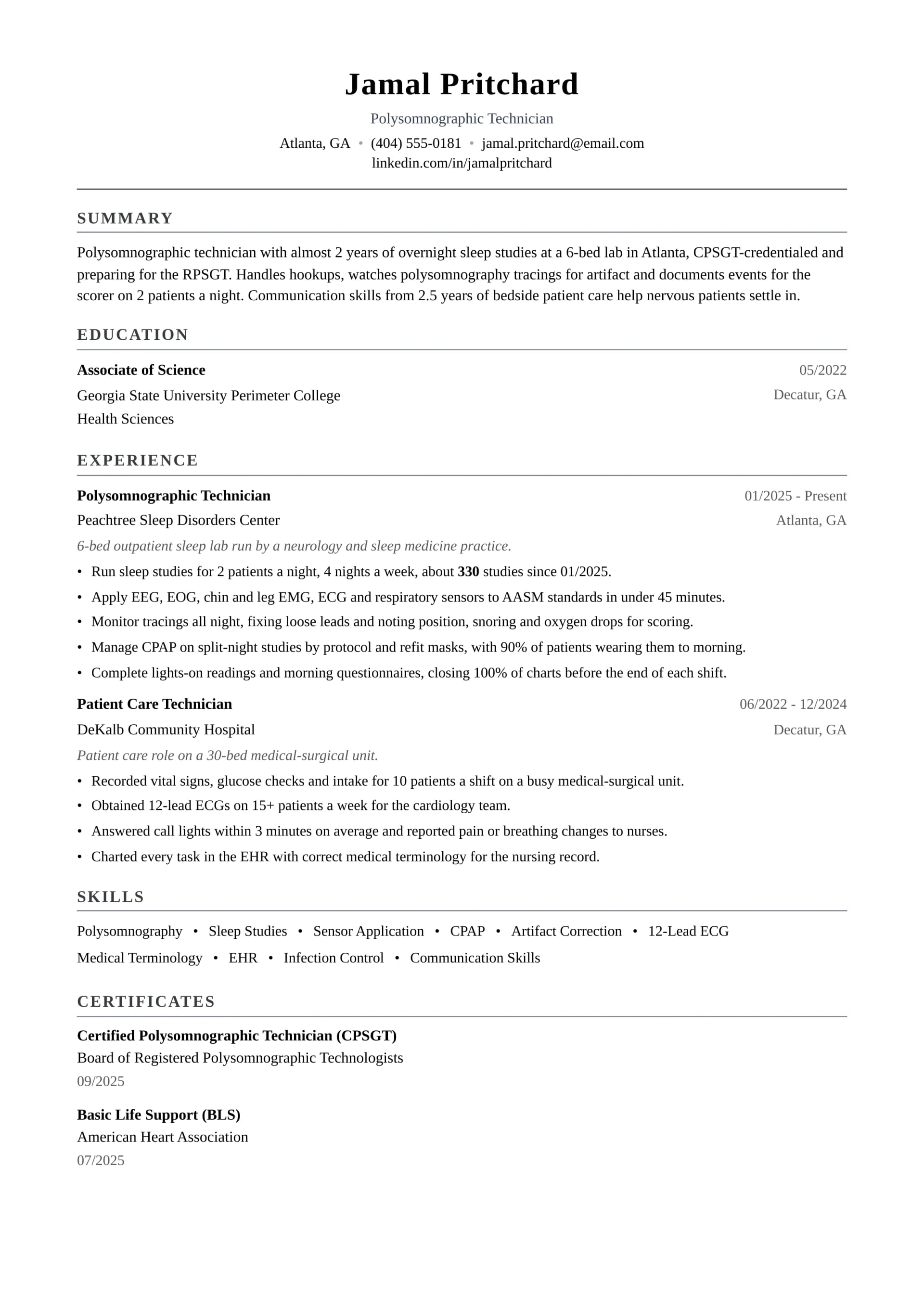
Polysomnographic Technician Resume Example
Why this resume works:
- Run sleep studies for 2 patients a night, 4 nights a week, about 330 studies since 01/2025.
- Apply EEG, EOG, chin and leg EMG, ECG and respiratory sensors to AASM standards in under 45 minutes.
- Monitor tracings all night, fixing loose leads and noting position, snoring and oxygen drops for scoring.
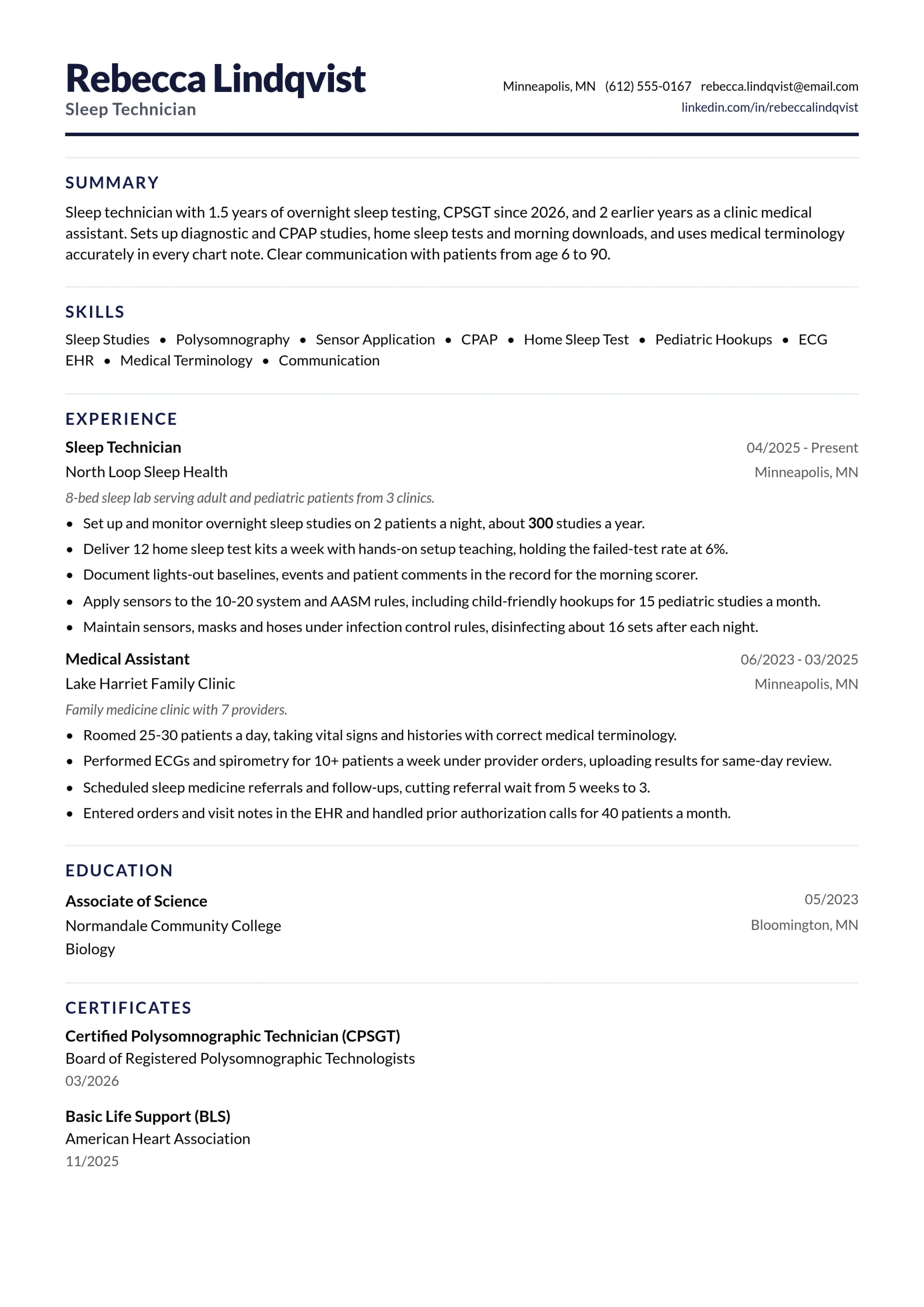
Sleep Technician Resume Example
Why this resume works:
- Set up and monitor overnight sleep studies on 2 patients a night, about 300 studies a year.
- Deliver 12 home sleep test kits a week with hands-on setup teaching, holding the failed-test rate at 6%.
- Document lights-out baselines, events and patient comments in the record for the morning scorer.
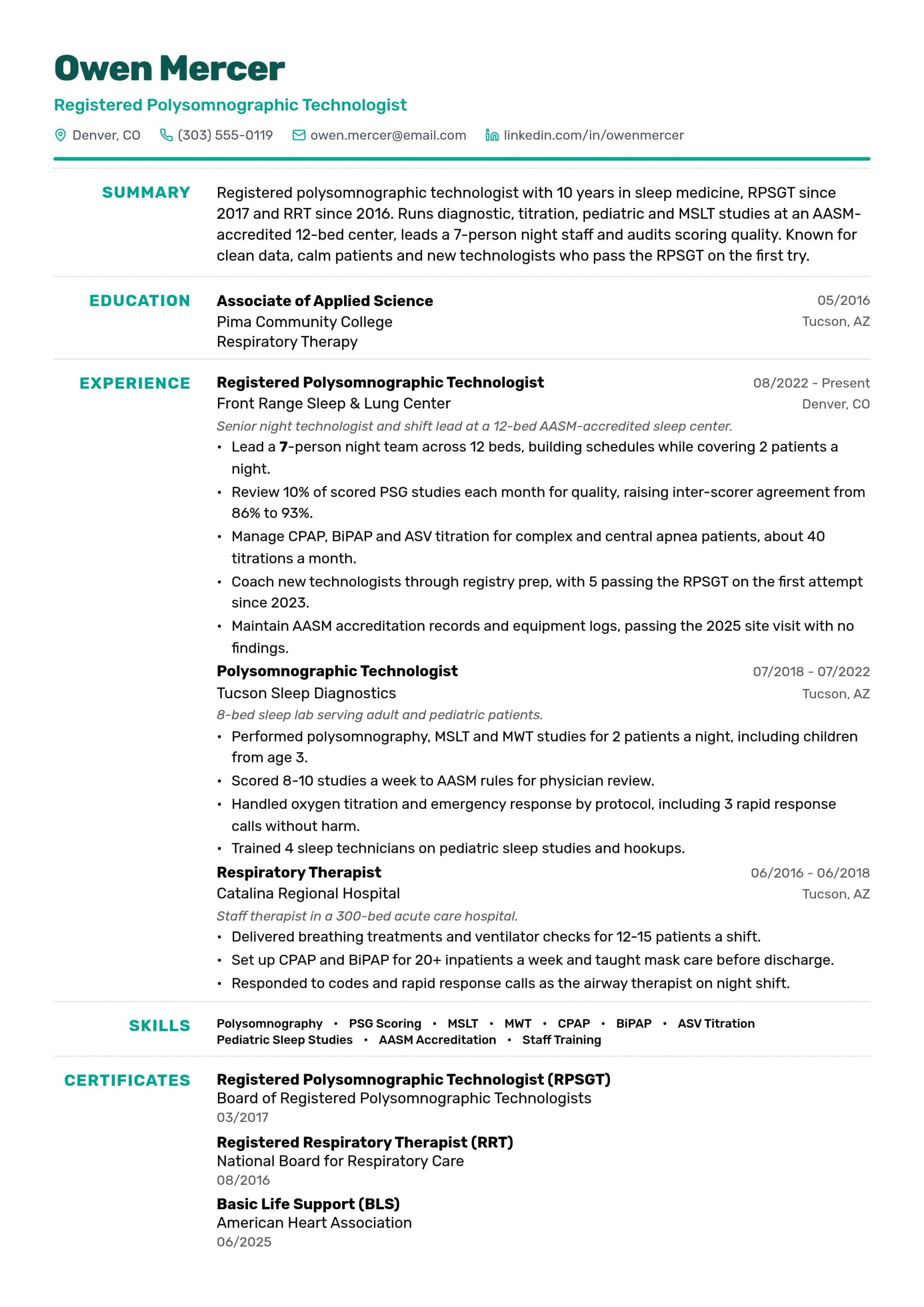
Registered Polysomnographic Technologist Resume Example
Why this resume works:
- Lead a 7-person night team across 12 beds, building schedules while covering 2 patients a night.
- Review 10% of scored PSG studies each month for quality, raising inter-scorer agreement from 86% to 93%.
- Manage CPAP, BiPAP and ASV titration for complex and central apnea patients, about 40 titrations a month.
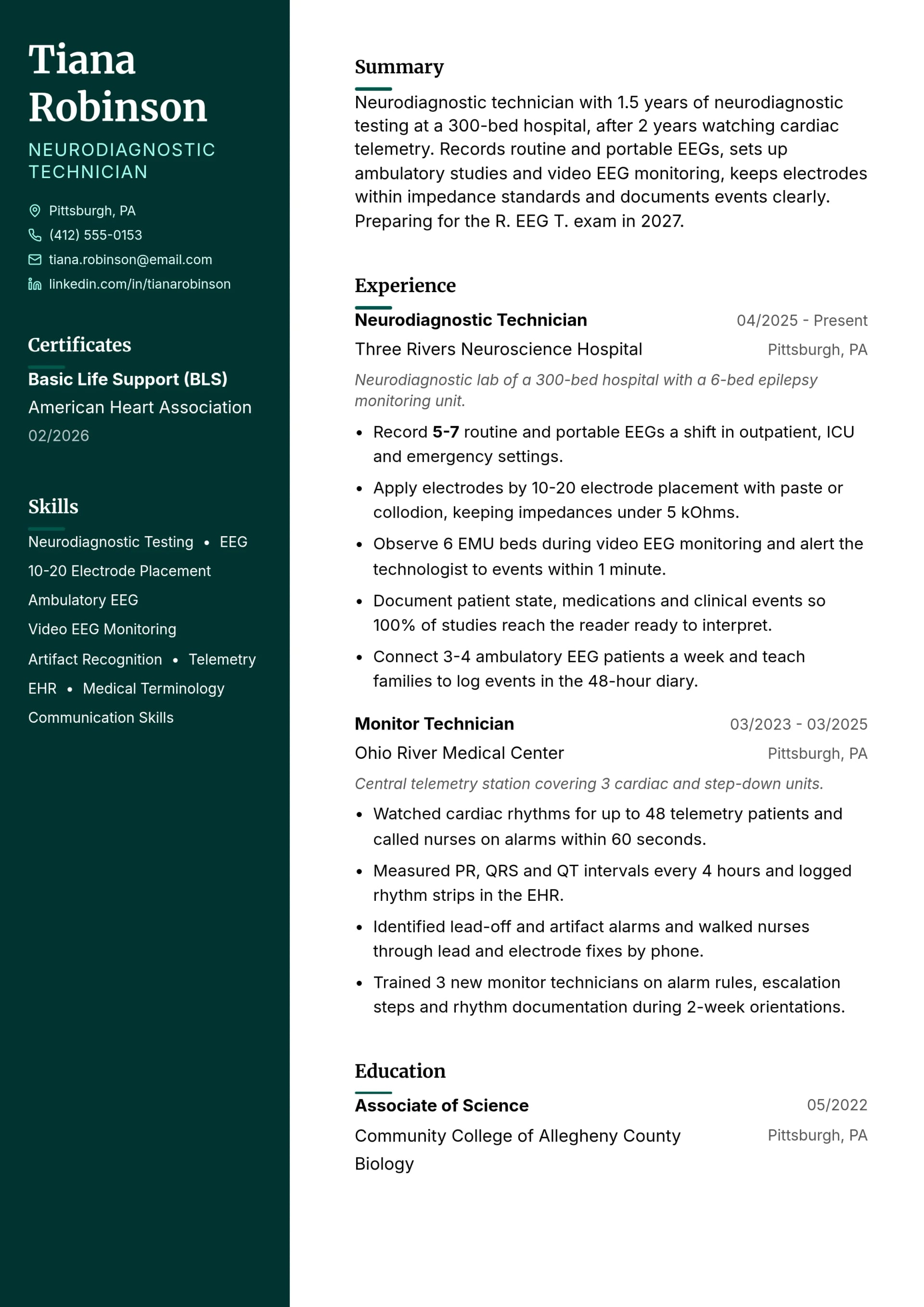
Neurodiagnostic Technician Resume Example
Why this resume works:
- Record 5-7 routine and portable EEGs a shift in outpatient, ICU and emergency settings.
- Apply electrodes by 10-20 electrode placement with paste or collodion, keeping impedances under 5 kOhms.
- Observe 6 EMU beds during video EEG monitoring and alert the technologist to events within 1 minute.
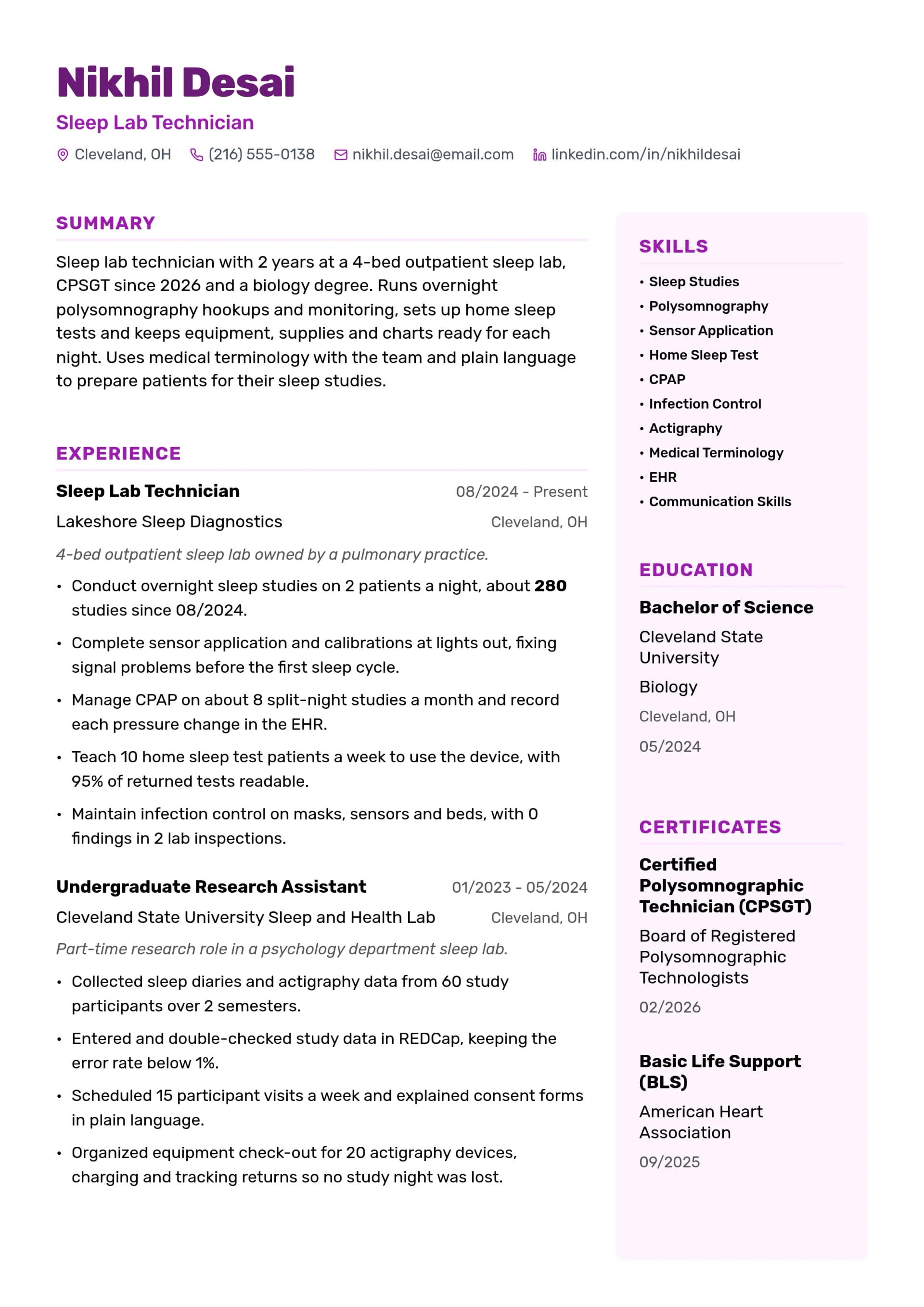
Sleep Lab Technician Resume Example
Why this resume works:
- Conduct overnight sleep studies on 2 patients a night, about 280 studies since 08/2024.
- Complete sensor application and calibrations at lights out, fixing signal problems before the first sleep cycle.
- Manage CPAP on about 8 split-night studies a month and record each pressure change in the EHR.
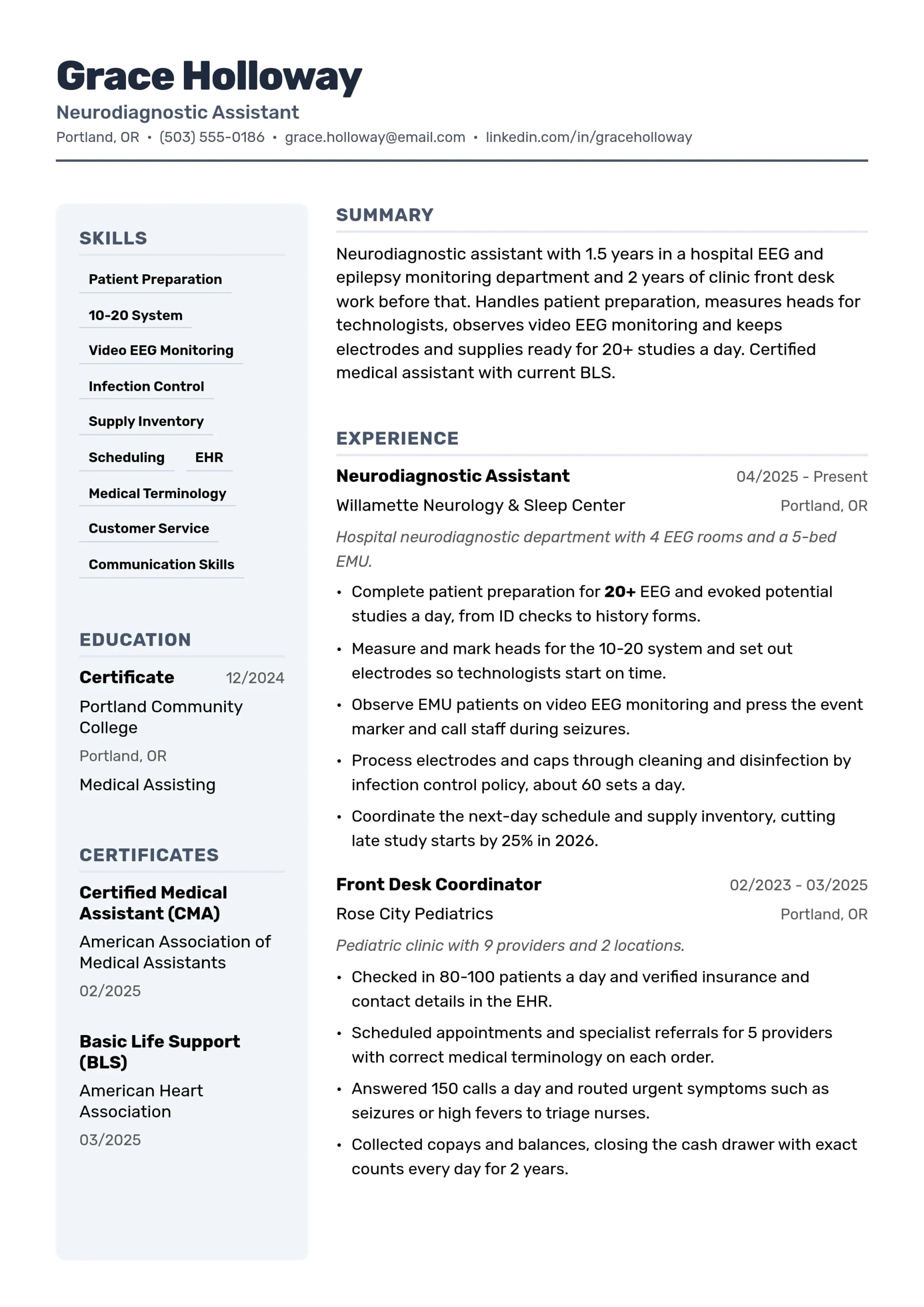
Neurodiagnostic Assistant Resume Example
Why this resume works:
- Complete patient preparation for 20+ EEG and evoked potential studies a day, from ID checks to history forms.
- Measure and mark heads for the 10-20 system and set out electrodes so technologists start on time.
- Observe EMU patients on video EEG monitoring and press the event marker and call staff during seizures.
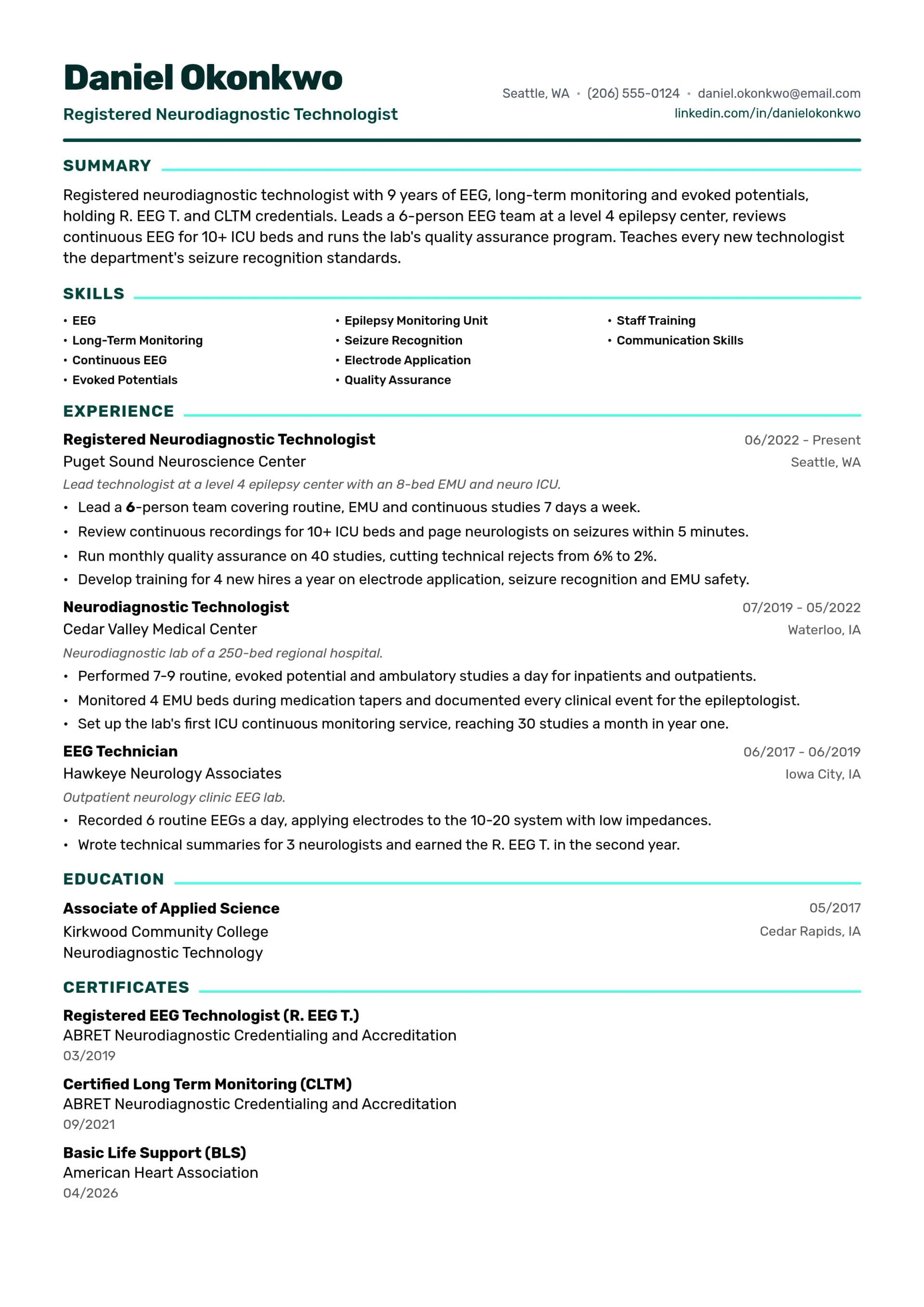
Registered Neurodiagnostic Technologist Resume Example
Why this resume works:
- Lead a 6-person team covering routine, EMU and continuous studies 7 days a week.
- Review continuous recordings for 10+ ICU beds and page neurologists on seizures within 5 minutes.
- Run monthly quality assurance on 40 studies, cutting technical rejects from 6% to 2%.
What employers ask for in neurodiagnostic technologist job postings
Neurodiagnostic Technologist job postings in the US, October 2026
- 1,106
- active US job postings
- 335
- employers hiring
- 1 yr
- median experience asked
- 55%
- ask for 1 year or less
Technical skills and tools employers name
| Skill | Share of postings |
|---|---|
| eeg | 9% |
| mslt | 7% |
| polysomnography | 7% |
| eegs | 5% |
| cpap | 6% |
Make sure your resume shows
- RPSGT credential from the BRPT (34% of employers)
- High school diploma or GED (23% of employers)
- Strong verbal and written communication skills (18% of employers)
- Current BLS certification from the American Heart Association (14% of employers)
- Age-specific care for pediatric, adult and geriatric patients (9% of employers)
- Works well with patients, families, physicians and coworkers (9% of employers)
- Associate degree or accredited program in polysomnography or respiratory therapy (6% of employers)
- R. EEG T. registry from ABRET (6% of employers)
Duties to build your bullet points around
What employers write most often under responsibilities. Show each one with a result (numbers, scale, outcome), not a copy of the duty.
- Prepare and calibrate testing equipment and fix problems (12%)
- Explain procedures to patients and keep them comfortable and safe (12%)
- Document sleep stages, clinical events and procedure changes for scoring (12%)
- Review patient history and verify the order and protocol (10%)
- Score sleep stages and clinical events to accepted guidelines (10%)
- Inspect and maintain study equipment and supplies (8%)
The examples on this page, in job postings
| Example | US postings | Median years asked |
|---|---|---|
| Polysomnographic Technologist | 117 | 2 |
| EEG Technician | 86 | 1.5 |
| Sleep Technologist | 104 | 1 |
| EEG Technologist | 64 | 1.5 |
| Neurodiagnostic Technologist | 41 | 1 |
| Polysomnographic Technician | 41 | 1 |
| Sleep Technician | 37 | 2 |
| Registered Polysomnographic Technologist | 27 | 1 |
| Neurodiagnostic Technician | 14 | 1 |
| Sleep Lab Technician | 10 | 1 |
| Neurodiagnostic Assistant | 8 | 1 |
| Registered Neurodiagnostic Technologist | 10 | 3 |
Which job title to put on your resume: the titles employers use most, so recruiters and applicant tracking systems search for them: Polysomnographic Technologist (54 employers), Sleep Technologist (45 employers), EEG Technician (44 employers), EEG Technologist (32 employers), Neurodiagnostic Technologist (30 employers).
Source: Owlapply analysis of active US job postings, October 2026. Requirements and duties are grouped by meaning from the postings' own bullet lists and counted once per employer.
Advertised pay, experience and the skills employers ask for: Neurodiagnostic Technologist pay and requirements.
Check your neurodiagnostic technologist resume against a real job posting
- Paste a neurodiagnostic technologist job posting into the job match score tool to see which of its skills your resume is missing.
- Upload your resume to the ATS resume checker to read the text an applicant tracking system gets from it.
Neurodiagnostic Technologist resume sample (text you can copy)
This is the text of the Polysomnographic Technologist example above. Paste it into the resume builder and replace the details with your own.
How to write a neurodiagnostic technologist resume
Write a neurodiagnostic technologist resume summary
- Open with your title, your years and your credential with its date, such as RPSGT since 2022 or R. EEG T. since 2023; about 34% of employers ask for the RPSGT.
- Name the study types you run: routine or ambulatory EEG, video EEG monitoring, evoked potentials, nerve conduction, polysomnography, MSLT, MWT or CPAP titration.
- Give the setting and load: a 10-bed sleep center with 2 patients a night, or 8-10 EEGs a shift at a hospital.
- If you are working toward a registry, say which one and when, such as preparing for the RPSGT or the R. EEG T. exam.
Write neurodiagnostic technologist experience bullets
- Count studies: per night, per shift or per year, and split them by type, such as 450 PSGs a year or 20 evoked potentials a month.
- Show data quality: impedances under 5 kOhms, studies rejected for poor signal under 1%, or inter-scorer agreement of 92%.
- For sleep roles, show titration and mask work, such as CPAP and BiPAP titrations a month or the share of patients who reach an optimal pressure.
- For EEG roles, show response time on events, such as calling the epileptologist within 2 minutes of seizure onset or starting stat ICU EEGs within 45 minutes.
Pick the skills for a neurodiagnostic technologist resume
- Communication (about 25% of postings), interpersonal skills (about 12%) and attention to detail (about 11%) top the list; prove them with patient preparation and clean records rather than listing the words alone.
- List the technical terms employers write: EEG (about 9%), MSLT (about 7%), polysomnography (about 7%) and CPAP (about 6%), plus your scoring rules (AASM) and 10-20 electrode placement.
- About 7% of postings ask you to work independently, so mention solo night shifts or overnight call.
Do's and don'ts
Do this
- List RPSGT, CPSGT, R. EEG T., R.NCS.T., CLTM and BLS in a certificates section with dates.
- Say which studies you can run alone and which you assist with.
- Give your scoring standard and your agreement rate on inter-scorer checks.
- Show pediatric or geriatric work if you have it; about 9% of employers ask for age-specific care.
Avoid this
- Don't write "performed sleep studies" without how many patients a night and how many studies a year.
- Don't mix up a credential you hold with one you are studying for; write "preparing for" with the exam year.
- Don't leave out BLS; about 15% of employers name current AHA BLS in their requirements.
- Don't use one resume for EEG and sleep jobs; EEG postings look for electrode placement and seizure recognition, sleep postings for PSG, titration and scoring.
Related resume examples
- Medical Receptionist
- Respiratory Therapist
- Athletic Trainer
- Radiation Therapist
- Pharmacist
- Physician Assistant
- Registered Nurse
- Medical Assistant