
Nurse Anesthetist resume examples
This page has 2 one-page nurse anesthetist resume examples: a certified registered nurse anesthetist with about 900 cases a year and a chief CRNA who leads a 32-CRNA department. Both are checked against 2,346 US postings from 381 employers, and the note under each sample says which credentials, case volumes and outcomes it puts first.
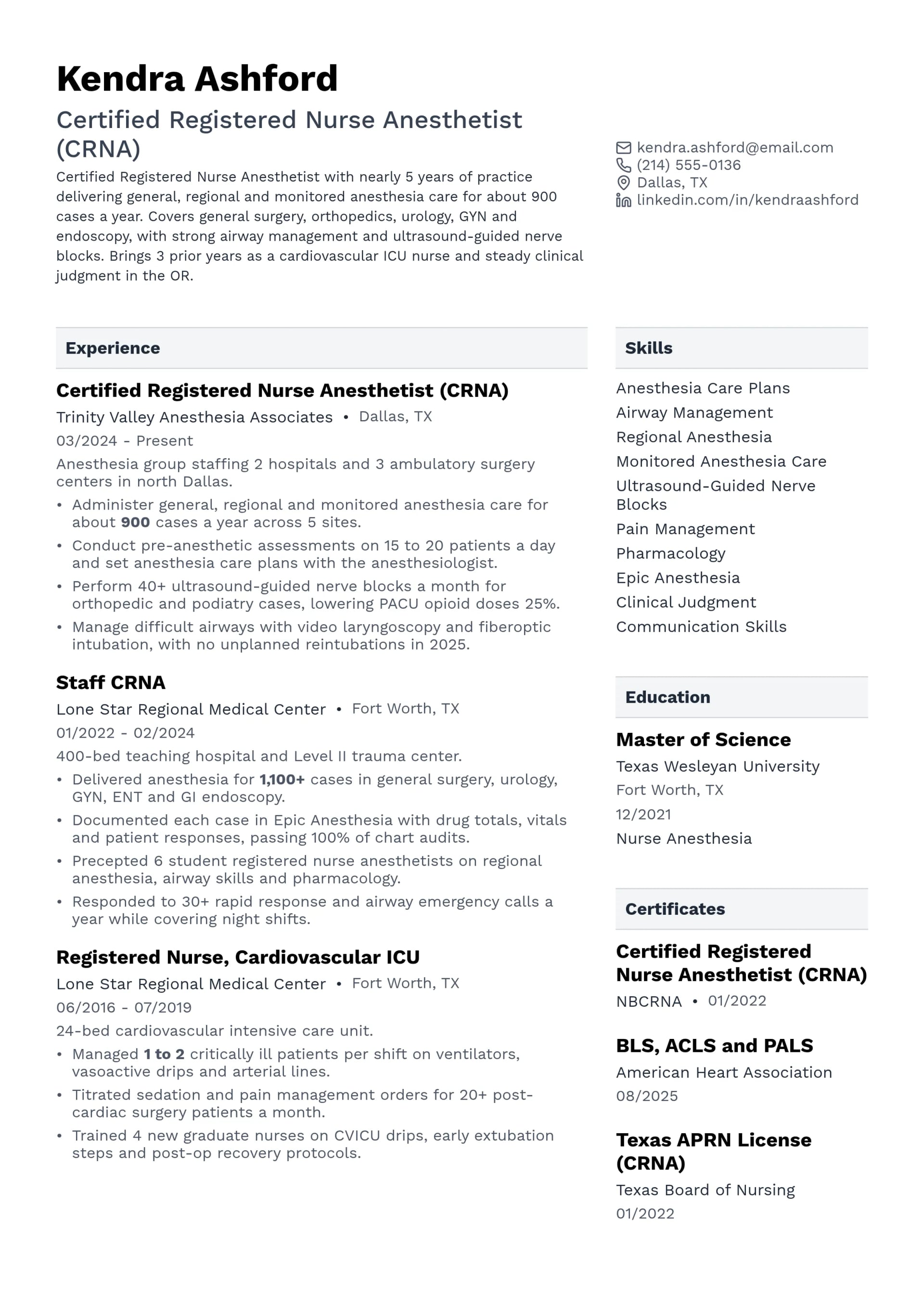
Certified Registered Nurse Anesthetist (CRNA) Resume Example
Why this resume works:
- Administer general, regional and monitored anesthesia care for about 900 cases a year across 5 sites.
- Conduct pre-anesthetic assessments on 15 to 20 patients a day and set anesthesia care plans with the anesthesiologist.
- Perform 40+ ultrasound-guided nerve blocks a month for orthopedic and podiatry cases, lowering PACU opioid doses 25%.
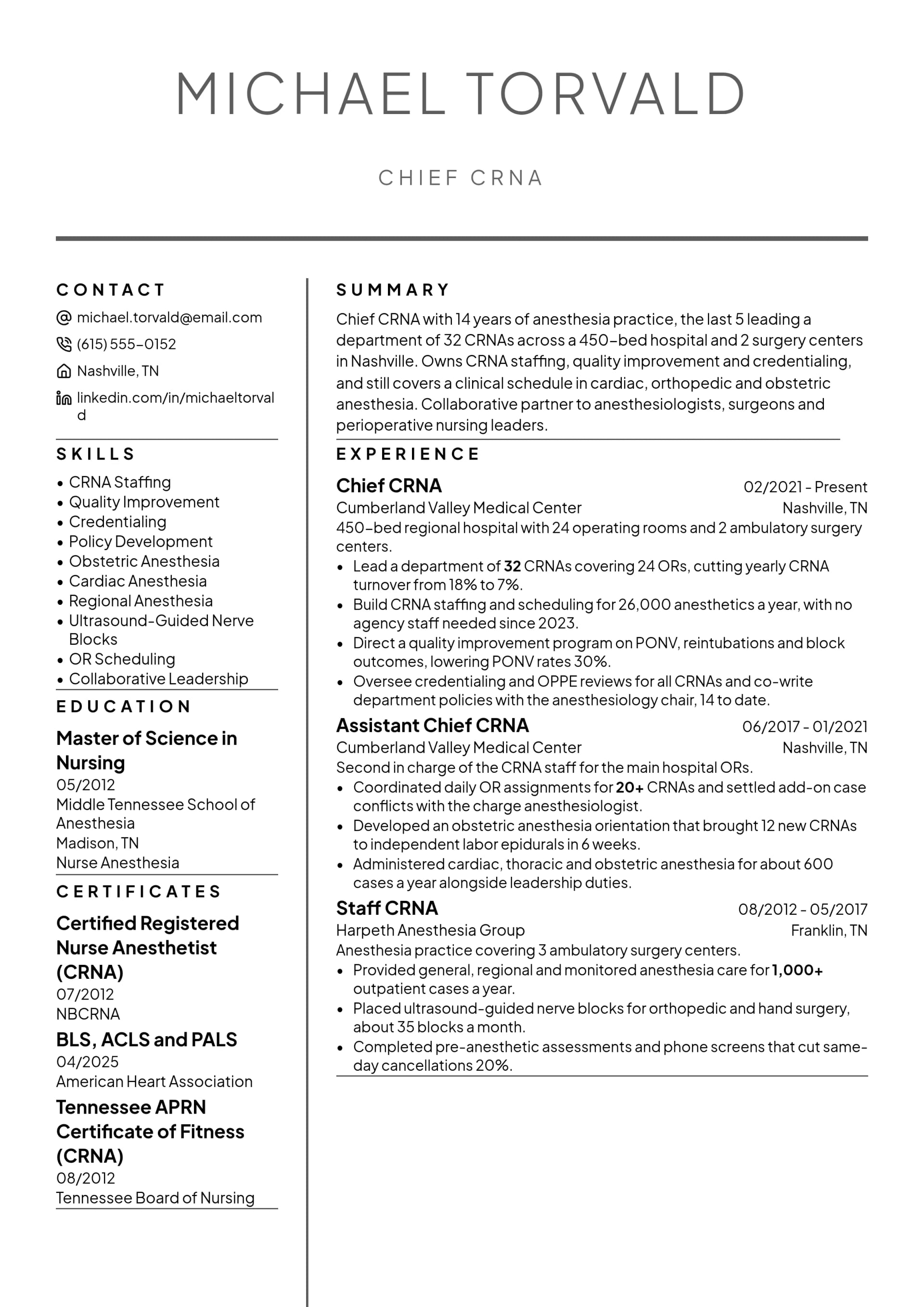
Chief CRNA Resume Example
Why this resume works:
- Lead a department of 32 CRNAs covering 24 ORs, cutting yearly CRNA turnover from 18% to 7%.
- Build CRNA staffing and scheduling for 26,000 anesthetics a year, with no agency staff needed since 2023.
- Direct a quality improvement program on PONV, reintubations and block outcomes, lowering PONV rates 30%.
What employers ask for in nurse anesthetist job postings
Nurse Anesthetist job postings in the US, October 2026
- 2,346
- active US job postings
- 381
- employers hiring
- 2 yr
- median experience asked
- 41%
- ask for 1 year or less
Make sure your resume shows
- CRNA certification (NBCRNA) (42% of employers)
- Master's degree from an accredited nurse anesthesia program (33% of employers)
- BLS, ACLS and PALS certifications (26% of employers)
- Strong communication and interpersonal skills (9% of employers)
- Strong clinical judgment and decision-making (7% of employers)
- 2 to 3 years of CRNA experience (preferred) (7% of employers)
Duties to build your bullet points around
What employers write most often under responsibilities. Show each one with a result (numbers, scale, outcome), not a copy of the duty.
- Do pre-anesthetic assessments to choose the anesthesia plan (35%)
- Manage the patient's airway and pulmonary status during anesthesia (16%)
- Work with surgeons, anesthesiologists, nurses and perioperative teams (11%)
- Keep accurate, detailed anesthesia records (10%)
- Select and give agents for general, regional and monitored anesthesia care (10%)
- Build anesthesia care plans for each patient and procedure (10%)
The examples on this page, in job postings
| Example | US postings | Median years asked |
|---|---|---|
| Certified Registered Nurse Anesthetist (CRNA) | 1,856 | 2 |
| Chief CRNA | 22 | 2 |
Which job title to put on your resume: the titles employers use most, so recruiters and applicant tracking systems search for them: CRNA (197 employers), Certified Registered Nurse Anesthetist (127 employers), Certified Registered Nurse Anesthetist (CRNA) (51 employers), Nurse Anesthetist (34 employers), Chief CRNA (10 employers).
Source: Owlapply analysis of active US job postings, October 2026. Requirements and duties are grouped by meaning from the postings' own bullet lists and counted once per employer.
Advertised pay, experience and the skills employers ask for: Nurse Anesthetist pay and requirements.
Check your nurse anesthetist resume against a real job posting
- Paste a nurse anesthetist job posting into the job match score tool to see which of its skills your resume is missing.
- Upload your resume to the ATS resume checker to read the text an applicant tracking system gets from it.
Nurse Anesthetist resume sample (text you can copy)
This is the text of the Certified Registered Nurse Anesthetist (CRNA) example above. Paste it into the resume builder and replace the details with your own.
How to write a nurse anesthetist resume
Write a nurse anesthetist resume summary
- Open with CRNA, your years of practice and your yearly case volume, such as about 900 cases a year.
- Name the case mix you cover: general surgery, orthopedics, urology, GYN, endoscopy, cardiac or obstetrics.
- Mention the techniques you do often, such as ultrasound-guided nerve blocks, difficult airway management or neuraxial anesthesia.
- Say whether you work in a care team with anesthesiologists or independently, and include your ICU nursing years if you are early in practice.
Write nurse anesthetist experience bullets
- Give volumes: cases a year, sites covered, pre-anesthetic assessments a day and blocks a month.
- Show safety and outcome results, such as no unplanned reintubations, lower PACU opioid doses or lower PONV rates.
- Cover the anesthesia types you deliver in one bullet: general, regional and monitored anesthesia care.
- For a chief CRNA, add department size, ORs covered, anesthetics a year, staffing results and quality programs you run.
Pick the skills for a nurse anesthetist resume
- Communication is the skill employers name most (about 25% of postings), followed by airway management (about 18%); list airway tools by name, such as video laryngoscopy and fiberoptic intubation.
- Add anesthesia techniques (about 8%), pain management and clinical judgment (about 5% each), and your charting system.
Do's and don'ts
Do this
- List NBCRNA certification, your state APRN license and BLS, ACLS and PALS at the top of certificates; about 26% of employers ask for all three life support cards.
- Put your nurse anesthesia degree and accredited program in education; about 33% of employers ask for it.
- Include your ICU nursing years, with the unit type, since they show the critical care base for your practice.
- Give a case volume for every CRNA job.
Avoid this
- Don't list every drug and technique you learned in school; keep the ones you use in your current case mix.
- Don't write "provided anesthesia" without case types, volumes and outcomes.
- Don't bury expiry dates; employers check that certifications are current.
- Don't leave out regional anesthesia or pain management work if you do it; those are skills employers name.
Related resume examples
- Respiratory Therapist
- EMT
- Neurodiagnostic Technologist
- Physician Assistant
- Physician
- Registered Nurse
- Medical Assistant
- Dental Assistant