

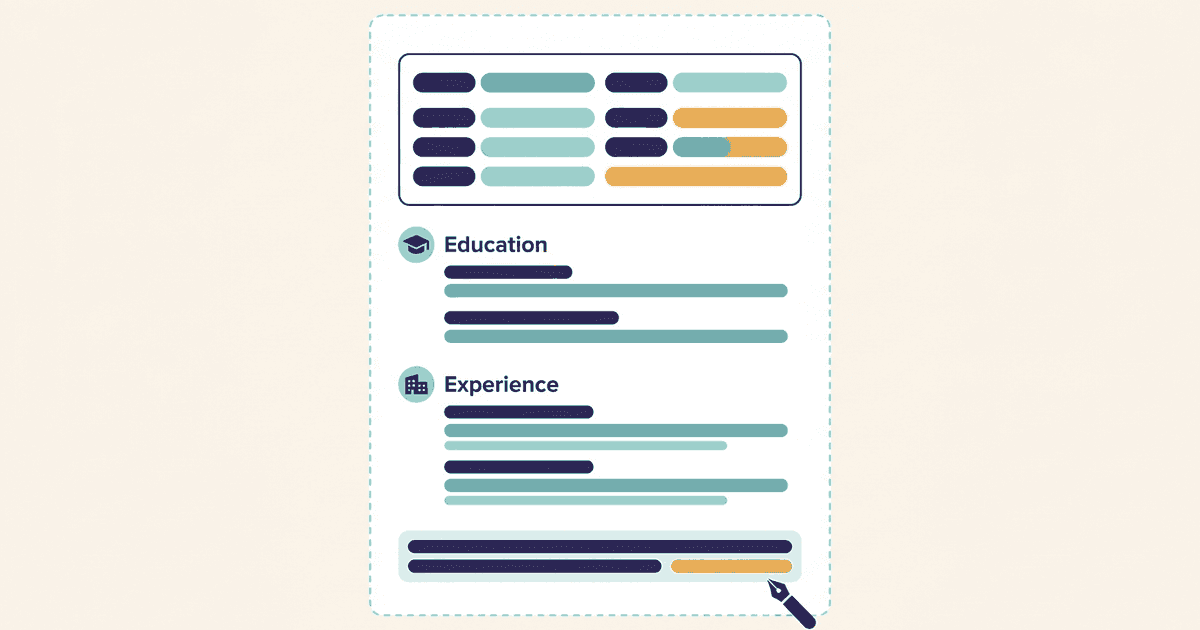
A biodata format for a job is a one-page document that lists personal details (name, date of birth, contact, sometimes nationality, marital status and languages), education, work experience and skills in a fixed, form-like order, ending with a declaration and signature. It survives in India, Bangladesh, Pakistan and parts of the Gulf for government posts, public-sector units, some schools and hospitals, and older private firms whose HR forms still say "attach biodata". For everything else in 2026, a resume is what recruiters and applicant tracking systems expect, and a biodata submitted in its place looks dated and parses badly. This page gives you a job biodata format you can copy, two filled samples (fresher and experienced), the fields to include and the ones to leave out, and a plain rule for when to send a biodata, a resume or a CV. It is about job biodata only; a marriage biodata is a different document and is not covered here.
Biodata vs resume vs CV: which one to send
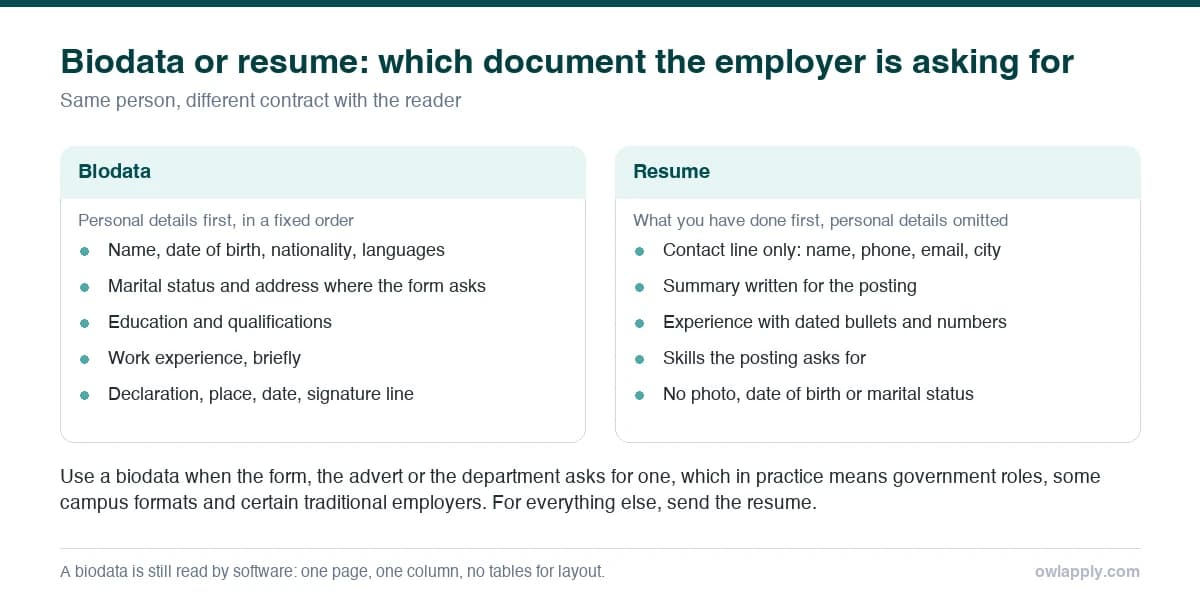
| Document | Length | Lead with | Send it when |
|---|---|---|---|
| Biodata | 1 page | Personal details, then education, then experience | The employer's form or advert explicitly asks for a biodata; government, PSU, some schools, hospitals and traditional firms |
| Resume | 1-2 pages | A summary and quantified experience; personal details limited to a contact line | Private-sector jobs, portals (Naukri, LinkedIn, Indeed), company career sites, anything that passes through an ATS |
| CV | 2+ pages | Education, publications, full career history | Academic, research, medical and some international applications |
The practical difference is what goes first. A biodata leads with who you are (date of birth, nationality, sometimes parents' names); a resume leads with what you have done. Applicant tracking systems map a resume's sections by heading and expect Experience, Education and Skills; a biodata's Personal Details block at the top is read as noise, and its form-style two-column layout is often read across columns. If a portal is involved, convert the biodata to the fresher resume format or the ATS resume format; keep the biodata for the employer that asked for it.
Biodata format for a job (copy and fill)
Keep it to one page, single column, one font, no photo unless requested (if requested, a passport-size photo in the top-right corner as a real image, not a text box). Fill only the personal fields the form asks for; date of birth and nationality are commonly required for government posts, marital status and parents' names increasingly are not. The declaration wording and placement rules are in declaration in resume. Keep this format for the employers and forms that ask for it. If you are applying outside India, send a resume instead: US employers may not decide on the personal characteristics a biodata leads with (the EEOC), and European applications use the EU’s own Europass CV or a plain CV.
Biodata sample for a fresher (clerk / accounts assistant)
Biodata sample for an experienced candidate (school teacher)
What to include and what to leave out
Do this
- Name, date of birth, nationality, languages, city, phone, email
- Education with board, year and percentage (government forms want all three)
- Experience with dates and at least one number per role
- Skills and certifications relevant to the post
- Declaration with place, date and typed name, last
- One page, one column, PDF (or the form's own format)
Avoid this
- Parents' names, religion, caste, blood group, height and weight unless the form requires them
- Salary drawn, reason for leaving
- A scanned signature image
- A photo unless requested
- Hobbies with no relevance to the post
- Tables and text boxes for layout (if the biodata will be uploaded, the parser reads them badly)
Biodata format in Word and PDF
The templates above are plain text: paste one into a blank Word or Google Docs file, set one font at 11 pt, bold the headings, and save as PDF unless the form asks for Word or a printed copy. If a printed copy is required, sign above your typed name on the print; do not paste a signature image into the file. For any application that goes through a portal or a company career site, rebuild the same content as a resume in the free resume builder and check the exported file with the free ATS resume checker; the biodata stays for the employer that asked for one.
Turn a biodata into a resume that parses
The free builder keeps the same details in a single-column resume format, exports PDF and Word, and takes about ten minutes.
Build my resume free