


An ATS resume format is a layout whose text an applicant tracking system can extract completely and in order: one column, standard section headings, contact details in the body, real text instead of icons, images or tables, and dates written one way throughout. It is not a special design and it does not have to look plain. It has to parse. In 44,255 resumes we ran through our own parser, only 5.8% of PDFs came through with no layout finding; the rest lost something on the way in, most often because of a table (32.7%), a non-standard heading (39.2%) or contact details in the page header (22.1%). This guide is the format that avoids every one of those, field by field, with the evidence for each rule, an ATS friendly resume format you can copy, and the two-minute test that tells you whether your current file passes. The layout underneath it is almost always reverse-chronological, which is the order parsers are built to read. This guide is about the rules themselves; if you want a file that already follows them, the free ATS-friendly resume templates are the faster route.
What breaks in resume files: 22,901 PDFs analysed
Source: ATS resume statistics, our first-party report. How the extraction itself works, step by step, is in how an ATS reads your resume.
The ATS resume format, rule by rule
| Element | Rule | Why (from the data) |
|---|---|---|
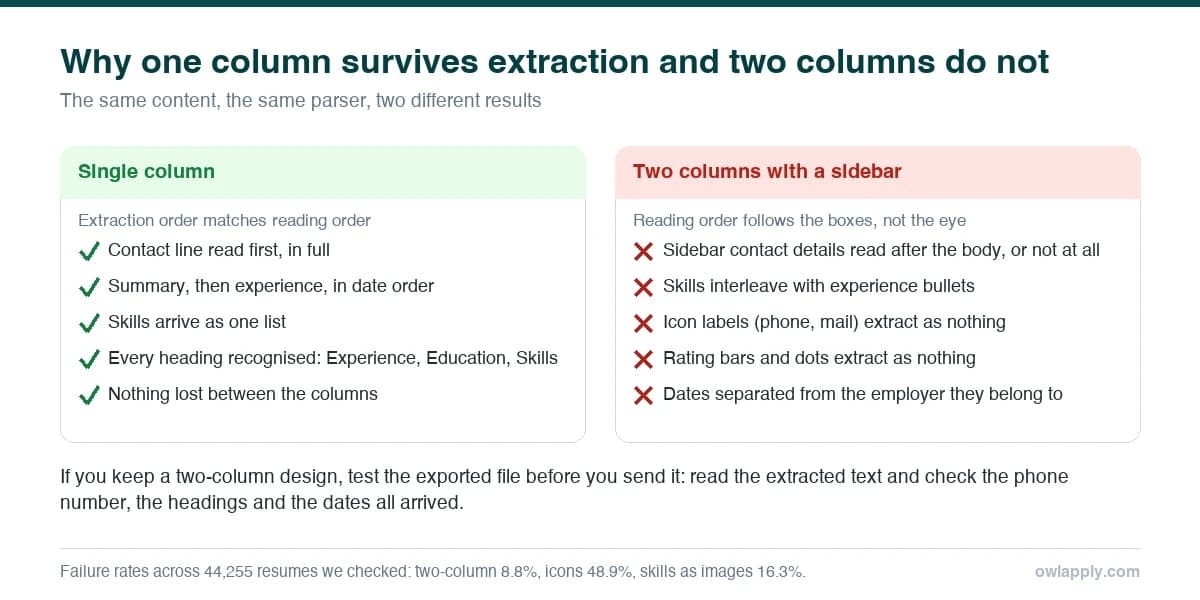
| Columns | One. Full-width sections, top to bottom | Two-column files (8.8%) are read left to right across both columns, gluing sections together |
| Section headings | Summary, Experience (or Work Experience), Education, Skills, Certifications, Projects | 39.2% of resumes use a heading the parser's whitelist does not know ("Professional Journey", "Where I've Worked") and the whole block is misfiled |
| Contact details | Name, city, phone, email, LinkedIn on the first two lines of the body | 22.1% put them in the header band; many parsers extract the body layer only, and the phone number vanishes |
| Tables and text boxes | None. Not for dates, not for skills, not for the header | Table cells are read row by row; a job title in one cell and its dates in the next arrive merged or out of order (32.7% of files) |
| Fonts | One standard, embedded font at 10.5-12 pt: Calibri, Arial, Helvetica, Georgia, Garamond, Cambria | 46% of files had a font risk: non-embedded, decorative, or under 9 pt, where extraction becomes unreliable |
| Bullets | Plain round or square bullets, or hyphens | 48.9% used icons, emoji or decorative glyphs that tokenise as unknown characters and can break section detection |
| Dates | One format everywhere: Jan 2024 - Mar 2026, or 01/2024 - 03/2026 | 31.4% mixed formats; parsers infer the pattern from the first date and blank later ones that do not match |
| Skills | Plain text, grouped, comma-separated | 16.3% put skills in bars or rating dots; the image is stripped and the skill with it |
| Images and photos | None, unless the posting asks for a photo; then a real image in the body, not a text box | Images carry no text; a photo in a text box often forces a two-column layout |
| Links | Visible URL text (linkedin.com/in/name), not just a hyperlinked word | 32.5% hid URLs behind link text; the target survives in PDF but is lost on print |
| Length | One page under ten years of experience, two above | Not an ATS rule, a reader rule; parsers handle any length |
| File type | PDF exported from Word, Google Docs or a builder; .docx only if asked | 4.0% were image-only PDFs (scanned or exported as pictures) with no text layer at all |
Section order for an ATS-friendly resume
Contact line, summary (or objective for freshers), experience, education, skills, then certifications, projects and anything optional. Parsers map sections by heading and expect this order; recruiters read in this order. Two exceptions: freshers and students put education and projects above experience, and academic CVs put publications after education. The heading text matters more than its styling: bold 12-pt "Experience" is fine, a 16-pt "Professional Journey" in a coloured band is not.
That skeleton is exactly what the free ATS-friendly resume templates are built on, with typography added; each template was uploaded to Workday, Greenhouse, Lever and Taleo and came back with every section in place.
ATS friendly CV format outside the US: two pages, photos, declarations
The parsing rules do not change by country; the conventions around them do. A two-page CV in India, the UK or Germany parses as well as a one-page resume. A photo, expected in parts of Europe and the Gulf and optional in India, should be a real image placed in the body at the top right, never inside a text box or a table cell. A declaration line at the end of an Indian resume is harmless if it stays in the body; the same line in the page footer disappears. Personal details such as date of birth or nationality, where an employer requires them, go in a plain "Personal Details" section with one item per line. In every country, the four things that actually break extraction are the same four: tables, columns, headers and non-standard headings. the EU’s own Europass CV shows the convention these markets grew out of: two pages, a photo field that is optional, and personal details the US format leaves out.
The two-minute test for your current resume
- Open the PDF, select all, copy, paste into a plain-text editor. If nothing pastes, the file is an image. If your sections arrive out of order or your phone number is missing, the layout is losing data.
- Read the pasted text for symbols. "oce" for "office" means a ligature or font-mapping problem; blocks of unknown characters mean icon bullets.
- Check the dates. Every date should be in the same form. A parser that reads "Jan 2024" first may blank "2024-06" later.
- Upload it to the free ATS resume checker. It shows the extracted text line by line, names each of the 34 findings, and tells you the fix and the points it costs. The plain-text test catches the crude problems; the checker catches the header, font and hidden-text ones.
Converting a designed resume to an ATS format without losing the content
Do not fight the template. Open a blank document, paste the plain text from the test above, restore the headings from the list, and re-enter dates in one format. Rebuild the skills list as text. Add the contact line at the top of the body. Then set one font and one size. The whole conversion takes twenty minutes for a two-page CV, and the result usually parses cleanly on the first upload. If you want the typography back, load the text into the free resume builder, which keeps every template single-column.
What an ATS format does not require
- It does not require a boring design. Colour in headings, a bold name, a horizontal rule: all fine. What matters is that text is text and columns are one.
- It does not require .docx. Modern parsers read PDF as well as Word; send PDF unless the posting asks otherwise.
- It does not require keyword stuffing. 17.8% of resumes repeat terms beyond natural use; the checker reports it as a finding, and recruiters see it.
- It does not require one page. Parsers do not care about length; readers do.
- It does not require removing your LinkedIn or portfolio link. Write the URL out so it survives print, and keep the hyperlink.
Get the format without rebuilding by hand
Every template in the library is single-column, standard-heading and tested on four major ATS platforms. Edit online, download as PDF or Word.
See the ATS-friendly templatesATS resume format: questions people ask
Test your file against the same 34 checks
Upload your resume, read the extracted text, and see which of the twelve format rules it breaks. Free, no account.
Check my resume