

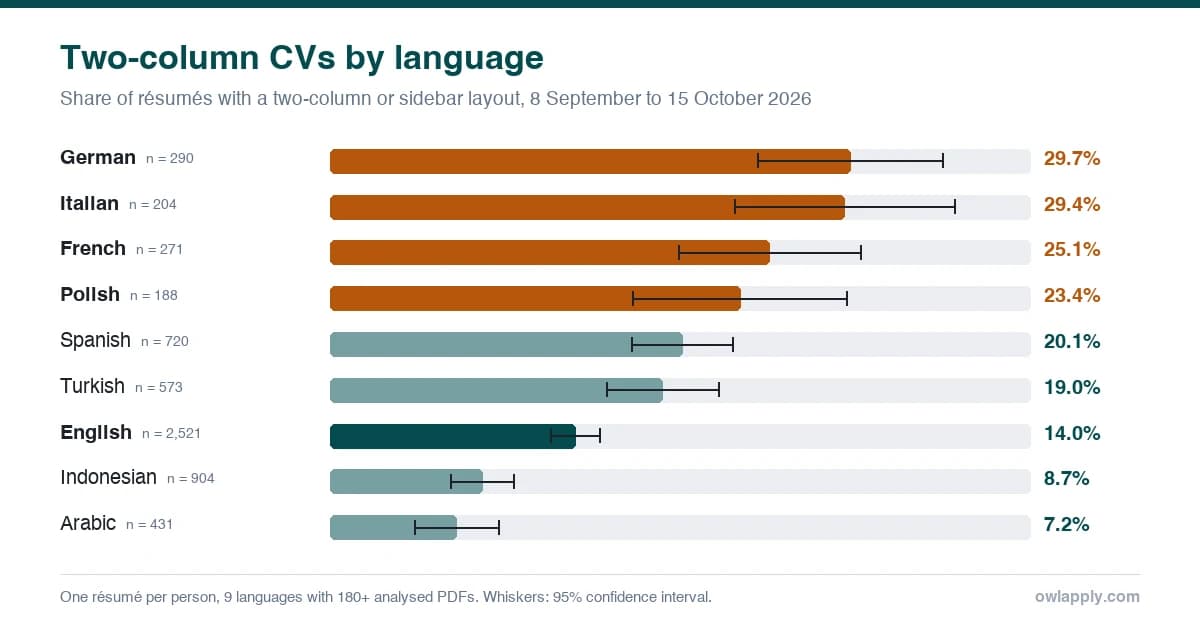
A résumé written in German, Italian, French or Polish is about twice as likely to use a two-column layout as one written in English, and Italian and Polish CVs carry a font problem more than twice as often. Those are the two clearest results from 7,285 résumés run through the free OwlApply ATS checker between 8 September and 15 October 2026, one per person, with the language detected from each résumé's own text. We compared only the checks that work the same way in every language (columns, fonts, header and footer placement, links, glyphs), so the differences below come from how people build the file, not from how we score the words. The per-language table, the method and a citation line are all on this page; the data is free to reuse under CC BY 4.0.
Two-column résumés by language, 8 Sep to 15 Oct 2026
- 29.7%
- of 290 German CVs used two columns or a sidebar
- 29.4%
- of 204 Italian CVs did the same
- 14.0%
- of 2,521 English résumés, for comparison
- 7.2%
- of 431 Arabic CVs, the lowest of the large samples
This is a follow-up to our ATS résumé statistics report, which measured what goes wrong in résumé files across all languages together. This study splits the same kind of measurement by language and runs it over a longer window.
Key findings
- Two columns are mostly a continental European habit. 27.1% of 953 German, French, Italian and Polish CVs used a two-column or sidebar layout, against 14.0% of 2,521 English résumés (OwlApply checker, 8 September to 15 October 2026).
- German CVs have the highest two-column rate of any large sample: 29.7% of 290, with a 95% confidence interval of 24.4% to 35.0%.
- Italian and Polish CVs carry font risk twice as often as English ones: 57.4% of 204 Italian and 54.8% of 188 Polish files were flagged, against 25.0% of English files.
- Contact details in the page header or footer are rare in English and common elsewhere: 3.0% of English résumés did it, against 11.0% of German, 9.4% of Turkish and 18.8% of 85 Romanian CVs.
- Arabic and Indonesian CVs rarely use columns: 7.2% of 431 Arabic and 8.7% of 904 Indonesian files, roughly half the English rate.
- Indonesian CVs were the cleanest large sample: 39.8% of 904 had no file-level finding at all, against 23.3% of English résumés and 16.2% of Italian CVs.
- English résumés hide link addresses most often: 50.0% had a link whose address was never printed, against 17.0% of Polish CVs.
- Image-only or unreadable files are twice as common in Indonesian and Arabic: 9.6% and 9.3%, against 4.1% in English.
Results by language: the full table
Sixteen languages had at least 50 people in the window, covering 6,988 of the 7,285 résumés. The remaining 25 languages are left out of the tables because a percentage from a few dozen files says more about the individuals than about the language.
| Language | Résumés | No file finding | Two columns or sidebar | Contact in header or footer | Font risk | Link with no printed address |
|---|---|---|---|---|---|---|
| English | 2,620 | 23.3% | 14.0% (±1.4) | 3.0% | 25.0% | 50.0% |
| Indonesian | 976 | 39.8% | 8.7% (±1.8) | 1.7% | 15.2% | 37.6% |
| Spanish | 756 | 30.6% | 20.1% (±2.9) | 6.1% | 26.8% | 34.9% |
| Turkish | 603 | 28.3% | 19.0% (±3.2) | 9.4% | 26.0% | 38.4% |
| Arabic | 471 | 31.3% | 7.2% (±2.4) | 1.6% | 24.1% | 39.7% |
| German | 302 | 25.9% | 29.7% (±5.3) | 11.0% | 28.3% | 35.5% |
| French | 284 | 26.2% | 25.1% (±5.2) | 4.1% | 36.9% | 41.3% |
| Italian | 210 | 16.2% | 29.4% (±6.3) | 3.4% | 57.4% | 38.7% |
| Polish | 201 | 21.3% | 23.4% (±6.1) | 4.3% | 54.8% | 17.0% |
| Portuguese* | 95 | 22.6% | 21.5% (±8.4) | 3.2% | 35.5% | 43.0% |
| Russian* | 90 | 14.6% | 4.5% (±4.3) | 3.4% | 69.7% | 18.0% |
| Ukrainian* | 90 | 17.4% | 22.1% (±8.8) | 5.8% | 17.4% | 43.0% |
| Malay* | 88 | 48.1% | 13.6% (±7.5) | 1.2% | 11.1% | 30.9% |
| Romanian* | 87 | 23.5% | 17.6% (±8.1) | 18.8% | 27.1% | 48.2% |
| Greek* | 61 | 22.8% | 22.8% (±10.9) | 1.8% | 26.3% | 33.3% |
| Hebrew* | 54 | 29.6% | 7.4% (±7.0) | 3.7% | 13.0% | 48.1% |
Three smaller findings, for completeness. A decorative bullet or icon tokenises as an unknown character; a ligature can turn "office" into "oce"; a file with no readable text layer gives a parser nothing at all.
| Language | Decorative bullets or icons | Ligature or special glyphs | No readable text layer |
|---|---|---|---|
| English | 8.5% | 11.8% | 4.1% |
| Indonesian | 7.1% | 9.7% | 9.6% |
| Spanish | 10.0% | 10.6% | 5.6% |
| Turkish | 7.9% | 8.6% | 5.2% |
| Arabic | 16.0% | 9.0% | 9.3% |
| German | 9.3% | 13.4% | 5.2% |
| French | 11.4% | 12.5% | 4.8% |
| Italian | 14.7% | 11.8% | 3.4% |
| Polish | 7.4% | 8.0% | 6.9% |
| Portuguese* | 2.2% | 14.0% | 2.2% |
| Russian* | 20.2% | 6.7% | 1.1% |
| Ukrainian* | 23.3% | 18.6% | 4.7% |
| Malay* | 1.2% | 8.6% | 8.6% |
| Romanian* | 12.9% | 14.1% | 2.4% |
| Greek* | 19.3% | 28.1% | 7.0% |
| Hebrew* | 27.8% | 11.1% | 0.0% |
Which languages use two-column résumés the most?
German (29.7%), Italian (29.4%), French (25.1%) and Polish (23.4%) CVs use two-column or sidebar layouts the most, roughly double the English rate of 14.0%. Spanish (20.1%) and Turkish (19.0%) sit in between, and Arabic (7.2%) and Indonesian (8.7%) use them least. The European figures are not noise: the lower end of the German interval, 24.4%, is still well above the upper end of the English one, 15.4%.
A two-column layout matters because it is the most expensive common file problem we measure. In our earlier study, files with a sidebar scored about 15 points below files with nothing flagged. The text is read left to right across both columns, so a skills sidebar ends up glued into the middle of an experience bullet.
The likely reason is the template culture these CVs come from. A German tabellarischer Lebenslauf is, by name and by convention, a CV laid out as a table with dates in a narrow left-hand column. The classic Europass CV, widely used in Italy, Poland and other EU countries, also put its labels in a left-hand column beside the content. Add the design-tool templates that dominate CV searches across Europe, nearly all of which ship with a photo sidebar, and the two-column default is easy to explain. We did not measure the cause directly; the data shows the layout, not where the file was made.
A two-column CV is not a German problem in Germany
Why do Italian and Polish CVs have so many font problems?
57.4% of Italian and 54.8% of Polish CVs were flagged for font risk, more than double the English rate of 25.0%. French follows at 36.9%. Font risk means the file uses an unusual or non-embedded typeface, or sets body text below 9pt; either can make extraction unreliable or produce garbled characters.
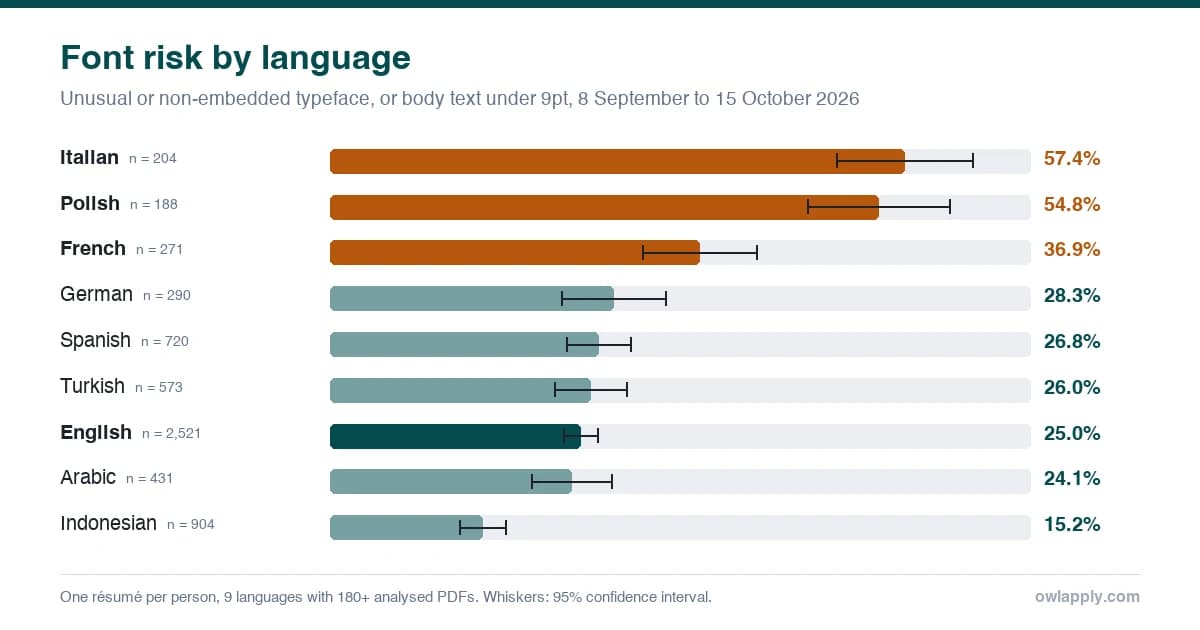
This cut does not split the finding into its two causes. Across all languages, our earlier study found the larger half was text set below 9pt (15.2% of files) rather than the typeface itself (11.0%). Languages that need accented or extra letters, such as Polish ą, ł and ż, are also more exposed when a decorative font is missing those glyphs and the PDF falls back to a substitute. Russian CVs showed the highest rate of all, 69.7%, but from only 89 files, so treat that as a signal to check rather than a measurement to quote.
Contact details in the header or footer: which languages do it?
Putting your name, phone and email in the page header or footer is uncommon in English résumés (3.0%) and much more common in German (11.0%), Turkish (9.4%) and Romanian (18.8%) CVs. It is an expensive mistake: many parsers read only the body of the page, so the record is created without a phone number, and in our earlier study files with this finding scored about 13 points lower.
Romanian's figure comes from 85 files and carries a wide interval (about ±8 points), but even its lower bound is above every large sample except German. For a German or Turkish CV the fix is simple: keep a decorative band in the header if you like, but repeat the contact line in the first lines of the body.
Which language has the cleanest résumés?
Indonesian résumés were the cleanest large sample: 39.8% of 904 had no file-level finding at all, against 23.3% of English résumés. Arabic (31.3%) and Spanish (30.6%) also beat English; Turkish (28.3%) is slightly ahead, but within the margin of error. Italian CVs were the least clean large sample at 16.2%, pulled down by font risk and columns together. Malay CVs looked cleanest of all at 48.1%, but from 81 files.
English résumés lose ground mostly on one cheap finding: 50.0% have a link whose address is never printed, typically a LinkedIn or GitHub link written as a word. That costs only a few points, but it means the address disappears on paper and in plain-text extraction. Polish CVs do it least, at 17.0%.
What this means for job seekers in each region
Germany, France, Italy, Poland and the rest of the EU
Your CV is most likely to be two columns and, in Italy and Poland, to carry a font problem. If you use a Europass export or a design template with a photo sidebar, keep it for direct applications to local employers, and send a single-column version with an embedded standard font through large job portals and international employers. Keep the photo, if local custom expects one, as an image in the body rather than in a sidebar. If those employers read another language, the resume translator saves a translated copy in the same template.
The US, the UK, India and the Philippines
English résumés are comparatively clean on layout: 14.0% two-column and 3.0% contact in the header. The common slip is the link written as a word. Print the address in full (linkedin.com/in/yourname) and keep the hyperlink too. If you are applying in the UK or Ireland, the CV maker builds the local CV format on A4.
Turkey and Spanish-speaking countries
About one CV in five is two-column (Turkish 19.0%, Spanish 20.1%), and Turkish CVs put contact details in the header more than three times as often as English ones (9.4%). Check those two things first.
Arabic, Indonesian and Malay
Layouts are simple, with columns in under 9% of Arabic and Indonesian CVs. The specific risks are different: about one file in ten has no readable text layer (9.3% Arabic, 9.6% Indonesian), usually a scan or a picture saved as PDF, and Arabic CVs use decorative bullets or icons twice as often as English ones (16.0% against 8.5%). Export from a word processor rather than scanning, and use plain bullets.
What to do before you send a CV in any language
Language-independent file checks
- One column, read top to bottom; no sidebar for skills, photo or contact details
- Name, phone and email in the first lines of the body, not only in the header or footer band
- A standard, embedded font with body text at 10pt or larger
- Plain round bullets or hyphens instead of icons and symbols
- Links with the address printed: linkedin.com/in/yourname, not just "LinkedIn"
- A PDF exported from a word processor or builder, never a scan or an image
- Select all, copy, paste into a plain-text editor: if the order or your phone number is wrong there, it is wrong in the ATS too
If you would rather not rebuild by hand, the ATS-friendly resume templates are single-column with standard headings and can be edited in any language. To see exactly what a parser extracts from your current file, upload it to the free ATS résumé checker; it needs no account.
Methodology, sample and limitations
Window. Every public check run on the OwlApply ATS checker from 8 September to 15 October 2026: 11,401 checks. The window starts on 8 September because the layout checks were revised on that date, and mixing results from before and after a checker change would measure the change rather than the résumés.
One résumé per person. Many people check the same file several times while they fix it. Counting every check would weight the result towards them, so we kept the most recent check from each IP address: 7,285 people. An IP address is an imperfect stand-in for a person (a shared office network merges people; a phone and a laptop split one), but it removes the repeat-upload effect, which is the large one.
Language. Detected automatically from the extracted text of each résumé, on our own server. No résumé text left the server for this study and no individual résumé was read; only counts per language and per finding were exported. 41 languages were detected; 16 had at least 50 people and appear in the tables (6,988 people). The other 25 languages (297 people) are omitted.
What was compared. Only the file-level checks, which inspect the PDF's structure and work identically whatever language the text is in: columns and sidebars, layout tables, contact details in the header or footer, font risk, ligatures and special glyphs, decorative bullets, links without a printed address, and files with no readable text layer. Percentages are shares of the 6,935 PDFs whose layout could be analysed.
What was left out, and why. The checker also scores the writing (bullets, keywords, summary and so on), but several of those checks rely on English word lists and are skipped for résumés in other languages. A content score for a German CV is therefore not comparable with one for an English résumé, so no content scores appear here.
Sample sizes and uncertainty. The table gives the number of people per language, and the two-column column carries a 95% confidence interval (normal approximation). Below roughly 385 résumés, an interval is wider than ±5 points, so for Portuguese, Russian, Ukrainian, Malay, Romanian, Greek and Hebrew the figures show a direction rather than a precise rate. We only call a difference a finding when the intervals do not overlap.
Consistency with the earlier study. Pooled across all 41 languages, this sample reproduces the all-language figures from our ATS résumé statistics report (3,313 PDFs, 8 to 26 September 2026) within one point: two-column 16.6% against 17.2%, no file-level finding 27.0% against 27.7%, link without a printed address 41.4% against 41.2%.
- Selection bias. These are people who chose to check a résumé on an English-language-led site. Within each language they are not a random sample of that country's job seekers.
- Language is not country. A Spanish CV may come from Spain, Mexico or the US; an English one from anywhere. The results describe résumés written in a language, not national markets.
- A finding is not a rejection. We measure what a parser is likely to do with a file. We cannot see what a recruiter did next.
- One checker. These are our checks. Other systems differ in detail, though the failure modes (column interleaving, header layers, missing glyphs) are common to all of them.
How to cite this research
You are welcome to quote, chart or republish these figures, including commercially, under the Creative Commons Attribution 4.0 licence (CC BY 4.0). The only condition is attribution with a link to this page. Please quote the sample size and window with any single figure, for example: "29.7% of 290 German CVs used a two-column layout (OwlApply, September to October 2026)."
See what a parser reads in your CV
Upload a PDF in any language and get every file-level finding, the extracted text and your score. Free, no account.