
School Administrator Resume Examples
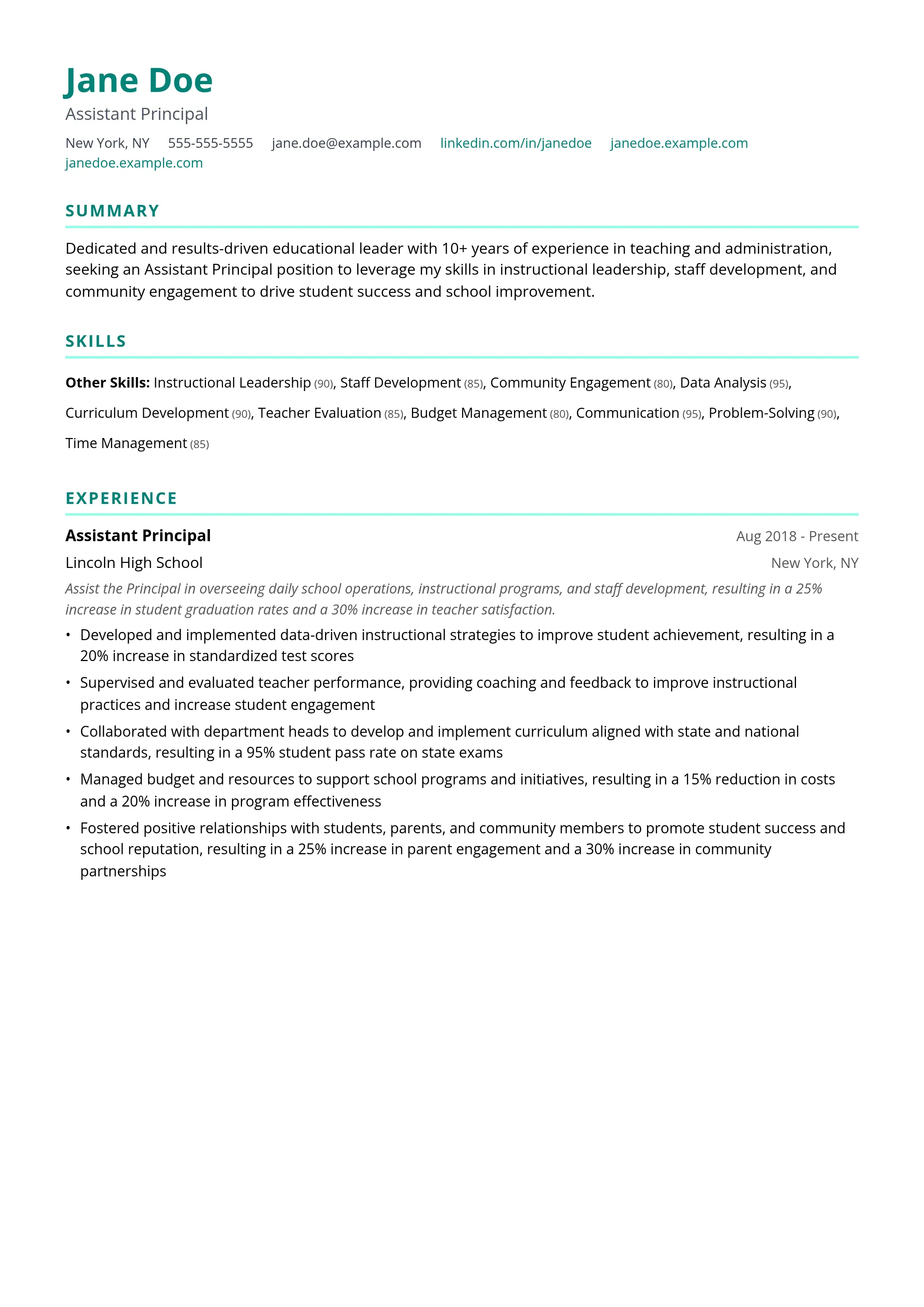
Assistant Principal
Why this resume works:
- Three years as AP at a 920-student Title I middle school; supervised 14 teachers and 4 support staff
- Drove a 9-point reduction in chronic absenteeism via the redesigned attendance-recovery program
- Co-led the curriculum alignment work that lifted 7th-grade ELA proficiency from 41% to 53%

School Administrator Intern
Why this resume works:
- Year-long administrative internship under the principal of a 1,400-student K-8 school
- Designed and ran the family-engagement night that recovered 38 chronic-absentee students from D/F status
- Co-authored the school's Title I budget narrative submitted to the state for the 2025-2026 cycle

Assistant School Administrator
Why this resume works:
- Five years across two K-8 schools as Assistant Administrator, supporting both instruction and operations
- Reduced annual facilities-vendor spend by 14% through renegotiated contracts (saved $48K)
- Managed the master schedule for 38 sections across 6 grade levels

School Administrator
Why this resume works:
- Six years as building administrator across two Title I middle schools
- Lifted overall school grade from D to B in three years through targeted MTSS implementation
- Owned a $4.2M annual budget; closed two consecutive years with surplus rather than deficit

Senior School Administrator
Why this resume works:
- Twelve years in administration; principal of a 1,800-student comprehensive high school for the last five
- Drove graduation rate from 78% to 91% via the redesigned ninth-grade transition program
- Mentored four assistant principals; three promoted to principalships within 24 months

Instructional Leadership
Why this resume works:
- Six years leading instructional coaching across a 1,200-student elementary school cluster
- Trained 38 teachers in the Lucy Calkins reading workshop methodology and TC writing units
- School-level NWEA MAP growth scores moved from 51st to 67th percentile under direct coaching

Special Education
Why this resume works:
- Eight years in special education leadership, the last four as SPED director at a K-8 building
- Reduced special-education due-process complaints from 6 per year to 1 through revised IEP procedures
- Brought 22 students off IEPs after general-education reading interventions reached fidelity

Instructional Coach
Why this resume works:
- Five years as a building-level instructional coach for grades 3-5 in a Title I elementary
- Coached 12 teachers through 1:1 cycles; 4 advanced from 'developing' to 'effective' on the state rubric
- Co-led the school's PLC restructure that increased weekly common planning time from 45 to 90 minutes

Deputy Principal
Why this resume works:
- Four years as Deputy Principal at a 1,600-student high school; lead admin for grades 11-12
- Built and ran the dual-enrollment partnership with the local community college (172 students enrolled by year three)
- Owned the school's MTSS Tier 2/3 process; reduced disciplinary suspensions by 31%

Assistant Superintendent
Why this resume works:
- Twelve years in district leadership; Assistant Superintendent for Curriculum & Instruction for 4 years
- Owned the district's $38M instructional materials budget across 47 schools and 28K students
- Led the K-12 math curriculum adoption that brought 14 of 47 schools above the state proficiency benchmark

School Director
Why this resume works:
- Founder and Director of a charter K-8 in its third year; 420 students, 38 staff
- Hired the entire founding teaching team (26 teachers); 22 still on staff in year 3
- Operationalized the school's $5.6M annual budget across instruction, operations, food service, and transportation

Superintendent
Why this resume works:
- Five years as superintendent of a mid-size urban district (32 schools, 24K students)
- Owned the $312M annual operating budget; closed all five years without a deficit
- Negotiated and ratified the 2024 teacher contract without a strike; raised starting salaries 11%

Chief Education Officer
Why this resume works:
- Eight years as CEO of a 14-school charter network across 3 states; 6,800 students total
- Lifted network-average proficiency from 38% to 58% on state tests over four-year span
- Raised $42M in philanthropic and impact-investment capital for facility expansion

School Operations Manager
Why this resume works:
- Six years in school operations across charter and traditional public school settings
- Designed the supply ordering and facilities-ticketing systems used across 8 schools
- Brought transportation on-time-arrival from 78% to 96% via the bus-route optimization project

Special Education Director
Why this resume works:
- Twelve years in special education; SPED Director at a mid-size district (18 schools, 1,400 SPED students)
- Reduced annual special-education legal settlements from $480K to $90K via training and procedural reform
- Drove the inclusion-rate improvement from 64% to 79% of school day in least-restrictive environment

District Assessment Coordinator
Why this resume works:
- Five years as District Assessment Coordinator overseeing all federal, state, and local testing
- Owned the secure-test-administration process for 18K students across 36 testing sites
- Built the district's assessment-data dashboard in Tableau (used by 47 principals weekly)

Education Technology Specialist
Why this resume works:
- Eight years in K-12 educational technology, the last four as a district-level EdTech specialist
- Led the 1:1 Chromebook rollout to 12K students across 22 schools (deployed in 6 months)
- Built the data-privacy review process for new ed-tech vendor adoption, used on 38 evaluations to date
Check your School Administrator resume against an ATS parser before you send it
The School Administrator examples above show what a parser-readable resume looks like. Whether yours reads the same way is a separate question: upload it to the free ATS resume checker and read the text a parser actually pulls from the file. Across 44,255 checks, only 5.8% of PDFs came through with no layout finding; a table used for layout (32.7%) and non-standard section headings (39.2%) were the usual reasons.
- •ATS resume checker: score, extracted text and 34 checks, free, no account.
- •ATS-friendly resume templates: layouts tested on Workday, Greenhouse, Lever and Taleo.
What school administrator hiring committees actually screen for
Administrator postings list 10-15 requirements, but the screening rubric is shorter. After comparing hundreds of district postings against the resumes that get callbacks at LAUSD, NYC DOE, Chicago Public Schools, Houston ISD, and Fairfax County, the consistent screening signals reduce to nine items. The first four are non-negotiable; the rest are tiebreakers.
- Active administrator license in the target state. Listed first, with the credential number and expiration year. Missing this disqualifies the application before any other section is read.
- Quantified academic outcomes. School grade movement, proficiency rate change, graduation rate, attendance rate. Numbers with named metrics, not 'improved student outcomes.'
- Building or district-level budget scope. Annual budget owned, in dollars. This sets the level the candidate has actually operated at.
- Supervisory scope. Number of teachers and staff supervised. Defines whether the candidate has done the role at the size the district is hiring for.
- Specific instructional frameworks named. Lucy Calkins, NWEA MAP, MTSS, RtI, PBIS, Marzano. Demonstrates depth, not just title.
- Title I or equity work. Most US districts have at least one Title I school. Experience here is heavily weighted in 2026.
- Community engagement evidence. Parent-teacher events, neighborhood partnerships, board interaction. Specifics, not 'strong communication skills.'
- Legal and compliance literacy. Especially for SPED, ELL, and Title IX adjacent work. Naming the standards (IDEA, Section 504, FERPA, WCAG 2.2 AA for digital accessibility) signals depth.
- Continuous learning record. Recent certifications, EdD progress, conference presentations. Districts want evidence of professional growth beyond the credentialed minimum.
Five changes that consistently move callback rate on administrator resumes
- •Lead with the licensure line. State, credential type, number, and expiration year in the first 50 words of the resume.
- •Quantify school-grade or proficiency movement. 'Improved school grade from D to B over three years' beats 'drove instructional excellence' every time.
- •Name the budget scope. Building or district budget owned, in dollars. This single number signals level more clearly than any title.
- •Cite specific frameworks. MTSS, NWEA MAP, Lucy Calkins, Marzano, PBIS, RtI. Generic 'curriculum development' lands flat; named frameworks land hard.
- •Show one operational artifact. A budget narrative, a master schedule, an assessment dashboard, a discipline-rate redesign. Operating artifacts are how committees evaluate readiness for the next level.
How to write a school administrator resume
Writing the summary line
Two to three sentences. Lead with the role and years of administrative experience. Name your active license. Close with one specific recent outcome, a school-grade movement, a budget closing position, a graduation-rate change. The summary is the part hiring committees read first; everything else gets skimmed until they decide it's worth a closer read.
What a working administrator summary actually does
- •Names the target role and years of administrative experience
- •Includes the active administrator license with state and credential type
- •Specifies the school context (elementary, middle, high, district; size; demographic)
- •Closes with one quantified recent outcome, school grade, proficiency, budget, graduation rate
- •Stays under 80 words. Anything longer gets compressed in the reader's head
The summary mistakes that get administrator resumes filtered out
Do this
- Mirror specific phrases from the posting, district size, demographic, framework names, into the summary.
- Pair the licensure line with one quantified recent outcome.
- Update the summary every time the posting context changes substantially.
Avoid this
- Don't recycle the same summary across 12 districts; each has a different rubric.
- Avoid leading with adjectives over concrete nouns; the committee reads the next sentence faster if the first one gives them facts.
Summary examples by level
Writing work experience that hiring committees actually read
Administrator bullets follow a different rhythm than teaching bullets. Each one should answer four questions: what did you own, what scale, what action did you take, and what was the measurable outcome. Bullets that skip the scale or the outcome get read as junior, regardless of the candidate's actual title.
- Lead with the administrative action verb. 'Owned,' 'led,' 'designed,' 'redesigned,' 'negotiated,' 'authored,' 'restructured.' Avoid 'helped' and 'supported.'
- Name the scale. Student count, teacher count, budget dollars, school count. Vague scope reads as junior.
- Name the framework, system, or program. MTSS, PBIS, RtI, NWEA MAP, Lucy Calkins, Marzano. Specific frameworks signal depth.
- Quantify the outcome. Proficiency change, graduation rate, attendance, suspensions, budget position, complaint reduction.
- Name the audience or stakeholder. Board of education, district leadership, state department of education, parent community. Audience signals seniority.
Action verbs that work for administrator bullets
- •Owned, for budget, schedule, or program responsibility
- •Led, for cross functional or building-level work
- •Designed, for new systems or programs
- •Restructured, for organizational redesign work
- •Negotiated, for labor contracts, vendor deals, or partnerships
- •Authored, for budget narratives, school improvement plans, or policy documents
- •Coached / Mentored, for people development at AP level and above
- •Supervised / Evaluated, for direct staff oversight
- •Drove, for movement on a measurable outcome
- •Recovered, for turning around a deficit, an enrollment slide, or a compliance issue
Numbers that signal administrator seniority
- •School-grade movement (state letter grade or accountability rating)
- •Proficiency rate change on state tests by subject and grade level
- •Graduation rate change and chronic absenteeism reduction
- •Annual budget owned in dollars (building, department, or district)
- •Staff size supervised (instructional, operational, total)
- •Student enrollment scope (single building, network, or district)
- •Suspension or discipline-incident reduction percentages
How to handle gaps, lateral moves, and pivots on an administrator resume
- •Career gaps, name the reason briefly (sabbatical, family care, advanced degree completion). Pair with one professional-development credential earned during that time if you have one.
- •Lateral moves between districts, this is common in administration. Lead each bullet with the program or outcome rather than the title; consistent results across districts signals reliability.
- •Coming from teaching, pull the most administrative-feeling teaching responsibilities (department chair, school improvement team, district committee work) to the top and frame them in administrative language.
- •Leaving a job under a board change, no explanation needed in the resume. Be ready for a single brief framing in the interview if asked.
Work experience bullets by level
Hard and soft skills that belong on a school administrator resume in 2026
| Hard Skills (Systems, Frameworks, Compliance) | Soft Skills (How You Lead) |
|---|---|
| Educational technology (Schoology, Canvas, PowerSchool) | Instructional leadership |
| Data analysis and dashboard tools (Tableau, Power BI) | Community engagement |
| Budgeting, financial planning, and grant writing | Conflict resolution |
| Compliance with IDEA, Section 504, FERPA, Title IX | decision making under uncertainty |
| Curriculum frameworks (Lucy Calkins, Marzano, EngageNY) | Coaching and mentorship |
| MTSS, PBIS, and RtI implementation | cross functional team building |
| Student information systems (SIS) and master scheduling | Empathy with students, families, and staff |
| Staff hiring, evaluation, and HR systems | Time management across operational and instructional demands |
| Policy development and state reporting | Critical thinking on long-horizon strategy |
| Risk management, safety, and emergency protocols | Resilience under board and community pressure |
Copying this table wholesale is the mistake: pick the School Administrator skills you can point to elsewhere on the page. the skills section, explained with 200+ examples explains how to choose between them and how many belong in the section.
Certifications worth listing on an administrator resume in 2026
- State Administrator License (Tier I and Tier II), the non-negotiable credential. List state, type, number, and expiration year.
- National Superintendent Certification (AASA), required or strongly preferred for most superintendent searches over 5,000 students.
- PSEL (Professional Standards for Educational Leaders), the framework most state credentialing programs are aligned to in 2026.
- Educational Leadership Constituent Council (ELCC) Standards, aligned with university accreditation; useful as a curriculum signal.
- Project Management Professional (PMP), uncommon but increasingly valued for district-level operations roles.
- Special Education Administrator Certification, required for most SPED Director roles; state-specific endorsements stack on top.
- Title I Director Endorsement, useful for federal funding and compliance roles at the district level.
- EdD or PhD in Educational Leadership, increasingly the floor credential for superintendent searches in 2026.
How to format your school administrator resume
Structure that hiring committees can scan in 30 seconds
- •Open with the summary line, including active licensure in the first two sentences.
- •Skills section grouped by category (frameworks, compliance, systems) rather than alphabetized.
- •Work experience reverse chronological; lead each role's bullets with the strongest quantified outcome.
- •Certifications block early in the document, administrator credentials are gating, not supporting.
- •Education at the bottom; drop the dates if you're more than 20 years past graduation.
- •Two pages for senior roles is acceptable; one page for AP or first-year administrators looks tighter.
Layout that survives district HR ATS parsing
- •Single column. District HR systems break on multi-column layouts.
- •Standard fonts: Calibri, Arial, Garamond, Times New Roman. 10-12pt body.
- •1-inch margins. Section headings in bold or a slightly larger size, not as graphics.
- •No tables for layout. No graphics. No text in headers or footers.
- •PDF export unless the application form explicitly asks for DOCX or.doc.
Content presentation tips specific to administrator resumes
- •Quantify proficiency, graduation, attendance, and discipline movement with concrete numbers.
- •Name the framework or system (MTSS, PBIS, RtI, NWEA MAP, Marzano) when it applies.
- •List the active state license with credential number and expiration year, required in 2026 across most states.
- •Specify the school or district context (size, demographic, Title I status) so the committee can compare against their setting.
- •Read the file aloud once before submitting. Typos in an administrator resume are read as carelessness, which is exactly the opposite signal you want.
Common mistakes to avoid
Do this
- Lead with the active administrator license, credential type, state, number, expiration year.
- Quantify academic and operational outcomes specifically: school-grade movement, proficiency rate, graduation rate, budget position.
- Name the frameworks (MTSS, Lucy Calkins, Marzano, NWEA MAP, PBIS, RtI) you've actually implemented.
- Show one operational artifact you authored, budget narrative, master schedule, school improvement plan, discipline redesign.
- Tailor the resume to the specific district's context: size, demographic, Title I status, urban/suburban/rural.
- Use district-specific terminology where it applies, LRE for special education, SIS for student information system, MTSS for tiered support.
- Read the resume aloud once before submitting; typos in an administrator resume are read as a competence signal.
Avoid this
- Avoid leading with adjectives ('passionate,' 'transformational,' 'visionary') instead of concrete administrative actions.
- Don't list the same generic bullets across multiple roles, each role should show distinct ownership.
- Skip vague responsibility framing ('managed school operations,' 'oversaw instruction'); each bullet should name what changed and by how much.
- Don't omit the licensure line. Missing it disqualifies the application before HR ever forwards it to the principal-selection committee.
- Avoid generic certifications listed without specifying which framework they're aligned to (PSEL, ELCC, state-specific).
- Don't bury budget scope deep in the work history; surface the largest budget you've owned in the summary or first role bullets.
- Skip exaggeration. Districts often verify state-test claims through their own data systems.
Key takeaways for your school administrator resume
What to focus on if you have an hour this week
- •Rewrite the summary line. Two or three sentences. Named license. Named district context. One quantified outcome. The first thing the committee reads.
- •Audit each bullet against the five-part formula. Action + scope + framework + outcome + audience. If a bullet is missing two of those, rewrite it.
- •Surface the licensure line. Move it to the top of the resume (right under contact info) so the gating credential isn't buried in a certifications section at the bottom.
- •Quantify academic outcomes specifically. 'Improved student outcomes' tells the committee nothing. 'Lifted 7th-grade ELA proficiency from 41% to 53% over two years' tells them what kind of administrator you actually are.
- •Name the frameworks you've implemented. MTSS, Lucy Calkins, NWEA MAP, PBIS, RtI, Marzano. Generic 'curriculum development' lands flat.
- •Show one operational artifact. A budget narrative you authored, a master schedule you owned, an SIP you wrote, an assessment dashboard you built. These earn the next round.
- •Match LinkedIn to the resume. Same job titles, same dates, same numbers. District background checks cross-reference both.
- •Cut the buzzwords. 'Transformational leader,' 'student-centered,' 'data driven.' Every administrator resume has these. Replace them with evidence.
- •Include the EdD or doctoral progress line. 2026 superintendent searches increasingly treat a doctorate as the floor credential.
- •Read it aloud, twice. Once for clarity. Once for typos. The bar is higher for administrators, the resume is itself a competence signal.
Related Resume Examples: Education
Hiring managers in Education read the same signals across neighbouring roles. If the School Administrator example is close but not exact, these are the nearest ones:
- Government Administrator
- Middle School Teacher
- System Administrator
- School Counselor
- Graduate School
- Healthcare Administrator