
Entrepreneur Resume Examples

Entry-Level Entrepreneur
Why this resume works:
- BS in Entrepreneurship plus a 12-month side venture reaching $42K revenue with 1 part-time contractor
- Filed an LLC, opened a Mercury account, and shipped 3 product iterations using Stripe and Plaid
- Y Combinator Startup School graduate with a refined pitch deck reviewed by 4 active angel investors

Junior Entrepreneur
Why this resume works:
- Built a B2B SaaS prototype to $9K MRR in 8 months with 2 contractors and a $25K self-funded budget
- Closed a $250K SAFE from 3 angel investors at a $4M post-money cap after 4 months of customer discovery
- Operates on a Stripe, Mercury, and Linear stack with 38 paying customers across 6 verticals

Senior Entrepreneur
Why this resume works:
- 13 years founding 3 ventures with 2 acquisitions totaling $48M in transaction value across SaaS and fintech
- Scaled the second company from $0 to $14M ARR with 38 employees before a 2024 strategic acquisition
- Raised $32M across SAFE, seed, and Series A rounds with Sequoia, Bessemer, and Khosla scout participation

Entrepreneur-in-Residence
Why this resume works:
- EIR at a $2.4B AUM venture firm sourcing 4 portfolio investments and incubating 2 internal company spinouts
- Prior founder of a $6M ARR SaaS company acquired by a strategic in 2023 at a 5.8x revenue multiple
- Mentors 12 portfolio founders on SAFE structures, board governance, and Series A pitch readiness

Startup Founder
Why this resume works:
- YC Winter 2022 batch graduate scaling to $4M ARR with 6 engineers using an AI-native product stack
- $12M Series A led by Sequoia with a16z and Founders Fund participating, after converting $3M in SAFEs
- Built payment, banking, and onboarding stack on Stripe, Plaid, Mercury, and Ramp
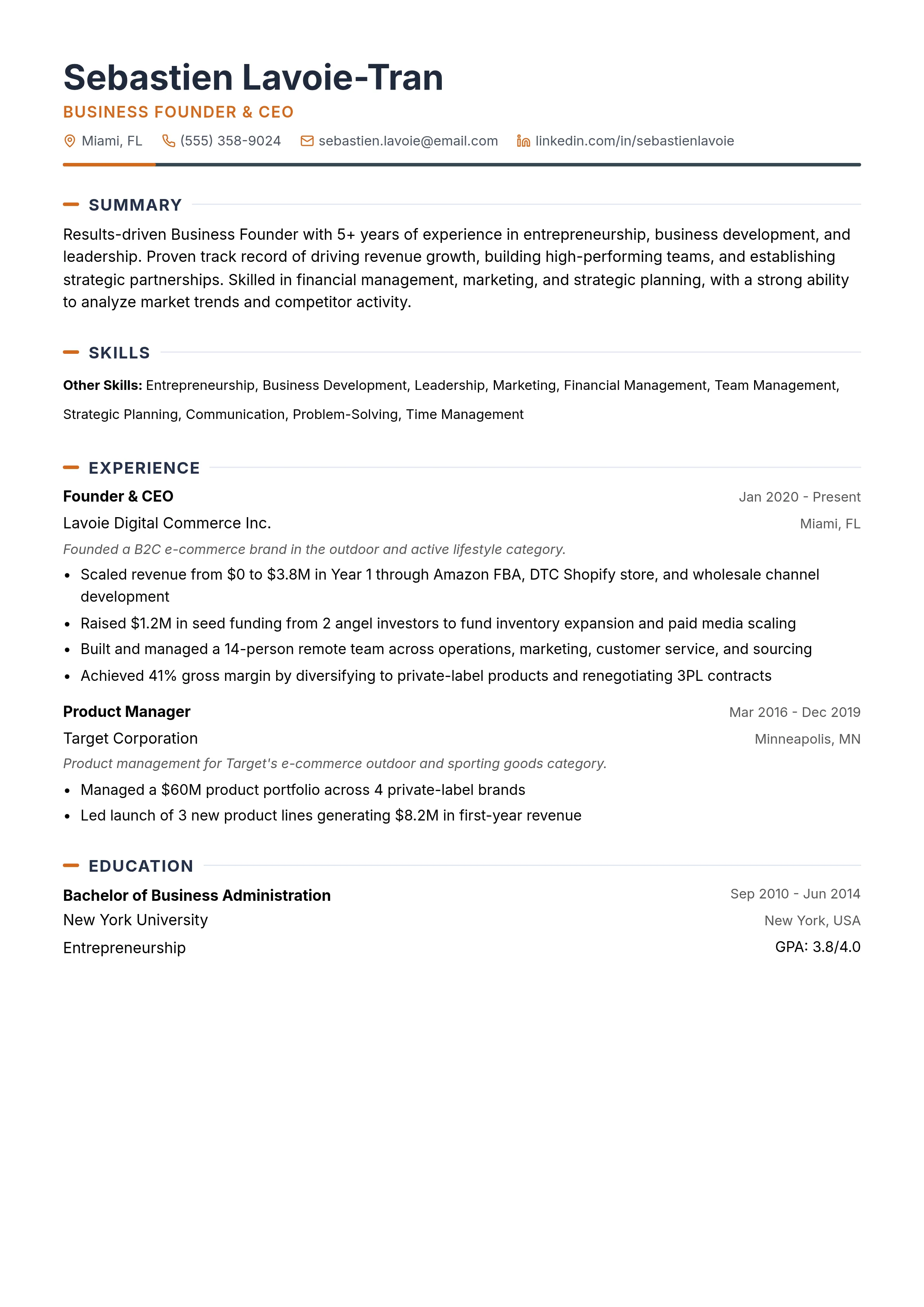
Business Founder
Why this resume works:
- Founded and scaled a venture-backed company from zero to $8M ARR with a 12-person team
- Navigated the 2023 VC capital crunch by extending runway 28 months and choosing profitability over a down round
- Closed institutional capital from Accel and Bessemer after early SAFEs from Y Combinator and Techstars scouts
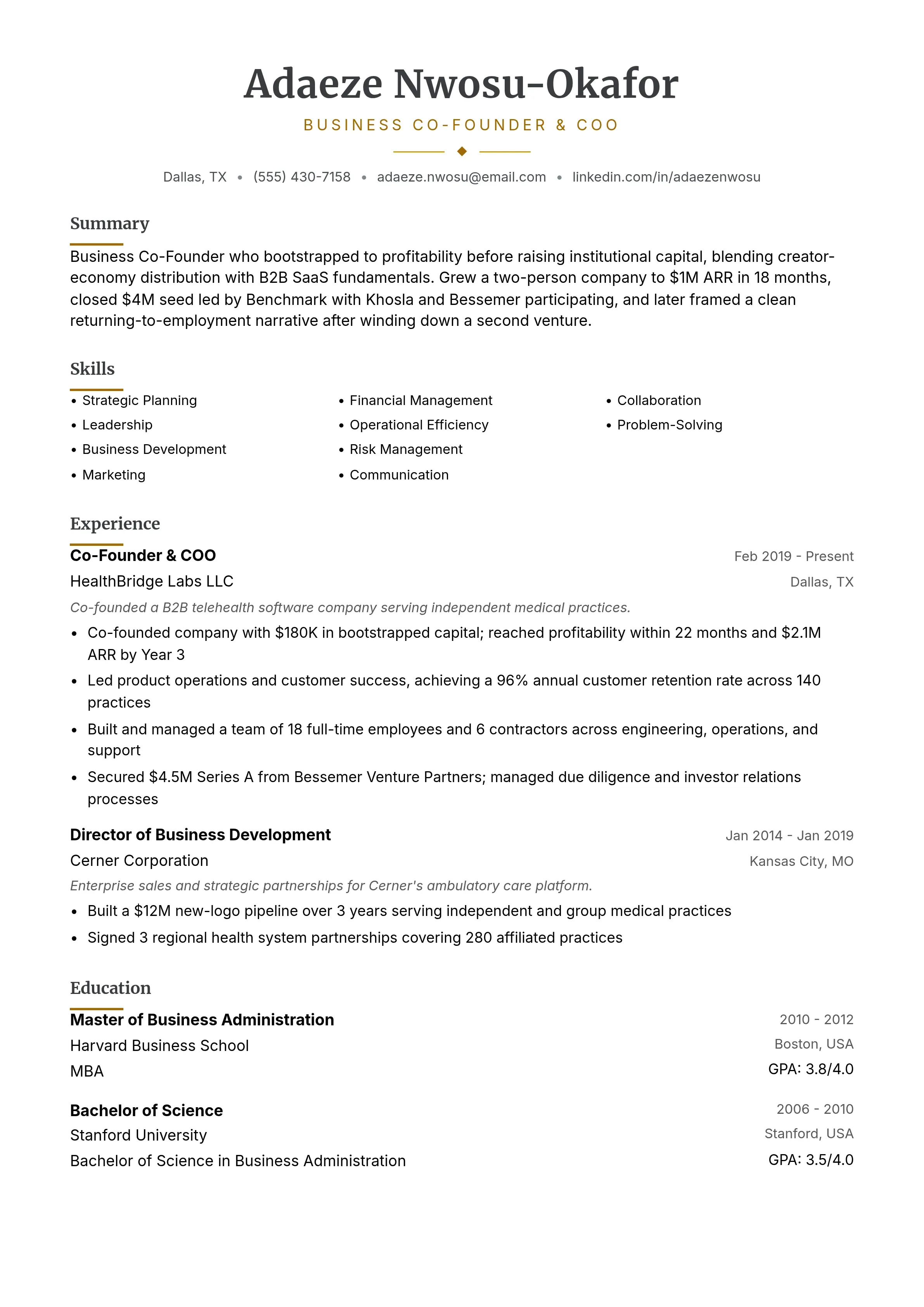
Business Co-Founder
Why this resume works:
- Bootstrapped to $1M ARR with 2 employees before taking institutional capital
- $4M seed led by Benchmark with Khosla and Bessemer participating, priced after a $750K SAFE from Techstars
- Built financial stack on Stripe Connect, Mercury, Brex, Ramp, and Plaid for creator payouts

Social Entrepreneur
Why this resume works:
- Founded a 501(c)(3)-affiliated B Corp serving 14,000 underserved students across 6 metro school districts
- Raised $3.2M in blended capital from Echoing Green, Skoll Foundation, and 2 impact-focused LPs
- Drove 28% measurable lift in graduation rates over 3 cohorts using IRIS+ and GIIN reporting frameworks

Technology Entrepreneur
Why this resume works:
- Founded an AI-native developer-tools startup reaching $2.8M ARR with 5 engineers in 18 months
- Closed a $7M seed led by a16z with Founders Fund and OpenAI Startup Fund participation
- Built core infrastructure on Anthropic Claude API, Pinecone, and AWS Bedrock with sub-200ms p95 latency

Digital Entrepreneur
Why this resume works:
- Built a niche newsletter and course business to $480K annual revenue with 12,000 paying subscribers
- Operates a Beehiiv, Stripe, and Circle stack with 4.6% monthly churn and a $42 LTV-to-CAC of 5.1
- Y Combinator Startup School alum running profitable paid acquisition across Meta and X with 2.8x ROAS

Solo Entrepreneur
Why this resume works:
- Reached $1M ARR with one full-time employee using an AI-native product and ops stack
- Operated profitably without outside capital, avoiding SAFE and priced-round dilution
- Built GTM and support entirely on Stripe, Mercury, and Ramp with no investor reporting overhead
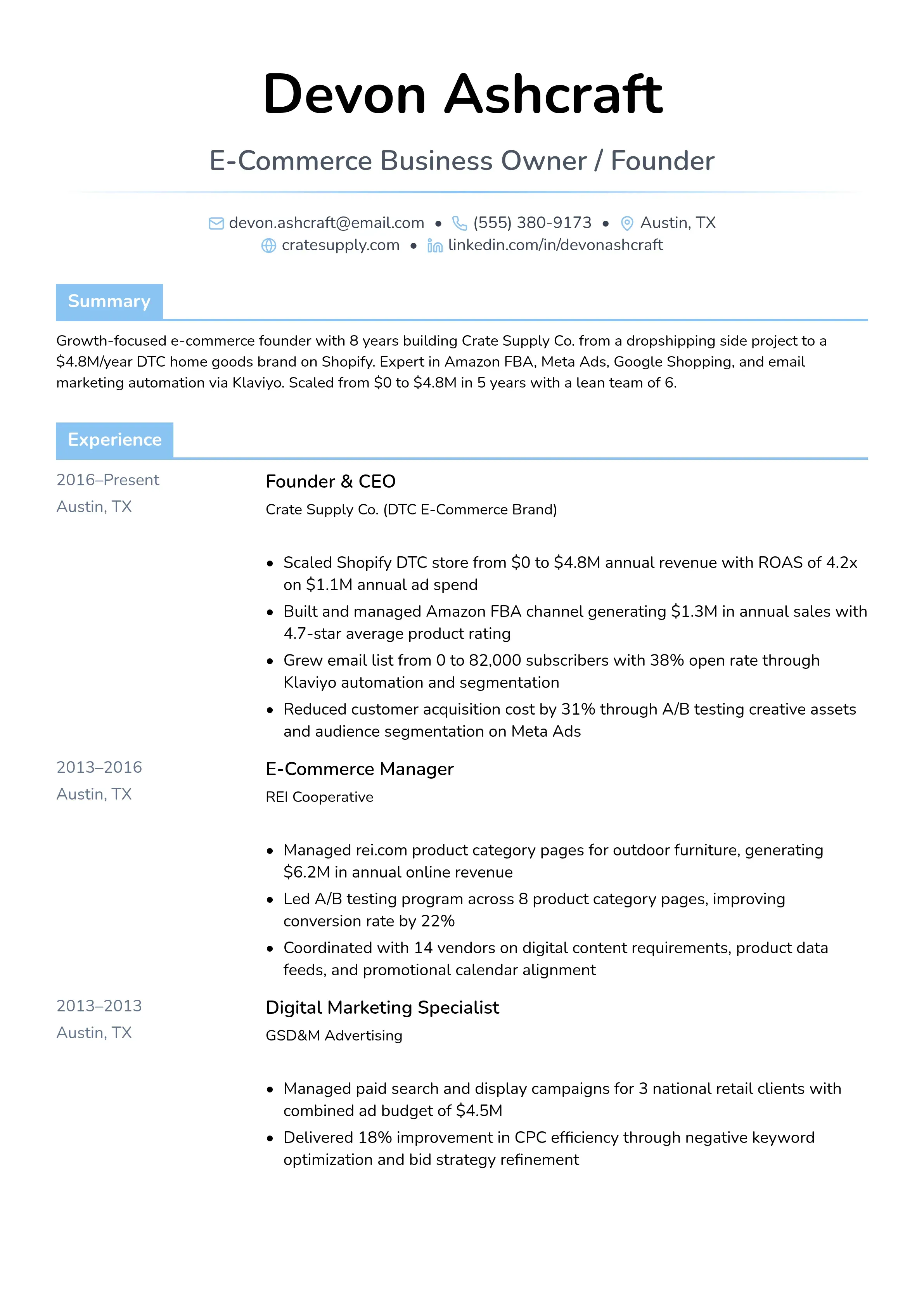
E-commerce Business Owner
Why this resume works:
- Scaled a DTC brand to $6M in annual revenue with a blended 4.2x ROAS across paid channels
- Integrated Shopify with Stripe, Plaid-backed financing, and Brex for merchant operating cash
- Navigated post-iOS 14.5 attribution and the creator-economy maturation for creator-led storefronts
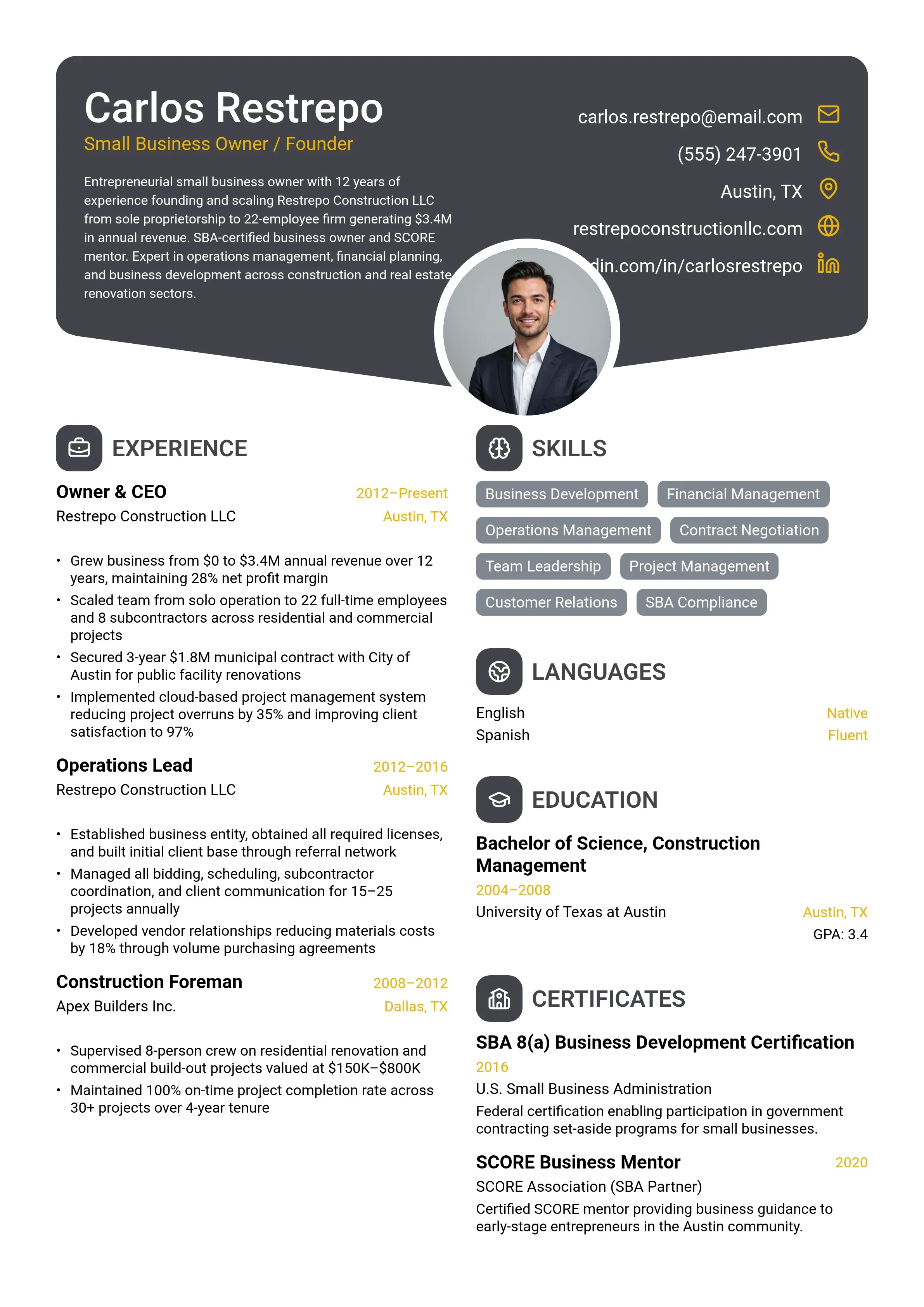
Small Business Owner
Why this resume works:
- Owner-operator of an LLC with $1.8M annual revenue, 14 employees, and a 17% net operating margin
- Secured a $480K SBA 7(a) loan and a $120K Brex line of credit to fund a 2024 second-location expansion
- Built ops on QuickBooks, Gusto, and Toast with monthly P&L reviewed against industry NAICS benchmarks

Franchise Owner
Why this resume works:
- Operated 3 franchise locations with $4.2M combined revenue and an 18% operating margin
- Handled SBA financing, Plaid-enabled cash flow tooling, and Ramp for multi-unit expense control
- Recruited and trained 42 hourly staff across locations, sustaining 85%+ customer satisfaction scores

Restaurant Owner
Why this resume works:
- Built a concept restaurant to $3.1M annual revenue with a 22% EBITDA margin over 4 years
- Handled POS, payments, and gift-card programs via Stripe Terminal and Toast integrations
- Managed a 28-person team with detailed labor scheduling and COGS tracking
Check your Entrepreneur resume against an ATS parser before you send it
The Entrepreneur examples above show what a parser-readable resume looks like. Whether yours reads the same way is a separate question: upload it to the free ATS resume checker and read the text a parser actually pulls from the file. Across 44,255 checks, only 5.8% of PDFs came through with no layout finding; a table used for layout (32.7%) and non-standard section headings (39.2%) were the usual reasons.
- •ATS resume checker: score, extracted text and 34 checks, free, no account.
- •ATS-friendly resume templates: layouts tested on Workday, Greenhouse, Lever and Taleo.
What Recruiters Want to See on Your Entrepreneur Resume
- Leadership Acumen: Demonstrated ability to lead and manage teams; this surfaces any previous entrepreneurial ventures or leadership roles that required strategic decision making.
- Financial Understanding: Proficient in financial planning, analysis, and management to showcase how you maintain fiscal health of a business.
- Capital Structure Fluency: Ability to explain SAFE vs priced rounds, down-round mechanics, and the post-2023 VC capital crunch thaw that shaped your fundraising decisions.
- AI-Native Operating Leverage: Evidence that you can ship $1M ARR with one to five people by combining AI tooling with a disciplined solopreneur operating model.
- Problem-Solving Skills: Examples of creative and effective solutions implemented to tackle business challenges.
- Innovative Mindset: Evidence of creativity and innovation in product development, marketing, or business strategy.
- Networking Capabilities: Skill in building and using a professional network to advance business goals and gain market insights.
- Market Analysis: Experience in analyzing market trends to identify business opportunities or threats.
- Communication Skills: Ability to communicate vision clearly to stakeholders, partners, and the team to drive engagement.
- Adaptability: Demonstrated ability to adapt to changing market conditions and pivot strategies effectively.
- Customer Focus: track record of understanding customer needs and providing exceptional customer experiences.
- Project Management: Capacity to oversee multiple projects simultaneously, so timely and successful outcomes.
Resume Optimization Tips for Entrepreneurs
- •Highlight Achievements: Focus on tangible outcomes and metrics, like revenue growth, customer acquisition rates, or successful product launches.
- •Tailor Your Resume: Customize your resume for each opportunity, incorporating industry-specific keywords and language.
- •Name the Program: Call out YC (Winter or Summer batch), Techstars, 500 Startups, or a16z Speedrun accelerator participation, these are searchable signals in 2026.
- •Name the Investors: List lead and participating investors (Sequoia, a16z, Benchmark, Accel, Founders Fund, Khosla, Bessemer) with round size and stage.
- •Showcase Innovation: Clearly present examples of how you've driven change or introduced new ideas that benefited the business.
- •Include Testimonials: Consider adding brief quotes from partners, clients, or employees that speak to your leadership or innovative mindset.
- •Visual Appeal: Use professional formatting and design elements to make your resume visually appealing, but maintain a clean and readable layout.
How to write a entrepreneur resume
How to write a entrepreneur summary or objective
What Makes an Effective Entrepreneur Summary
- •Clarity and focus on key achievements
- •Highlighting of leadership and innovation skills
- •Inclusion of quantifiable business successes
- •Demonstration of strategic vision and adaptability
- Entrepreneurial mindset and strategic planning
- Achievements in business growth and revenue increase
- Leadership and team-building capabilities
- Adaptability and problem-solving skills
- Industry-specific expertise
Do this
- Use specific metrics to demonstrate success
- Highlight innovative solutions and strategic initiatives
- Name accelerators (YC W22, Techstars, 500 Startups, a16z Speedrun) and investors (Sequoia, a16z, Benchmark) explicitly
- Frame returning-to-employment narratives as an active choice after a wind-down or acqui-hire
- Tailor your summary to the target industry
- Focus on how past experiences translate to new opportunities
Avoid this
- Avoid generic statements without evidence
- Don't list duties instead of achievements
- Don't hide a failed venture, recruiters in 2026 prefer honest wind-down framing over gaps
- Avoid overly complex language or jargon
- Don't forget to align with the job description
Tailoring for Different Experience Levels
Checklist for Crafting a Perfect Entrepreneur Summary
- Start with a strong, compelling opening line.
- Include examples of entrepreneurial achievements.
- Quantify results with specific numbers or percentages.
- Name the accelerator, investor, and round type (SAFE vs priced) when relevant.
- Align with the company's values and mission.
- Keep it concise and relevant to the position.
Resume Summary Examples for Entrepreneurs
How to write a entrepreneur work experience
Structuring Work Experience Sections
- •Begin with your current or most recent role and work backwards.
- •Use reverse chronological order to highlight your progression and most recent achievements.
- •Include the name of your business, your position, and the duration of your tenure.
- •Include accelerator tags (YC W22, Techstars Boulder '20) directly in the company line for instant recognition.
- •Provide a brief description of your business if it is not widely known, focusing on the industry and your unique contributions.
Highlighting Achievements and Skills
- •Focus on achievements that had a noticeable impact on your business success.
- •Use specific and measurable outcomes to illustrate your contributions, such as revenue growth, client retention rates, or market expansion.
- •Call out ARR-per-employee and AI-native operating leverage (for example, $1M ARR with 1 employee).
- •Mention key skills that are crucial for entrepreneurial success, such as strategic planning, market analysis, fundraising, and leadership.
- Accelerated
- Streamlined
- Pioneered
- Innovated
- Cultivated
- Negotiated
- Transformed
Tips for Quantifying Accomplishments
- •Use precise numbers to showcase the impact of your work, like percentage increases in sales or the number of new clients acquired.
- •Translate abstract achievements into tangible benefits, such as monetary savings or improvements in operational efficiency.
- •Pair round size with post-money valuation and lead investor so recruiters can calibrate dilution and stage.
- •Include context to give numbers meaning, such as comparing them against industry benchmarks or historical performance.
Addressing Common Challenges
- •For career gaps, focus on what you learned or how you grew personally or professionally during that time.
- •In cases of job hopping, emphasize the skills gained and experiences acquired from each role, showing adaptability and continuous learning.
- •If you are returning to employment after a wind-down or acqui-hire, state it plainly and frame the learnings, hiring managers at Stripe, Ramp, and Mercury explicitly value this honesty in 2026.
Work Experience Examples for Entrepreneurs
Top hard skills and soft skills for entrepreneur resumes in 2026
| Hard Skills | Soft Skills |
|---|---|
| Fundraising (SAFE & Priced Rounds) | Leadership |
| Financial Management | Communication |
| Market Research | Adaptability |
| AI-Native Product Development | Creativity |
| Digital Marketing | Problem-solving |
| Project Management | Negotiation |
| GTM & Sales Strategy | Emotional Intelligence |
| Stripe / Plaid / Ramp / Mercury Stack | Team Building |
| M&A & Acqui-hire Economics | Strategic Thinking |
| Supply Chain Management | Resilience |
Copying this table wholesale is the mistake: pick the Entrepreneur skills you can point to elsewhere on the page. how to pick the skills that earn a line explains how to choose between them and how many belong in the section.
Best certifications for entrepreneur resumes in 2026
- Y Combinator Startup School (Completion): Free, widely recognized signal of founder seriousness and exposure to YC frameworks around SAFEs, growth, and fundraising.
- Certified Business Coach (CBC): This certification equips entrepreneurs with the skills to coach other business owners, enhancing leadership and mentoring abilities critical for entrepreneurial success.
- Project Management Professional (PMP): Recognized globally, this certification helps entrepreneurs effectively manage projects, so they meet deadlines and stay within budget.
- Digital Marketing Certification: In the digital age, understanding online marketing strategies is crucial for entrepreneurs to effectively reach and engage their target audience.
- Lean Six Sigma Certification: This certification provides entrepreneurs with the skills to improve processes and efficiency within their organizations, which can be pivotal for scaling operations.
- Financial Modeling & Valuation Analyst (FMVA): Entrepreneurs often need to interpret financial data; this certification strengthens financial analysis skills necessary for smart decision making.
- ScrumMaster Certification: As many startups adopt agile methodologies, this certification helps entrepreneurs implement agile practices to foster innovation and flexibility.
- Certified Entrepreneurship and Small Business (ESB): Specifically designed for entrepreneurs, this certification covers essential skills like business planning, funding, and marketing strategies.
- Negotiation Mastery Certification: Negotiation is a key skill for entrepreneurs in dealings with partners, investors, and clients; this certification hones persuasive communication and negotiation abilities.
How to format your entrepreneur resume
Structure and Layout
Organize your resume effectively to surface your entrepreneurial skills and accomplishments.
- •Contact Information: Place this at the top of your resume. Include your name, phone number, email, and LinkedIn profile.
- •Professional Summary: Provide a brief overview of your entrepreneurial experience and key achievements. Highlight your value proposition in 3-4 sentences.
- •Work Experience: Focus on your entrepreneurial ventures, roles, and the impact you made. Use bullet points to list achievements, responsibilities, and key metrics.
- •Education: Include relevant educational background. Mention any business-related courses or workshops.
- •Skills: Highlight entrepreneurial skills such as leadership, strategic planning, innovation, financial acumen, etc.
- •Optional Sections: Consider adding sections like 'Certifications', 'Awards', or 'Professional Affiliations' if relevant.
Formatting Tips
Follow these best practices to improve readability and presentation.
- •Font: Use professional fonts like Arial, Calibri, or Times New Roman. Keep the size between 10-12 points.
- •Margins: Use standard margins of 1 inch on all sides for a clean look.
- •Bullet Points: Use bullet points for easy reading, especially under work experience. Limit to 3-5 points per job or role.
- •Consistency: Ensure consistent formatting throughout the resume, including alignment and spacing.
- •Length: Keep the resume to 1-2 pages, focusing on relevance and impact.
- •Action Verbs: Start bullet points with action verbs that convey leadership and results, such as 'Established', 'Led', 'Innovated', 'Optimized'.
Common Mistakes to Avoid
Do this
- Highlight successful ventures with specific outcomes, like revenue growth, market reach expansion, or strategic partnerships.
- Include metrics and KPIs to quantify achievements, such as percentage increase in sales, customer base growth, or fundraising totals.
- Name accelerators and investors explicitly (YC W22, Techstars, Sequoia, a16z, Benchmark) rather than referring to 'top tier VCs'.
- Showcase leadership and team-building experiences, especially in driving teams towards a unified vision.
- Detail innovative solutions or products developed, and their impact on the market or company.
- Tailor your resume to emphasize industry-specific skills and knowledge relevant to the ventures you are pursuing.
- Include any awards, recognitions, or industry accolades that affirm your expertise and success.
- Mention your networking capabilities and how they have aided in business growth and scalability.
Avoid this
- Avoid overloading your resume with jargon or buzzwords that do not clearly convey your experiences and achievements.
- Refrain from listing generic or vague skills without providing context or examples of how they were applied.
- Don't neglect to include specific ventures or projects, as the absence of these can make your entrepreneurial experience seem less credible.
- Don't obscure a wind-down or returning-to-employment transition, recruiters in 2026 see through vague date ranges.
- Steer clear of excessive emphasis on roles that are not directly related to entrepreneurial achievements.
- Don't ignore the importance of updating your resume to reflect current ventures or the latest accomplishments.
- Avoid using a one-size-fits-all resume; make sure it's tailored to align with the demands of potential investors, partners, or markets.
- Refrain from omitting any notable failures that transformed into learning experiences, as these are also valuable.
Key Takeaways for Your Entrepreneur Resume
Resume Tips for Entrepreneurs
- •Highlight Leadership Skills: Emphasize your ability to lead and manage teams effectively.
- •Showcase Results: Use quantifiable achievements to demonstrate your impact, such as revenue growth percentages or cost savings.
- •Emphasize AI-Native Leverage: Quote ARR-per-employee ratios, especially if you approached the $1M ARR with 1 employee pattern.
- •Name the Accelerator and Investors: YC (Winter or Summer batch), Techstars, 500 Startups, a16z Speedrun; Sequoia, a16z, Benchmark, Accel, Founders Fund, Khosla, Bessemer.
- •Reference Real M&A Comparables: Figma-to-Adobe (attempted), Loom-to-Atlassian, and MosaicML-to-Databricks are the anchors that signal diligence fluency in 2026.
- •Detail Business Growth: If applicable, provide metrics related to the growth of your business, such as client base expansion or market share increase.
- •Network and Collaborations: Mention strategic partnerships or collaborations that have advanced your business objectives.
- •Focus on Problem-Solving: Illustrate your problem-solving capabilities with specific examples of challenges faced and solutions implemented.
- •Include Financial Acumen: Demonstrate your understanding of financial management, budgeting, and forecasting.
- •Adaptability and Flexibility: Include examples where you successfully adapted to changes in the market or industry trends.
- •Continuous Learning: Mention any courses or learning experiences that have refined your entrepreneurial skills.
- •Use Clear and Professional Language: Ensure your resume is free from jargon unless it is industry-specific and relevant.
Related Resume Examples: Business & Management
Hiring managers in Business & Management read the same signals across neighbouring roles. If the Entrepreneur example is close but not exact, these are the nearest ones:
- CTO
- Entry Level Business Analyst
- General Manager
- Marketing Manager
- CFO
- Project Coordinator
- 22 Self-Employed
Entrepreneur Resume FAQ
Frequently asked questions about crafting effective resumes for Entrepreneurial positions.